Introduction
AI now touches every stage of music production — beat generation, mixing, mastering, even artwork. For independent artists, that's genuinely useful. But it's also where the confusion starts, particularly around what streaming platforms and distributors will and won't accept.
Spotify removed over 75 million "spammy" tracks in the 12 months through September 2025. Deezer now fields over 30,000 fully AI-generated track submissions every single day. These aren't abstract industry statistics — they signal tightening enforcement that can result in takedowns, account bans, or algorithmic suppression.
This guide breaks down how platforms are responding to AI-generated music, what the disclosure and royalty rules actually say, and how to use AI tools without putting your catalogue at risk.
Key Takeaways
- AI tools now assist every production stage—from composition to mastering—directly affecting where and how you can distribute music
- Major DSPs enforce evolving policies around AI content, particularly regarding artist impersonation, copyright violations, and spam uploads
- Safe AI use requires keeping human creative input primary, documenting your process, and verifying platform rules before every release
- Combining AI-assisted production with AI-powered analytics and pitching tools helps artists maximize reach and revenue
How AI Is Reshaping Music Production for Independent Artists
AI in music production refers to machine learning models, generative algorithms, and neural networks that automate or assist creative tasks—from generating chord progressions to isolating stems from mixed tracks. By 2025, 48% of artists reported using AI in their music-making process, down from 59.5% in 2023. The dip signals a shift from broad experimentation to purposeful, selective use.
For independent and emerging artists, this shift matters. AI dramatically lowers production barriers:
- Achieve professional-quality output without expensive studio budgets
- Turn around releases faster with automated workflows
- Compete with better-resourced artists on technical quality alone
Main Categories of AI Music Tools
AI Audio and MIDI Generators
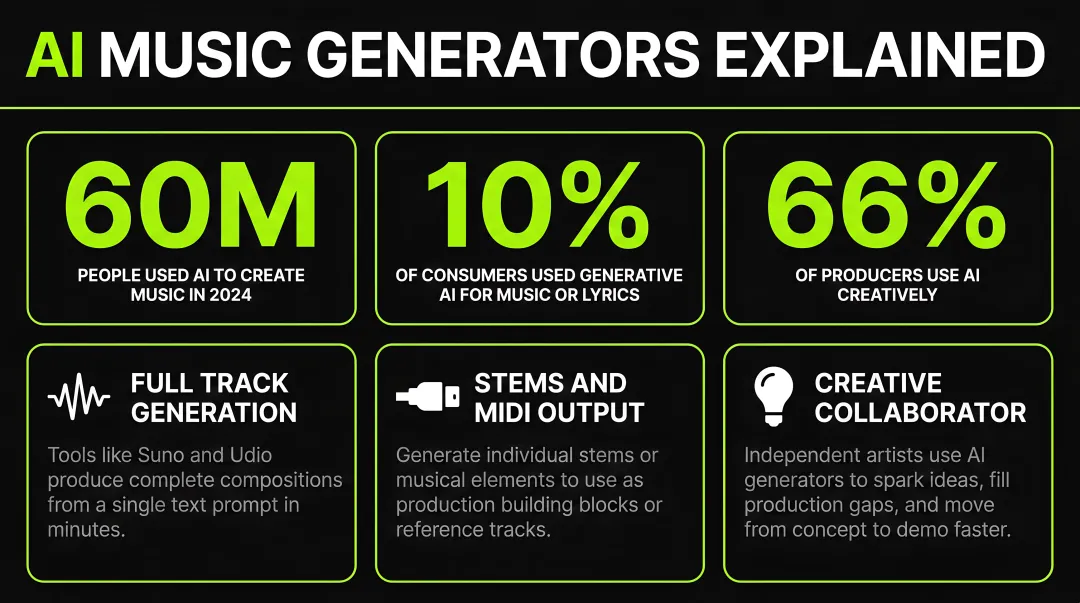
These tools produce full tracks, stems, or musical elements from text prompts or musical input. Popular platforms like Suno and Udio allow artists to generate complete compositions in minutes. In 2024, 60 million people used AI to create music, with 10% of consumers specifically using generative AI for music or lyrics.
For independent artists, these tools serve as creative collaborators—generating ideas, building reference tracks, or filling production gaps. Notably, 66% of producers use AI creatively for songwriting and melodies—most treat it as a collaborator, not a substitute.
AI Stem Splitters
These tools isolate individual elements—vocals, drums, bass—from mixed recordings. Advanced models like HT Demucs achieve average Signal-to-Distortion Ratios of 9.20 dB, delivering high-fidelity separation for remixing, practice, and learning.
Legitimate use cases include:
- Creating instrumental versions for sync licensing
- Isolating vocals for cleared remix projects
- Studying production techniques on your own recordings
Extracting stems from copyrighted recordings and releasing derivative works without clearance is copyright infringement—legally the same as unlicensed sampling.
AI Mastering Engines
AI mastering services offer fast, affordable alternatives to traditional engineering. By 2025, 79% of producers used AI for technical tasks like mixing and mastering.
That said, a 472-person blind listening test found human engineers consistently outperformed AI on quality and artistic nuance. Several AI platforms were disqualified entirely due to clipping and distortion.
Other Generative Tools
AI lyric generators and artwork tools like Midjourney and DALL·E complete the production toolkit. Artwork generation carries an additional compliance consideration—distributors increasingly require disclosure of AI-generated cover art, and some DSPs flag synthetic imagery for review.
AI's Impact on Music Distribution and Streaming Platforms
AI tools have opened real creative possibilities for independent artists — but platforms have drawn clear lines around how that music gets distributed. The problem isn't AI itself. It's specific misuse patterns that trigger flags, takedowns, and account bans.
Core Risk Areas for AI Music Distribution
Artist Impersonation
Using AI to clone or mimic a recognizable artist's voice and releasing it under that artist's identity violates policies on every major platform. The widely-cited case of the AI-generated track mimicking Drake and The Weeknd was pulled from all major streaming services in 2023, setting a precedent for enforcement.
Spotify now explicitly prohibits unauthorized voice clones, allowing vocal impersonation only when the impersonated artist has authorized usage. Platforms invest heavily in detection technology to catch "content mismatches" where AI tracks are fraudulently uploaded to real artist profiles.
Copyright Violations via Stem Splitters
Extracting stems from copyrighted recordings and releasing music built from those stems is treated as copyright infringement. Even if you isolate a vocal stem using AI and build entirely new instrumentation around it, you're still using copyrighted material without clearance. This can result in takedowns, DMCA strikes, and legal action from rights holders.
Spam Releases
Full-song AI generators enable bulk output at a scale that has overwhelmed platforms. Deezer reported receiving over 30,000 fully AI-generated tracks daily by September 2025. In response, streaming services implemented spam detection systems that identify and de-prioritize bulk AI uploads.
Algorithmically flagged releases get no promotional benefit — even when they aren't removed outright. Spotify's Fall 2025 spam filtering system specifically targets mass uploads, duplicates, SEO manipulation, and artificial streaming abuse. That's catalog damage that compounds over time.
Platform Responses at Scale
Platforms have moved quickly to enforce new standards. Key actions already in effect:
- Deezer launched AI tagging systems that exclude fully AI-generated tracks from algorithmic recommendations
- YouTube updated monetization policies to demonetize "mass-produced" or "repetitious" content
- Spotify now supports DDEX industry standards for AI credits in release metadata, pushing toward mandatory disclosure
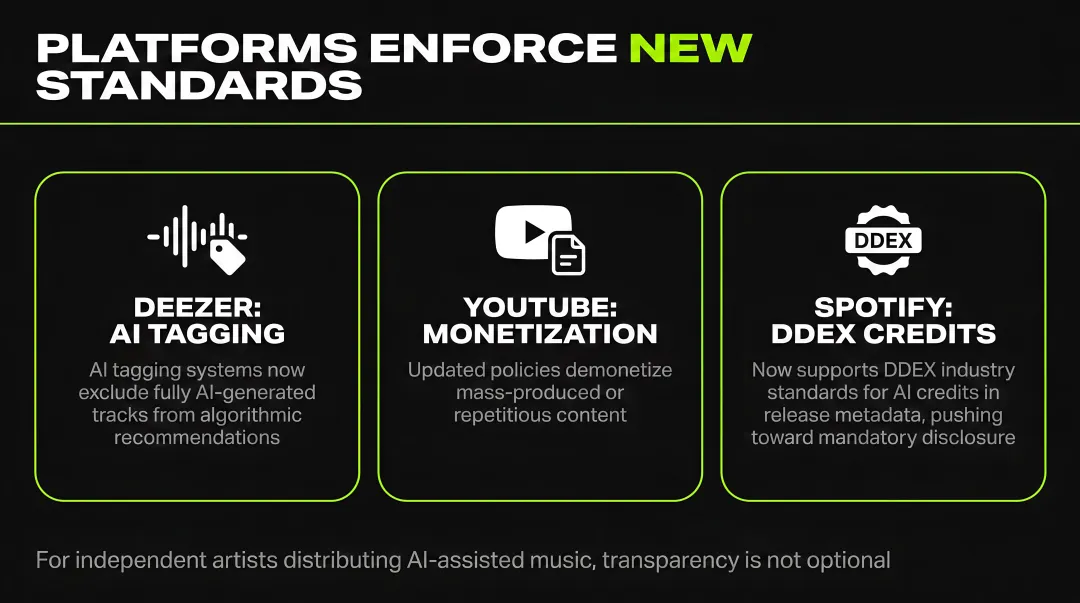
For independent artists distributing AI-assisted music, this means transparency isn't optional — it's becoming a baseline requirement for staying in good standing with DSPs.
Navigating Platform Policies: What Every Artist Needs to Know
DSP Policies Are a Moving Target
Policies differ significantly across Spotify, Apple Music, YouTube, TikTok, and Meta—and they evolve quickly. What's permitted today may be restricted tomorrow. For example, YouTube updated its monetization policies in July 2025 to specifically target "mass-produced" AI content for demonetization, while Spotify introduced DDEX-based AI disclosure standards in September 2025.
Consistently Safe Uses:
- Generating original sounds integrated with human-made material
- AI-powered effects applied to your own original audio
- AI mastering engines on tracks you created
Consistently Prohibited Uses:
- Artist voice impersonation without authorization
- Releasing music built from copyrighted stem separations
- Bulk uploading AI-generated tracks for algorithmic manipulation
The Distributor-DSP Relationship
Platform policies don't exist in isolation — your distributor has to comply with every DSP they deliver to simultaneously. That means distributor rules often default to the most restrictive policy across all platforms they serve. A distributor may restrict AI content even if one specific DSP technically permits it.
Proactive Steps:
- Check if your distributor requires disclosure of AI tool usage in release metadata
- Verify whether they limit the proportion of fully AI-generated content
- Confirm whether AI-generated music is restricted from monetization channels like YouTube Content ID or TikTok
Staying current on both DSP and distributor policies is an ongoing task — bookmark their official policy pages and check for updates before each major release cycle.
Best Practices for Safely Distributing AI-Assisted Music
Best Practices for Safely Distributing AI-Assisted Music
Document Your AI Tool Usage
Keep a brief record specifying which tools contributed to lyrics, stems, mastering, or artwork. This protects you if a distributor's review team questions your release's originality — and sharpens your own understanding of your workflow. Note the tool name, version, and your specific use case in your project notes.
Verify Copyright and Ownership at Every Step
Before releasing any track using AI-separated audio, soundalike elements, or material generated from identifiable copyrighted input, confirm you have legal rights to use those source materials. When in doubt:
- Consult the AI tool's terms of service
- Seek clearance from original rights holders
- Use only royalty-free or originally created source material
Stay Continuously Informed
Policies shift month to month — not just at account setup. Build a habit of checking for updates before each new release, not just when you first sign up. Key sources to monitor include:
- Music rights organizations (such as IPRS or global equivalents)
- Your distributor's terms of service page
- Target DSP policy updates
- Trusted music industry news outlets
AI-Powered Strategies to Maximize Your Music's Reach
AI-driven analytics tools enable artists to move beyond vanity metrics and understand real audience behavior. Demographic data, listening patterns, and platform-specific performance inform when to release, how to price sync licensing opportunities, and where to direct promotional energy.
Platforms like Madverse provide advanced music analytics and audience demographic reporting that surface data most independent artists never had access to before. These tools help you:
- Identify which markets and demographics respond best to your music
- Understand earnings per platform to optimize promotional spend
- Track performance trends that reveal optimal release timing
- Monitor audience behavior across multiple DSPs simultaneously
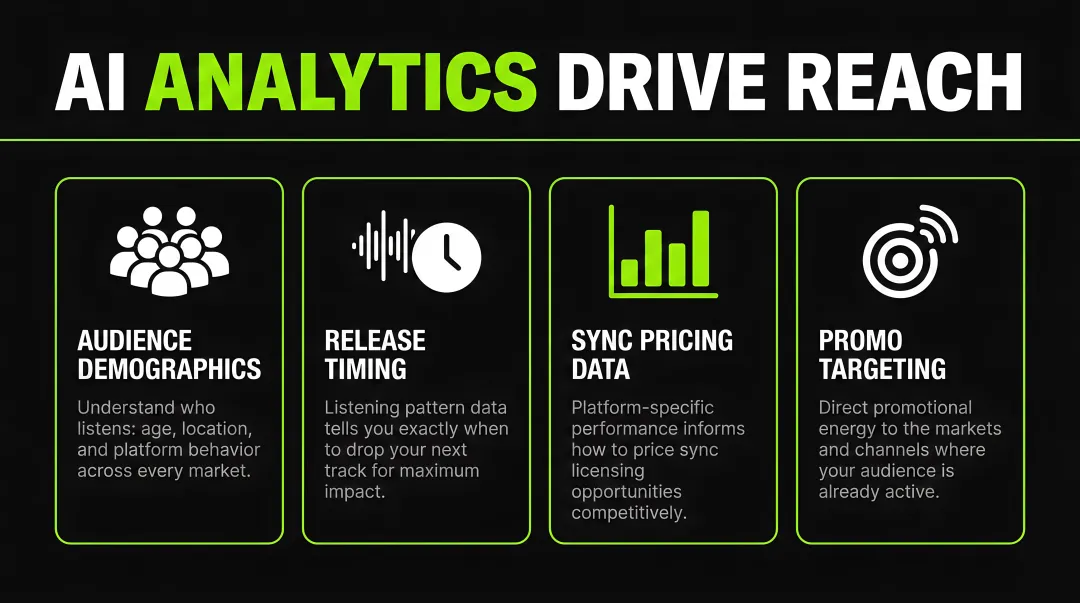
That data does more than inform release strategy—it directly sharpens how you pitch and position your music.
Precision Playlist Pitching
AI improves the precision of editorial playlist pitching and algorithmic placement. Crafting metadata carefully, releasing consistently, and using detailed analytics to identify responsive markets all improve your chances with both algorithms and human curators. Artists who understand their audience demographics can pitch more effectively to curators whose playlists match their listener profiles.
Sync Licensing Opportunities
AI tools help identify sync licensing potential in a track's mood, tempo, and energy profile. Partnering with a distributor that has sync licensing infrastructure—connecting you to TV, film, commercials, and video game placements—gives AI-assisted and human-made tracks alike a wider range of revenue streams. Madverse, for example, achieved a milestone by syncing the first-ever South Asian track in The Kardashians, demonstrating the platform's capability to secure high-profile placements for independent artists.
Frequently Asked Questions
Can I sell music made with AI?
Yes, you can monetize AI-assisted music in most cases, but fully AI-generated tracks with no meaningful human creative input may face restrictions on certain platforms. Originality, copyright compliance, and disclosure to your distributor determine whether your release can be monetized.
Do I need to disclose that my music is AI-generated when distributing?
Disclosure requirements vary by distributor and platform. Some require disclosure in metadata or during review, while others don't mandate it upfront. Always check your specific distributor's terms before submitting a release, as policies are evolving rapidly.
Will Spotify or Apple Music remove my AI-assisted tracks?
Tracks are typically removed for specific violations—artist impersonation, use of copyrighted stems, or bulk spam uploading—not simply for using AI tools. Releases that are original, driven by genuine human creativity, and compliant with platform policies generally stay live.
Which distributors accept AI-generated music?
Many major distributors accept AI-assisted music but may set limits on fully AI-generated content or require it to meet originality and quality thresholds. Distributors like Madverse support AI-assisted releases while providing tools for compliance and analytics, though specific policies should be confirmed before submission.
Does using AI in music production affect my royalty rights?
Using AI tools doesn't automatically forfeit royalty rights, but fully AI-generated content with no human authorship may face challenges in copyright registration and royalty collection. The US Copyright Office maintains that works lacking human authorship are ineligible for blanket mechanical licenses across most jurisdictions.