Imagine finishing a track in your bedroom studio and having it recommended to thousands of fans worldwide within hours, with every royalty tracked automatically. That’s the reality of AI in today’s music industry, where AI‑powered recommendation engines influence over 50 % of how top tracks are discovered and promoted on streaming platforms.
However, for independent artists and labels in India, reaching this level of efficiency is not straightforward. Slow distribution cycles, unclear royalty collection, and complex copyright processes often stand in the way. This is where AI tools play a critical role by automating metadata creation, identifying potential copyright conflicts, and delivering listener analytics that support faster, more informed decisions.
In this blog, you’ll explore how AI in the music industry is influencing creation, distribution, rights tracking, fan engagement, and strategies to grow your career.
Key Takeaways
Optimize Global Reach: Use AI in the music industry to connect with the right audience efficiently across streaming platforms.
Protect Royalties: Use AI-powered tools to automate royalty tracking and publishing administration for accurate payments worldwide.
Streamline Releases: Reduce approval time with AI-driven quality control and metadata validation in the music industry.
Make Data-Driven Decisions: Utilize listener analytics from AI in the music industry to plan releases and playlist submissions strategically.
Maintain Creative Control: Treat AI as a support tool; artists retain final creative decisions while benefiting from AI insights.
AI in the Music Industry: An Overview
AI is increasingly used across the music industry for creation, production, and distribution. It assists with composition, mixing, mastering, stem separation, and audio restoration, while also automating routine workflows. On the listener side, AI powers recommendation systems and adaptive soundtracks that influence how music is discovered and consumed.
At the same time, AI raises unresolved issues around copyright, training data, and artist compensation. The growth of AI-generated music on streaming platforms has led to legal disputes and regulatory debate. While AI tools expand access for new creators and support existing artists, they also pose risks to income stability and clarity of ownership.
With this broader context in mind, let’s look at how AI is changing music creation and production at the ground level.
AI’s Role in Music Creation and Production
AI is collaborating in music creation, generating melodies, aiding harmonies, automating mixing, and even performing live with musicians. A notable example occurred in November 2022, when pianist David Dolan performed with a semi‑autonomous AI system by composer Oded Ben‑Tal, marking the first live AI‑musician collaboration and showing AI as a creative partner.
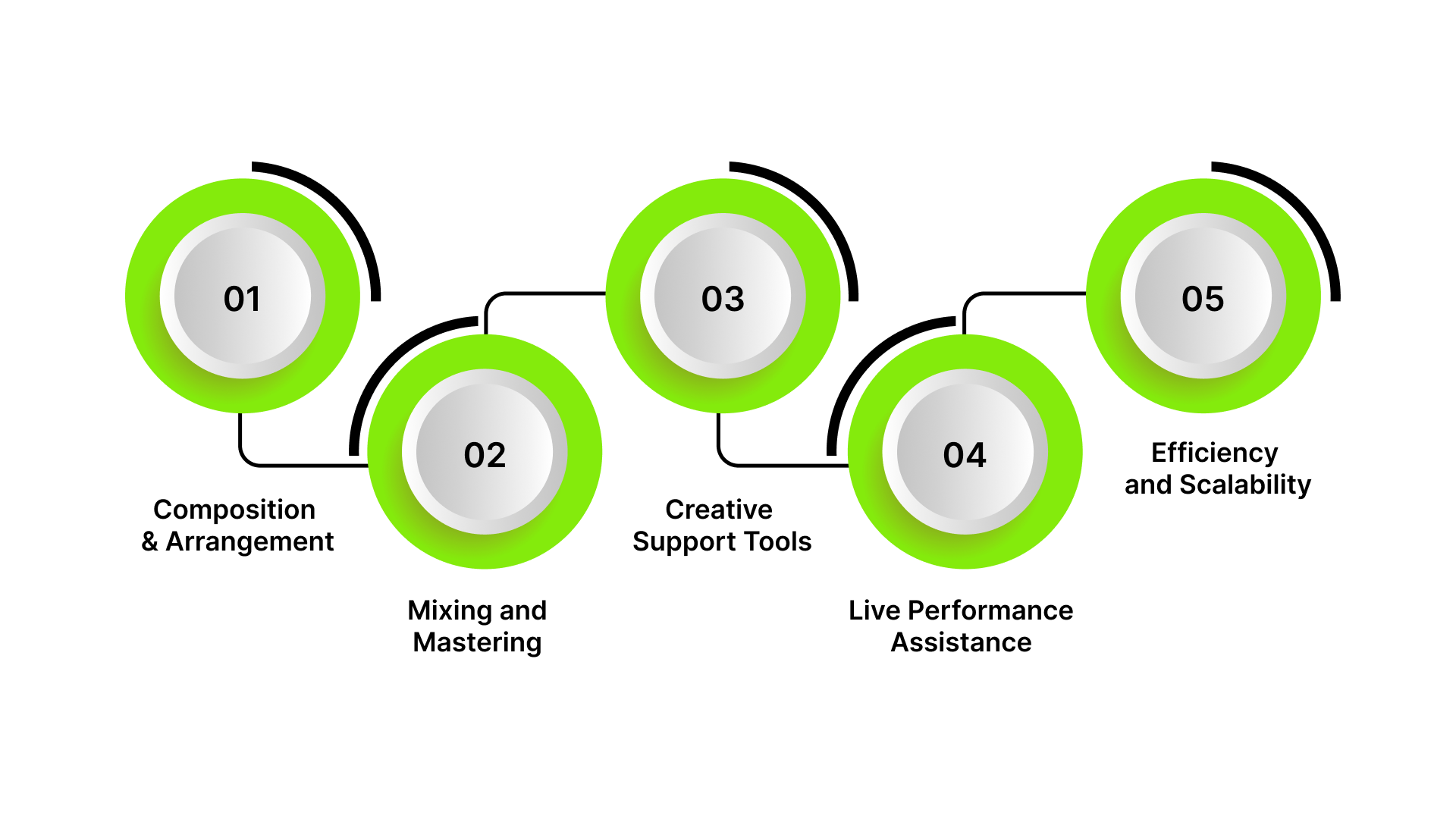
For artists, producers, and engineers, AI now assists or augments nearly every stage of music creation:
Composition and Arrangement
In AI-driven music industry workflows, algorithms assist artists by generating chord progressions, melodic ideas, rhythmic patterns, and harmonic layers. These outputs provide structured starting points that artists can refine and adapt to their creative intent. This reduces time spent on ideation while preserving artistic control.
Mixing and Mastering
AI-powered tools analyze audio signals to identify balance issues, frequency conflicts, and dynamic inconsistencies. They suggest EQ, compression, and loudness adjustments to speed up mixing and mastering. This makes professional-sounding output more accessible without relying entirely on specialized engineers.
Creative Support Tools
Beyond audio, AI in the music industry supports lyric suggestions, hook generation, and visual elements such as album artwork. These tools help artists develop supporting creative assets more quickly while retaining ownership of final decisions. The result is a more integrated creative workflow from concept to release.
Live Performance Assistance
AI systems can accompany musicians in real time by responding to tempo, key, and improvisational cues. This enables new performance formats where human musicians interact dynamically with algorithmic systems. Such applications expand creative possibilities beyond traditional studio environments.
Efficiency and Scalability
By automating repetitive production tasks, AI shortens production cycles and reduces dependency on high-cost studio infrastructure. Independent artists in India can iterate quickly, experiment with multiple versions, and release music more frequently. This scalability supports consistent output in competitive global markets.
Note: AI does not replace the artist’s vision. Musicians still define creative direction, while AI accelerates workflows and expands possibilities. At the same time, managing rights, royalties, and copyright remains critical. |
Want to focus on music while handling distribution and royalties seamlessly? Madverse supports independent artists and labels with global distribution, royalty collection, and publishing administration, all while keeping your music under your control. Sign up to simplify releases and royalties.
Thoughtful use of AI lets you create professional music faster, experiment freely, and reach audiences. This shift in creation also raises questions about ownership and rights, and for that, we need to understand how AI affects discovery and distribution.
From Upload to Streams: AI in Music Distribution and Discovery

Once music is created, the next challenge for artists is getting it in front of listeners who will stream, share, and pay for it. Here’s where AI makes a difference:
Personalized Recommendations
Streaming platforms analyze listening history, skips, saves, and repeat plays to match songs with likely listeners. AI-driven recommendations determine what appears on home feeds, radios, and suggested tracks. This directly affects an artist’s daily streams and long-term audience growth.
Smart Metadata and Tagging
AI tools can analyze audio features like tempo, mood, genre, and language to generate detailed metadata. Accurate tagging improves search results, genre placement, and platform categorization. It also reduces the risk of missed or misattributed royalties due to incorrect data.
Playlisting and Predictive Analytics
Algorithms track listener behaviour to identify songs gaining traction early. Tracks with positive signals are more likely to be added to editorial or algorithmic playlists. Since playlists drive a large share of streams, these systems heavily influence visibility.
Automated Release Timing
AI analyzes listener activity patterns across regions and platforms. Based on past performance and audience behaviour, it can recommend optimal release days and times. This helps artists avoid low-visibility windows and improve initial engagement.
Turn insights into action. Use performance data to plan releases, identify growth opportunities, and refine your strategy. Submit A Track today!
Putting these together, the message is clear: AI helps match music to listeners at scale. For independent artists in India eyeing global audiences, this is a powerful advantage. Now that music can reach listeners more efficiently using AI, the next concern is whether creators are fairly compensated.
AI, Rights and Royalty Tracking: What Artists Need to Know
Innovation often outpaces regulation, and AI in music brings both opportunities and risks. Independent creators need to understand how rights and royalties are changing to protect their income. Key developments include:
Fair Compensation Debates: Globally, there is ongoing discussion on whether AI training datasets should require payment to original creators and how existing copyright law applies to AI-assisted or AI-generated outputs.
Transparency Demands: Artists want AI systems to clearly explain what data is used to train models, how AI-generated outputs are created, and how royalties are calculated and assigned to rights holders.
Metadata and Attribution Accuracy: As AI-driven distribution scales, incorrect or incomplete metadata can result in lost royalties, ownership disputes, or misattribution across platforms.
Fragmented Royalty Reporting: Earnings are often spread across multiple platforms and rights bodies, making it difficult for artists to track income, verify splits, and identify missing payments.
Platforms like Madverse address these issues by offering integrated royalty-splitting and reporting tools that make payouts transparent and accurate, automate earnings distribution to collaborators, and provide a unified dashboard to track revenue across platforms.
For independent artists and labels in India, where music rights systems and performing rights organisations are still developing, staying informed about these trends is crucial for protecting income and making strategic decisions about AI-assisted music creation.
What AI Means for Independent Artists in India
For independent artists in India, AI is opening new doors, making professional-quality production accessible, expanding their global reach, and providing data-driven insights to strategically grow their music careers.
Here are a few ways AI is changing the music industry:
Lower Barriers to Entry: Professional-quality production is now accessible without big budgets. Emerging artists can compose, mix, and master tracks using tools once available only to major studios.
Global Reach: AI-powered discovery systems help Indian artists, from folk to indie pop, connect with listeners worldwide.
Business Insights: Analytics show where listeners engage most, which regions are growing fastest, and which playlists drive streams, helping plan releases strategically.
Creative Control: Tools that generate stems, suggest arrangements, or assist with harmonies let artists prototype ideas quickly without a large team.
However, there is a flip side: AI can reduce discoverability if metadata isn’t accurate or claims aren’t submitted properly, and creators need reliable rights tools.
Also Read: How to Make Money as an Independent Artist in India
Let’s take a closer look at the common challenges independent artists and labels face in the AI-driven music industry.
Key Challenges of AI in the Music Industry
As AI becomes integral to music production and distribution, independent artists and labels face new hurdles alongside its benefits. Mismanaged metadata, unclear royalty attribution, and algorithmic biases can impact both visibility and earnings.
Here are the key challenges to be aware of:
Unlicensed AI Training Data: Many AI models are trained on existing music without clear permission or licensing, raising concerns about copyright infringement and lost income for original creators.
Oversaturation of AI-generated Content: The rapid increase in AI-generated tracks can flood streaming platforms, making it harder for human artists to stand out and gain meaningful discovery.
Loss of Artistic Identity and Trust: When listeners cannot easily distinguish between human-made and AI-generated music, questions arise around authenticity, originality, and creative ownership.
AI as a Direct Market Competitor: Fully automated systems can now create, distribute, and promote music independently, competing with artists for playlist placements, streams, and attention.
Regulatory Uncertainty Across Regions: Copyright laws and licensing standards for AI in the music industry remain inconsistent globally, creating confusion around rights, attribution, and royalty eligibility.
Also Read: What to Look For in a Music Distribution Company: A Guide for Independent Artists
Taken together, these risks show why independent artists and labels need platforms that prioritize automation, transparency, rights protection, and clarity of ownership. Let’s see how Madverse supports artists across these operational areas.
Madverse’s AI-Driven Quality Check for Faster Music Releases
Independent artists and labels often face delays and inefficiencies when distributing music globally. Waiting days for track approval, manually managing metadata, tracking royalties, and coordinating releases across platforms can slow momentum and distract from creative work.
Madverse addresses these challenges by combining AI-driven quality control, global distribution, and rights management into a single platform. Automating approvals and streamlining administrative tasks, it helps artists focus on creating music while ensuring their work is properly tracked and monetized.
Key features:
Instant AI Quality Control: Tracks are reviewed and approved within minutes, not days, letting you release music faster.
Accurate Metadata & Rights Management: Ensure your P‑lines and C‑lines are correctly applied so your work is properly recognized and royalties collected.
Global Distribution to 150+ DSPs: Reach listeners worldwide on platforms powered by recommendation algorithms and personalized feeds.
Royalty Splits & Analytics: Automate payments to collaborators and track which regions, platforms, and playlists drive your revenue.
Publishing Administration: Register your songs with global PROs to efficiently collect royalties in every territory.
AI Cover Art Tool: Generate professional cover art instantly from prompts or inspiration, reducing design time and costs.
Marketing Tools: Promote your music effectively with Express Ads, fan links, pre-saves, playlist pitching, and sync opportunities. These tools help you reach the right audience and build a loyal global fan base.
With AI-driven insights and automation, Madverse helps independent artists and labels focus on building their careers while maintaining full control over their work. This combination of distribution, rights management, and intelligent AI features sets the stage for scaling your music business globally.
Final Thoughts
AI in the music industry is changing how music is created, distributed, and discovered. It enables artists to produce professional-quality tracks, reach global audiences, and make data-driven decisions efficiently. Understanding rights, royalties, and metadata remains essential to ensure fair compensation.
Madverse makes this practical. With AI-assisted quality control, global distribution, and accurate metadata, artists and labels can manage releases efficiently. Integrated marketing tools, roster management, and global PRO partnerships further help creators grow their audience, collect royalties worldwide, and scale their music business with ease.
Get in touch with us to see how Madverse can help you release music, track royalties, and grow your audience worldwide.
FAQs
1. How can independent artists ensure AI doesn’t affect their creative control?
Use AI tools as assistants, not replacements. Focus on guiding melodies, harmonies, and production choices while AI automates repetitive tasks or suggests ideas. Maintain final decisions to preserve your artistic vision.
2. Can AI improve royalty collection for global streams?
Yes. Within AI in the music industry, platforms like Madverse automate royalty tracking, verify rights, and calculate splits across regions, reducing errors and ensuring accurate global payments without manual effort.
3. How does AI help emerging artists compete internationally?
AI in the music industry exposes tracks to global audiences, identifies target listener demographics, and provides insights. Independent artists can strategically plan releases and grow fan bases in emerging and international markets.
4. How can AI help artists plan marketing for potential hits?
AI in the music industry analyzes streaming trends, listener engagement, and playlist performance to identify tracks with high growth potential. Artists can prioritise promotion, schedule releases strategically, and focus resources on songs most likely to resonate with audiences.
5. How does AI support collaborations between artists remotely?
AI tools facilitate AI-assisted collaboration by synchronizing tracks, suggesting harmonies, and automating version control. In the music industry, this allows global artists to co-create without being in the same studio.