Introduction: AI Music Marketing Revolution for Independent Artists
Independent artists now control nearly half the global music market—46.7% in 2023, generating ₹1,18,900 crore—yet they face a daunting reality: major labels collectively invest ₹58,900 crore annually in marketing and A&R. This resource gap has historically made professional-level promotion feel impossible for solo artists and small labels.
AI marketing tools are changing that equation. In 2023, 27% of independent artists began using AI for promotional assets, artwork, and campaign automation—accessing targeting capabilities that were exclusive to major label marketing departments just three years ago.
These tools enable artists to execute sophisticated campaigns, optimize ad spend, and analyze listener behavior without needing six-figure budgets or industry connections.
This guide covers practical AI strategies for music promotion: specific tools with real pricing, audience targeting techniques that actually work, and how to maintain your authentic voice while leveraging automation.
You'll learn which platforms deliver results, how to measure ROI accurately, and how distribution platforms enable you to retain maximum royalties while accessing professional marketing infrastructure.
TLDR: Key Takeaways
- AI tools deliver major-label targeting and automation for under ₹8,400/month
- Automated ad buying, playlist optimization, visual content, and predictive analytics
- Use AI for efficiency and scale while keeping your authentic storytelling human
- Spotify Marquee delivers listeners at ₹50-₹70 each; Meta Advantage+ cuts ad costs by 9.7%
- Madverse combines distribution, analytics, and sync licensing—artists keep 95% royalties
How AI is Transforming Music Marketing for Independent Artists
What AI Music Marketing Means
AI music marketing uses machine learning, automation, and data analysis to optimise how artists find listeners, create promotional content, and allocate budgets.
Unlike traditional marketing (which relies on guesswork, manual ad placement, and broad demographic targeting), AI platforms analyse listener behaviour patterns, predict which audiences will engage, and automatically optimise campaigns in real time.
The shift is from "spray and pray" to precision targeting. Instead of manually selecting age ranges and locations, AI identifies users who stream similar artists, show specific engagement behaviours, and match your music's sonic characteristics.
The Democratisation of Music Promotion
AI has removed two barriers that once demanded label backing: cost and expertise.
Cost barrier removed: Tools that major labels use for audience segmentation and campaign automation now start at ₹800-2,500/month. Artists access the same targeting algorithms that previously required enterprise contracts.
Expertise barrier removed: Platforms like Symphony and Hypeddit automate complex tasks (ad creative generation, audience lookalike modelling, budget reallocation) that once required specialised marketing teams.
Artists launch campaigns in minutes rather than weeks.
Over seven million artists now release music globally, with independent artists capturing nearly half the market.
AI tools drive this shift: they enable solo artists to compete for attention without hiring agencies or signing restrictive deals.
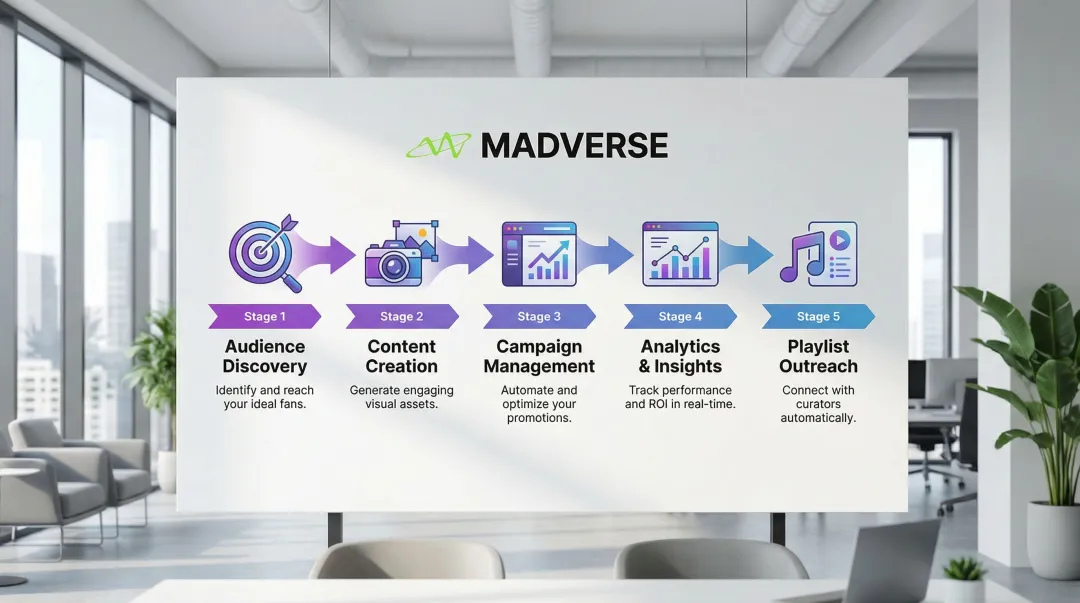
Key Areas Where AI Makes the Biggest Impact
These capabilities translate into specific competitive advantages for independent artists:
Audience discovery and targeting: AI analyses streaming behaviour to find listeners who genuinely want your genre. Instead of targeting "18-34-year-olds who like music," algorithms identify users who stream specific artists, engage with particular playlists, and show behaviours indicating they'll save your track.
Content creation and optimisation: Generate promotional graphics, lyric videos, social captions, and ad creatives without hiring designers or videographers. Tools like Runway and Midjourney produce professional-quality assets in minutes.
Campaign management: Automated ad buying across Meta, YouTube, and TikTok with continuous A/B testing and budget optimisation. AI reallocates spend to best-performing placements without manual intervention.
Analytics and insights: Understand which demographics stream your music, where engagement peaks, and which promotional tactics drive saves versus passive listens. Platforms track listener behaviour across streaming services and social media.
Playlist and curator outreach: AI identifies playlists that match your music's sonic profile, analyses curator contact patterns, and suggests optimal pitch timing based on historical acceptance rates.
Essential AI Tools and Platforms for Music Promotion
AI-Powered Advertising Platforms
| Platform | Starting Price | Best For | Key AI Features |
|---|---|---|---|
| Symphony | ₹1,660/mo + ad spend | Centralized campaign management | Automated audience targeting, multi-platform ad creation, budget optimization across Meta/YouTube |
| Hypeddit | ₹830/mo (Basic) | Quick-launch campaigns | AI-powered music ads, smart links, Spotify popularity tracking, download gates |
| Feature.fm | Free tier available | Pre-save campaigns & retargeting | Predictive analytics, audience segmentation, retargeting pixels, DSP analytics integration |
Automated optimizations through Symphony deliver 30% improvement in cost-per-click. Independent artist Cash Cobain used Symphony's data collection tools—QR codes and custom landing pages—to drive engagement for his "Fisherrr" remix.
For beginners, Hypeddit simplifies ad creation with campaign launches in minutes. While manual management might yield better results for experts, the platform removes the learning curve for artists new to paid promotion.
Conversion moments are where Feature.fm shines. Artist Stacey Ryan captured hundreds of thousands of pre-saves during a viral TikTok moment using Feature.fm's tools, converting them into millions of streams on release day.
Content Creation and Visual Tools
Visual content tools include:
- Runway (from ₹995/month): High-end generative video for Text-to-Video and Image-to-Video creation, ideal for music videos and Spotify Canvas content (625 monthly credits)
- Kaiber (from ₹2,400/month): Stylized animations and audio-reactive visualizations for social media (1,400 credits with Creator plan)
- Midjourney/DALL-E: AI image generation for cover art, social graphics, and promotional imagery without hiring designers
Fan Engagement and Link Management
Beacons.ai offers a free tier with AI-powered link-in-bio pages, email marketing automation, and merch sales. The Creator Plus plan (₹2,490/month) adds AI text/image generation and eliminates platform fees.
AI chatbots maintain fan engagement at scale, handling common questions and routing complex inquiries to you while you focus on creating music.
How to Choose the Right AI Tools for Your Budget
Start with your budget range to identify the right tool combination:
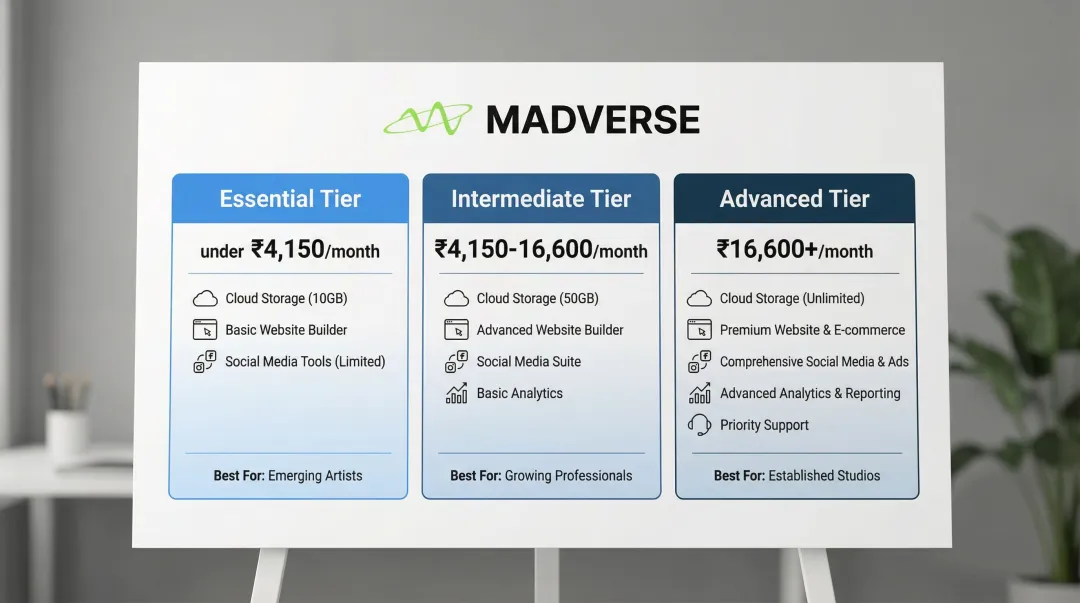
Essential tier (under ₹4,150/month):
- Feature.fm Free + Hypeddit Basic (₹830) + Beacons.ai Free
- Focus: Smart links, basic ad campaigns, centralized fan hub
- Best for: Artists testing AI tools with minimal investment
Intermediate tier (₹4,150-16,600/month):
- Symphony Pro (₹1,660) + Runway Standard (₹995) + Beacons Creator Plus (₹2,490) + ad spend (₹8,300-12,450)
- Focus: Automated campaigns, visual content creation, fan engagement
- Best for: Artists with proven traction ready to scale
Advanced tier (₹16,600+/month):
- Hypeddit Elite (₹8,300) + Kaiber Pro (₹12,370) + Feature.fm Pro (₹3,240) + substantial ad spend
- Focus: Complete campaigns, high-quality video content, advanced analytics
- Best for: Established artists treating music as full-time business
Decision framework: Identify your biggest bottleneck. Limited reach? Prioritize ad platforms. No visual content? Invest in creation tools. Poor data visibility? Start with analytics integration.
Distribution and Analytics Integration
Integration matters: when your distribution, analytics, and marketing tools share data, you track campaigns comprehensively—from ad click to stream to playlist add.
Platforms like Madverse combine AI-powered analytics with music distribution. Artists keep 95% of royalties while accessing marketing insights that connect promotional efforts to streaming performance. The platform also offers sync licensing opportunities (TV, film, commercials, gaming) and editorial playlist pitching, creating additional revenue streams beyond streaming royalties.
AI-Powered Audience Targeting and Fan Growth Strategies
Understanding AI Audience Analysis
AI analyzes listener behavior patterns—which artists they stream, how long they listen, whether they save tracks or skip after 30 seconds. This identifies potential fans with precision.
The approach goes beyond demographic targeting (age, location) to psychographic targeting: music taste profiles and engagement behaviors.
Meta's Advantage+ automation can lower costs per result by 9.7% for traffic objectives by identifying users most likely to click based on historical conversion data.
However, for impression-based campaigns, Advantage+ may reduce click-through rates by 61%, prioritizing cheaper placements over high-quality engagement.
On Spotify, over one-third of new artist discoveries happen through algorithmic "Made for You" sessions. When listeners engage with your content through targeted ads, this feeds directly into these recommendation engines.
Setting Up Smart Ad Campaigns
Here's how automated campaigns work:
- Upload your track to an AI ad platform
- The platform analyzes musical characteristics (tempo, genre, mood, instrumentation)
- It identifies audiences who stream similar artists
- Automated targeting begins with continuous optimization
Multi-layered strategy:
- Start with broad engagement content (15-second clips, behind-the-scenes footage)
- Retarget engaged users with focused promotional materials (pre-save links, new release announcements)
- Use lyric snippets and authentic moments that showcase personality
Optimizing for Streaming Platform Algorithms
Metadata optimization: Refine track descriptions, genre tags, and mood classifications for better algorithmic discovery on Spotify, Apple Music, and YouTube.
Timing matters: Submit tracks to Spotify at least 7 days before release to ensure inclusion in Release Radar playlists, which automatically collect new releases for your followers.
Discovery Mode: Spotify's tool prioritizes your tracks for algorithmic placement in exchange for a commission on those specific streams—useful when launching new releases.
Marquee: Spotify's sponsored recommendation tool. A Spotify study showed it delivered 10x more listeners per dollar than social ads. Independent tests show effective costs per listener ranging from ₹50-70 (approximately $0.60-$0.84 USD)—significantly better than broad social campaigns.
Building and Segmenting Your Fan Database
Once you're driving traffic, sophisticated tracking tools monitor fan behavior across platforms to create detailed audience segments. This targeting moves beyond one-size-fits-all campaigns.
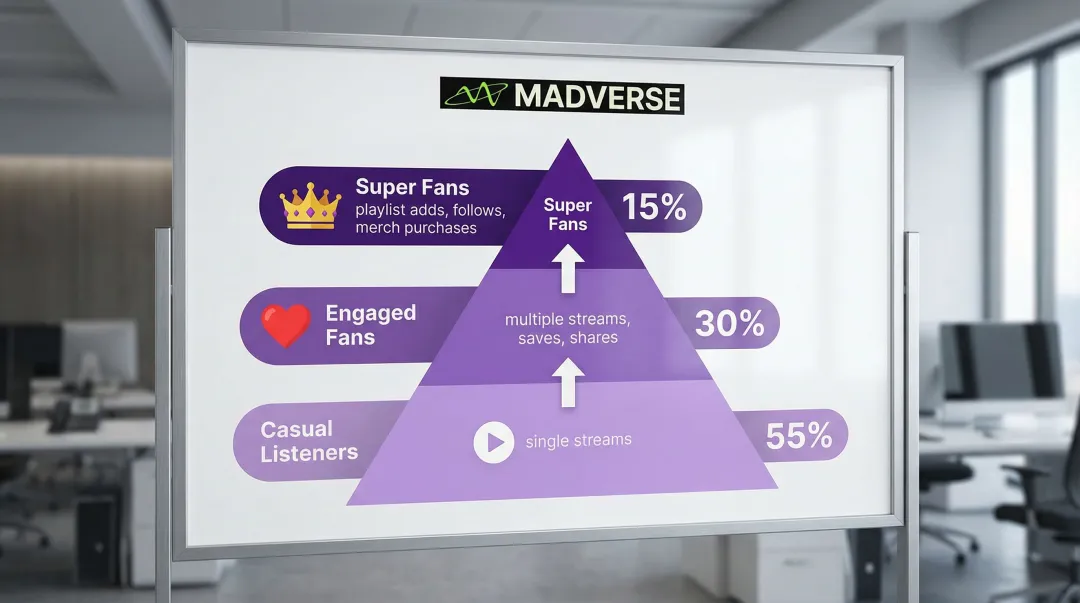
Three key audience tiers:
- Casual listeners (streamed once)
- Engaged fans (multiple streams, saves, shares)
- Super fans (playlist adds, follows, merchandise purchases)
Automated email sequences move casual listeners through this funnel with personalized content based on their engagement level.
Measuring and Scaling What Works
Key metrics to track:
- Engagement rate (saves and shares per 1,000 impressions)
- Cost per stream
- Follower growth rate
- Conversion to saves/playlist adds (intent signals)
Modern platforms automatically optimize campaigns by shifting budget to best-performing content. If lyric videos drive more saves than performance clips, the algorithm shifts spend accordingly.
2024 Global Benchmarks:
- Meta CPM: ₹500-900 ($6.05-$10.83 USD) (varies seasonally)
- YouTube CPM: ₹165-475 ($1.98-$5.70 USD)
- TikTok CPM:
₹390 ($4.67 USD) - Spotify Marquee: ₹50-70 ($0.60-$0.84 USD) per listener
Automating Content Creation with AI
AI-Generated Social Media Content
Tools like ChatGPT or Claude draft social media posts, captions, email newsletters, and blog content in seconds. Use prompts that maintain your artist voice:
"Write an Instagram caption for my new single 'Midnight Drive,' a moody indie-pop track about late-night introspection. Tone: vulnerable but hopeful. Include a question to engage fans."
Critical warning: Over-automation kills authenticity. Use AI for drafts and ideas, then add personal touches—specific stories, genuine emotions, unique perspectives only you can provide.
Creating Visual Content Efficiently
AI image generators help you maintain visual consistency across album art, social posts, and promotional materials. Create templates with your color palette and aesthetic, then generate variations.
Key applications include:
- Spotify Canvas and Instagram Reels using tools like Runway or Kaiber
- Audio-reactive animations that turn tracks into shareable visual content
- TikTok clips and YouTube Shorts without expensive production costs
- Album artwork and promotional graphics at a fraction of traditional costs
According to industry research, 38% of artists now use AI for artwork creation, reducing costs from ₹8,000-10,000 per asset to minimal expenses.
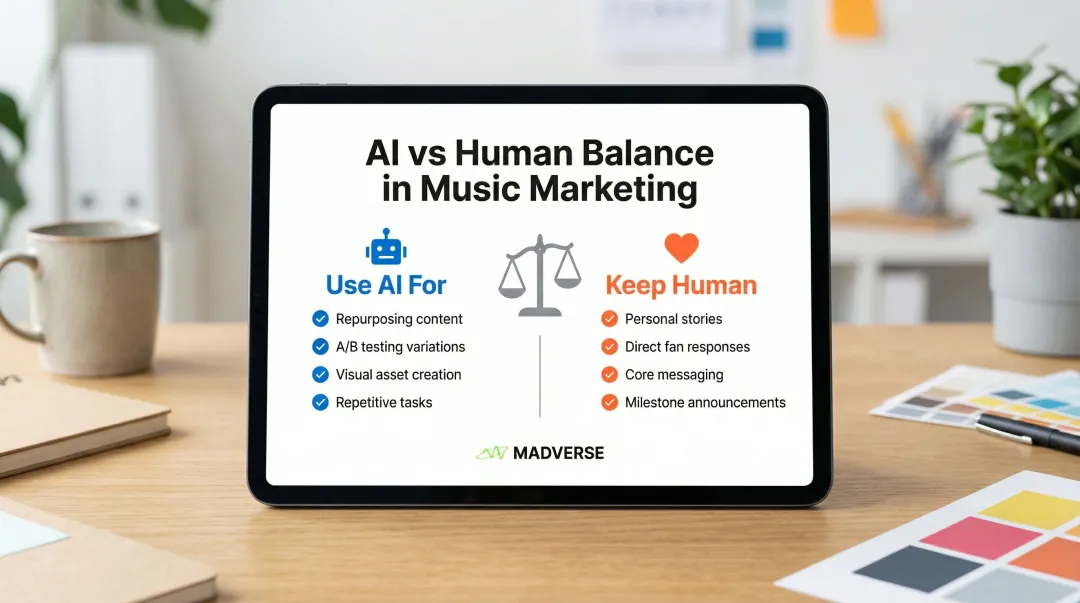
Balancing Automation with Authenticity
Use AI for:
- Repurposing content (turn one music video into 10 social clips)
- A/B testing with multiple ad copy variations
- Visual assets matching your established brand
Keep human:
- Personal stories and vulnerable moments with fans
- Direct responses to comments and messages
- Your core messaging and values
- Milestone announcements or life updates
AI is your backstage crew, not your voice. Let it handle repetitive tasks while you focus on what only you can create: genuine connection with listeners.
Measuring Success: Analytics and ROI
Key Performance Indicators for AI Marketing
Essential metrics:
- Streams, saves, playlist adds
- Follower growth rate
- Engagement rate (likes, comments, shares per post)
- Website traffic and email signups
- Cost per stream and cost per conversion
Dashboard framework:
- Daily: Ad spend and immediate engagement (clicks, video views)
- Weekly: Stream counts, follower growth, playlist adds
- Monthly: ROI calculation, audience changes, campaign performance comparison
Set realistic goals based on current audience size. If you have 1,000 monthly listeners, target 10-20% monthly growth as a sustainable benchmark.
Understanding Your Marketing ROI
Formula: (Revenue from streams/sales - Marketing costs) / Marketing costs × 100
Example: You spend ₹15,000 on ads, generating 50,000 streams at Spotify's rate of ₹225 per 1,000 streams = ₹11,250 in royalties. ROI = (₹11,250 - ₹15,000) / ₹15,000 × 100 = -25%
This looks negative, but consider lifetime value: those listeners may become fans who stream your entire catalog, buy merchandise, and attend shows.
One converted fan generates ongoing value far beyond initial streams.
Streaming rates (2024):
- Spotify: ₹225 per 1,000 streams
- YouTube: ₹360 per 1,000 streams
- Apple Music: ₹465 per 1,000 streams
- Amazon Music: ₹660 per 1,000 streams
Leveraging Advanced Analytics
Once you understand your ROI, use detailed analytics to refine your strategy. Platforms like Madverse provide audience demographics and performance data to inform marketing decisions.
Track geographic data to identify growth markets—if 30% of your streams come from Berlin, consider targeting German ads or planning tour dates there.
Sync licensing data offers additional insights: if your music is placed in TV shows or commercials, analyse which tracks attract licensing interest and create similar material.
Getting Started: Implementation Roadmap for Independent Artists
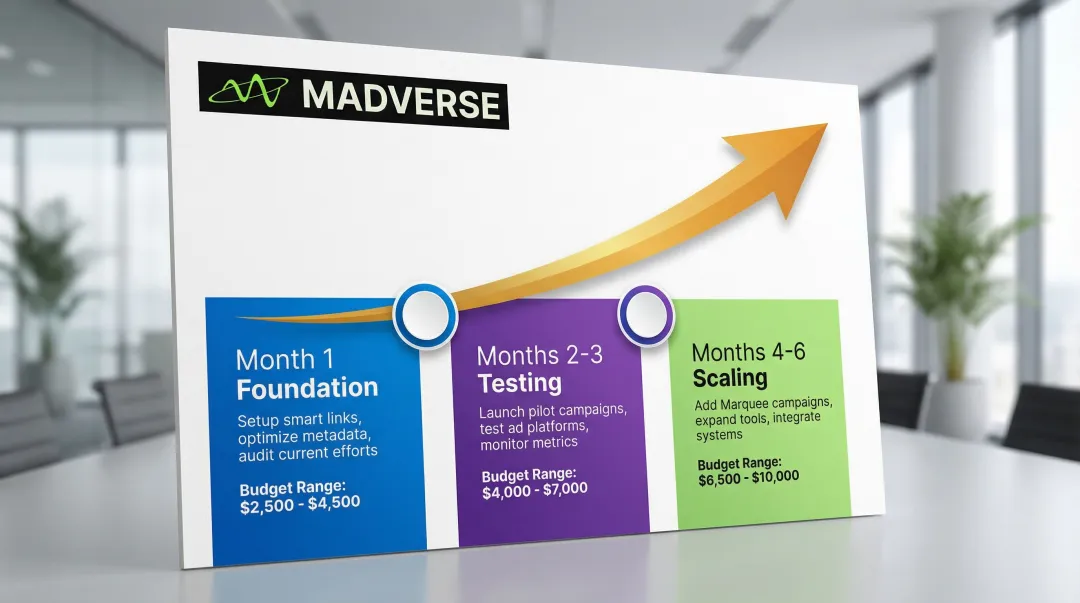
This three-phase roadmap helps you integrate AI marketing tools systematically, starting with free platforms and scaling as you see results.
Month 1: Foundation and Setup
Start with ₹0-4,000 using free tools like Feature.fm and Beacons.ai.
- Audit current marketing efforts: Where do streams come from? Which social posts drive engagement?
- Identify biggest gap: reach, content quality, engagement, or data visibility
- Set up centralized fan hub with smart links
- Ensure all metadata is optimized for algorithmic discovery
Months 2-3: Testing and Optimization
Invest ₹8,000-25,000 total, including Hypeddit Basic (₹800/mo) or Symphony Pro (₹1,600/mo) plus ₹8,000-16,000 in ad spend.
- Launch pilot campaigns testing different ad creatives (lyric videos, behind-the-scenes clips, performance footage)
- Test Meta Advantage+ for traffic objectives
- Monitor performance metrics and refine creative or targeting based on results
- Identify which platforms and content formats drive strongest engagement
Months 4-6: Scaling and Integration
Scale to ₹40,000+ monthly budget, adding Spotify Marquee campaigns and Runway Standard (₹1,000/mo).
- Reinvest streaming revenue into Marquee campaigns for new releases
- Expand tool stack based on proven results
- Create high-quality music videos or visualizers to sustain engagement
- Integrate multiple AI tools for comprehensive marketing: ads + content + analytics + fan engagement
What to expect:
- 15-25% monthly increase in streams
- 10-15% follower growth rate
- 500-1,000 new email subscribers per quarter
Frequently Asked Questions
Can I use AI to promote my music?
Yes, AI music promotion tools handle advertising, content creation, audience targeting, and analytics without requiring technical expertise—automating tasks that previously needed specialised teams.
Is it legal to use AI to make music?
AI-generated music is legal but has complex copyright considerations. This article focuses on using AI for marketing and promotion rather than music creation itself. For promotional assets, AI tools are fully legal and widely adopted.
Does Spotify ban AI music?
Spotify doesn't ban AI-assisted music but prohibits artificial streaming manipulation. As of late 2025, Spotify removed over 75 million "spammy" tracks and banned unauthorised vocal impersonation. AI marketing tools are allowed; fraudulent streaming is not.
How much does AI music marketing cost?
Entry-level tools start at $10-30/month, mid-tier platforms cost $50-200/month, and comprehensive suites run $200+/month. Add ad spend budget ($100-500/month) for paid campaigns. Many artists start with free tiers and scale as they see results.
What are the best AI tools for independent artists on a budget?
Feature.fm (free tier for smart links), Hypeddit Basic ($10/mo for AI-powered ads), Beacons.ai (free for link-in-bio and email marketing), and Runway Standard ($12/mo for video content). This stack costs $22/month plus ad spend.
Can AI replace traditional music marketing entirely?
No. AI enhances efficiency but can't replace authentic engagement, curator networking, fan relationships, and genuine storytelling. AI handles repetitive tasks while you provide the irreplaceable human connection that creates loyal fans.