
Introduction
In 2024, an average of 99,000 tracks were uploaded to streaming platforms daily, with independent artists now commanding 46.7% of the recorded music market's ownership share—worth $14.3 billion.
This shift has democratized music distribution—anyone can now release globally. Yet many musicians struggle with distribution costs that appear simple but quickly get complicated with hidden fees, royalty commissions, and add-on charges.
Music distribution pricing varies dramatically—from free services that take revenue commissions to premium platforms charging ₹6,999 annually, with hidden costs potentially doubling your initial budget.
Knowing these pricing structures helps you maximize royalty retention while minimizing recurring expenses in an increasingly saturated market.
This guide breaks down pricing models across major distributors, reveals hidden fees that catch artists off guard, compares subscription versus per-release costs, and helps you calculate the true cost of getting your music heard on platforms like Spotify, Apple Music, and YouTube.
TL;DR
- Distribution costs range from free plans to ₹8,400/year depending on features and release volume
- Pricing models split between per-release fees (₹830-4,150 per single/album) and unlimited annual plans (₹1,660-8,300/year)
- Watch for hidden costs: YouTube Content ID monetization, collaboration split fees, and cover licensing charges
- Choose budget distributors for 1-2 annual releases; premium services pay off for frequent releasers and labels
- Cheapest rarely means best value—compare royalty retention, support quality, and cumulative costs
How Much Does Music Distribution Cost? (Pricing Overview)
Music distribution has no fixed price, ranging from ₹0 to several thousand rupees annually depending on your release strategy, feature needs, and career stage. The complexity lies not in the headline subscription price but in understanding what's included, what costs extra, and how different pricing models affect your long-term earnings.
Common mistakes cost artists hundreds to thousands of rupees annually. These include underbudgeting for essential features like YouTube monetization, choosing the wrong pricing model for release frequency, and getting locked into unfavorable royalty splits.
Understanding the three main pricing tiers helps you match costs to your career stage and release needs.
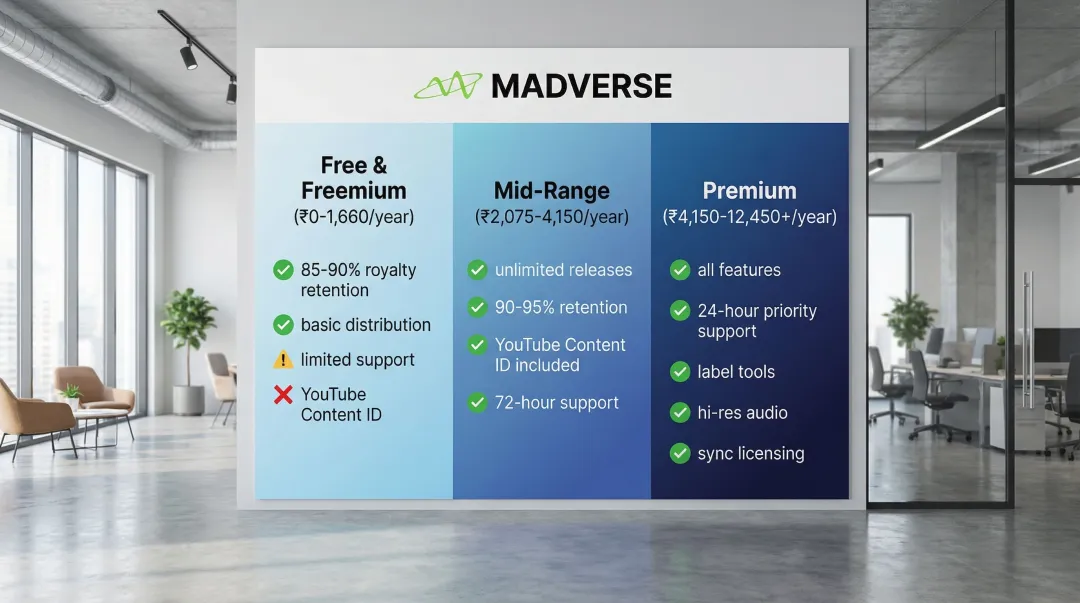
Free and Freemium Plans (₹0-1,660/year)
Core Features:
- Distribution to Spotify, Apple Music, Amazon Music
- 85-90% royalty retention after platform fees
- Basic analytics and 14-21 day processing
- Limited customer support
Missing Features: YouTube Content ID, priority support, royalty splits, expedited processing, cover licensing
Ideal For: Solo artists releasing 1-2 tracks annually who prioritize zero upfront cost over advanced features.
Mid-Range Subscription Plans (₹2,075-4,150/year)
This tier unlocks unlimited releases and broader monetization:
Included:
- Unlimited releases to 100+ platforms
- 90-95% royalty retention
- YouTube Content ID monetization
- Pre-save links and basic royalty splits
- 72-hour customer support, 14-day processing
Not Included: Priority support, label tools, hi-res audio (Dolby Atmos), sync licensing access
Who Benefits: Active artists releasing 3+ tracks yearly who need YouTube monetization and reliable platform support.
Premium and Professional Plans (₹4,150-12,450+/year)
Professional-grade features for labels and high-output artists:
Full Feature Set:
- All mid-range features plus 24-hour priority support
- Label roster management (unlimited artists)
- Custom branding and team collaboration
- Hi-res audio distribution (Dolby Atmos)
- YouTube Official Artist Channel setup
- Free cover licensing and 7-day processing
- Editorial playlist pitching
- Sync licensing opportunities
- Advanced analytics and reporting
Enterprise-Only Features: Dedicated account managers, custom distribution deals, marketing campaign budgets (application-based)
Target Users: Emerging labels managing multiple artists, established musicians with frequent releases, teams needing collaboration tools and rapid turnaround.
Key Factors That Affect the Cost of Music Distribution
Distribution pricing depends on your release frequency, team size, feature requirements, and long-term career goals—not just the sticker price on a plan.
Understanding these factors helps you calculate the true cost of ownership and select the most cost-effective option for your situation.
Distribution Model: Per-Release vs. Subscription
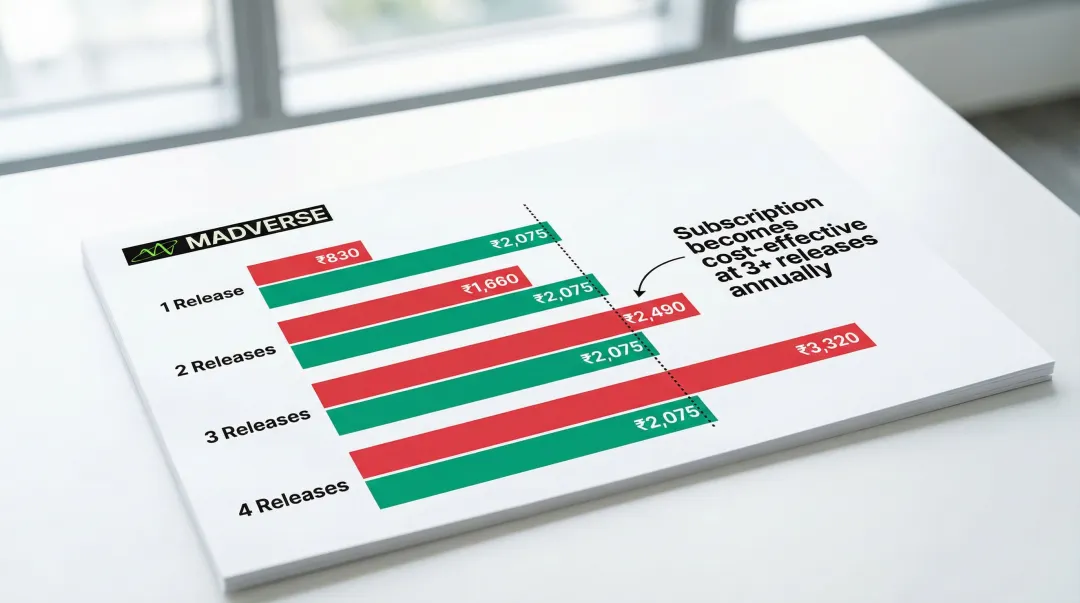
Per-release pricing (₹830-4,150 per single/album) benefits artists with infrequent releases—if you're releasing just 1-2 tracks yearly, paying ₹830 per single totals ₹1,660 annually, which can be cheaper than some subscription plans.
This model becomes expensive quickly for prolific creators. Releasing 3 singles at ₹830 each costs ₹2,490, while unlimited annual subscriptions (₹1,660-8,300/year) offer better value for artists releasing 3+ tracks annually.
Break-even calculation example:
- CD Baby charges ₹830 per single plus 9% commission on earnings
- DistroKid charges approximately ₹2,075/year for unlimited releases
- At 3 singles yearly: CD Baby costs ₹2,490 upfront (before commission) vs. DistroKid's ₹2,075 flat fee
- Conclusion: 3+ releases annually favor subscription models
Number of Artists and Team Collaboration
Beyond release frequency, team size directly impacts your distribution budget.
Managing multiple artist profiles significantly impacts pricing. Most distributors charge per artist (₹1,660-3,320 each) or offer tiered plans:
- 1 artist: ₹1,660-2,905/year
- 2 artists: ₹3,735-4,980/year
- Unlimited artists: ₹8,300/year (label plans)
Additional costs arise for team collaboration features like manager access, royalty splitting, and shared analytics.
Platforms like Madverse offer unlimited artist management at ₹6,999 annually, making them cost-effective for labels compared to per-artist pricing that scales linearly.
Royalty Retention Rates and Commission Structures
Distributors structure their revenue take differently, significantly impacting long-term earnings:
- 100% royalty models: Charge subscription fees but let you keep all streaming revenue (DistroKid, TuneCore, Madverse Star/Label plans)
- Commission-based models: Free or low-cost upfront but take 10-15% of your earnings (CD Baby takes 9%, AWAL takes 15%, RouteNote's free plan takes 15%)
- Hybrid models: Keep DSP royalties but take commissions on YouTube/social revenue (TuneCore takes 20% of social platform revenue)
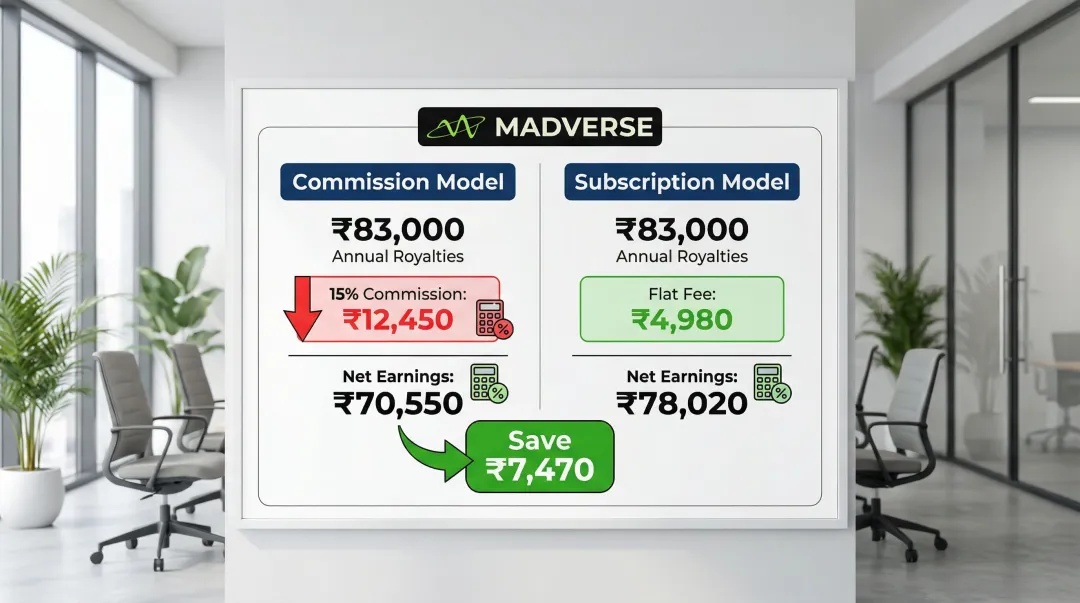
Real-world impact calculation: On ₹83,000 annual royalties:
- 15% commission costs ₹12,450 annually
- 9% commission costs ₹7,470 annually
- ₹4,980 subscription with 100% retention saves ₹2,490-7,470 compared to commission models
The break-even point for CD Baby's 9% commission versus a ₹2,075 subscription occurs at just ₹23,055 annual earnings (approximately 92,500 streams at ₹0.25 per stream).
YouTube Content ID and Monetization
YouTube monetization represents a significant hidden cost multiplier for video-focused artists. Pricing structures vary dramatically:
- Flat fee models: ₹415-1,660 annually per release
- Revenue commission models: 15-30% of all YouTube ad revenue
- Bundled models: Included free in premium plans
Cost comparison example: An artist earning ₹1,66,000 annually from YouTube Content ID faces these scenarios:
- 20% commission model: ₹33,200 annual cost
- 30% commission model: ₹49,800 annual cost
- ₹1,660 flat fee: ₹1,660 annual cost
- Free with premium plan: ₹0 additional cost
Artists generating significant YouTube revenue benefit most from platforms bundling Content ID free. Madverse Star at ₹2,905/year with 95% royalty retention delivers substantially better value than commission-based alternatives.
Support Quality and Processing Speed
Support tiers directly affect pricing and can impact revenue during critical release windows:
- Basic plans: 5-7 day email responses, 14-21 day distribution processing
- Mid-tier plans: 72-hour support, 14-day releases
- Premium plans: 24-hour priority support, 7-day distribution
Time-sensitive releases matter. Holiday albums, trending topics, and sync opportunities all have narrow windows.
The ₹1,245-2,490 annual premium for faster processing justifies the cost when a delayed release could cost you far more than the subscription upgrade.
Hidden Costs and Fee Structures Musicians Often Miss
The advertised subscription price rarely tells the complete cost story. Add-ons, collaboration fees, and exit penalties can double your actual annual spend—turning a ₹2,000 plan into a ₹4,000+ reality.
Common hidden costs include:
- YouTube Content ID fees of ₹415-1,660 per release or 15-20% revenue commission
- Cover song mechanical licensing at ₹995-1,245 per track
- "Leave a Legacy" fees: ₹2,490-4,150 per release to keep music live after cancellation
- Collaboration fees running ₹830 annually per collaborator, or 10-15% deductions for non-members
- Expedited distribution upgrades: ₹830-2,490 for rush releases
- Additional artist profiles costing ₹1,660-3,320 when you exceed plan limits
These charges stack quickly once you move beyond basic single releases.
Real-World Cost Comparison
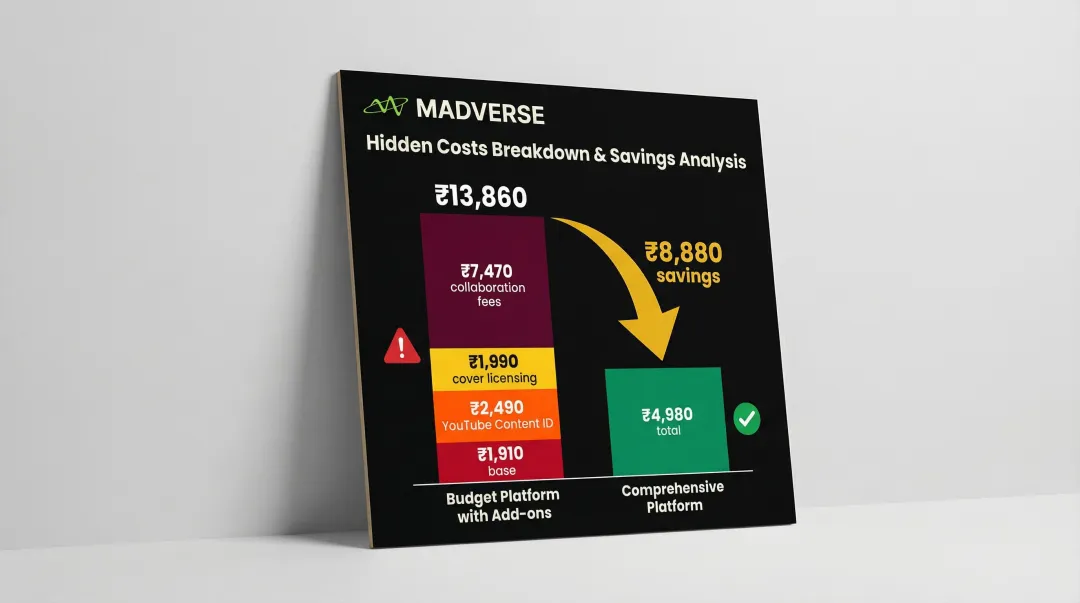
An artist releasing 6 singles annually with 2 collaborators on a "budget" platform might pay:
- ₹1,910 base subscription
- ₹2,490 YouTube Content ID (6 releases × ₹415)
- ₹1,990 cover licensing (2 covers × ₹995)
- ₹7,470 collaboration fees (15% × ₹49,800 earned by collaborators)
- Total: ₹13,860
Compare this to ₹4,980 on a comprehensive platform like Madverse that includes YouTube Content ID, royalty splits, and 95% retention—a savings of ₹8,880 annually.
The "Free" Plan Trap
Distributors offering free distribution with 15% commission seem attractive at first, but the math quickly turns unfavorable. On ₹41,500 annual earnings (modest for active artists), a 15% commission costs ₹6,225 annually versus a ₹4,980 premium subscription that includes all features.
Once you earn even ₹27,650 annually, the commission exceeds most mid-tier subscription costs.
Comparing Distribution Models: Finding the Right Fit
Different business models in music distribution serve different artist needs. Understanding these models helps you match your release strategy and career stage to the most cost-effective platform.
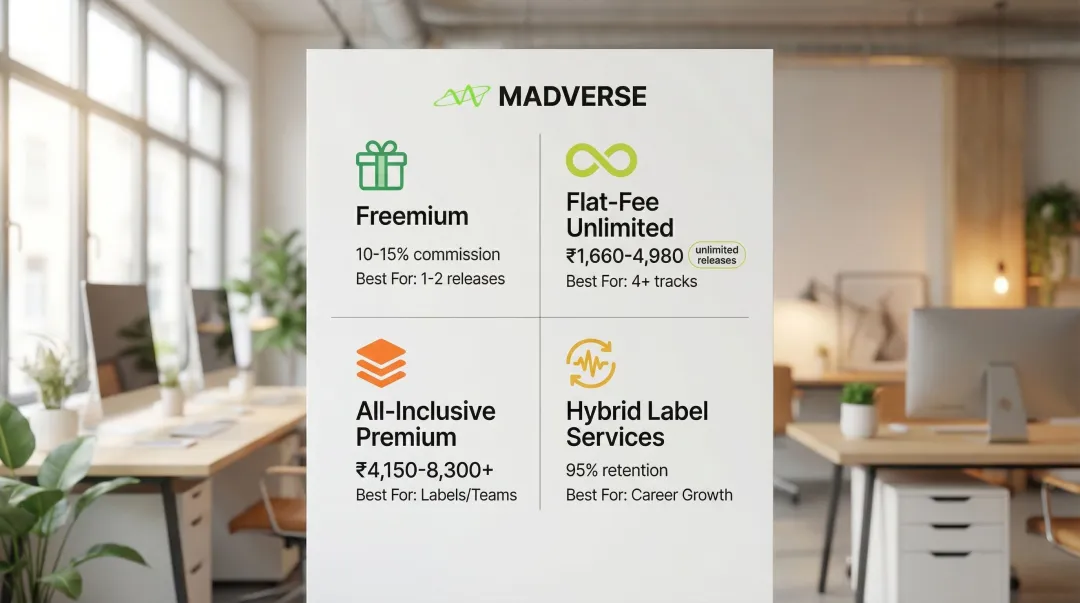
Freemium Distributors (Free with paid upgrades)
How they work: Free basic distribution in exchange for royalty commissions (10-15%) or limited features, with premium tiers unlocking full feature sets.
Best for:
- Artists just starting out with 1-2 releases
- Musicians testing platform quality before committing financially
- Those with limited upfront budget
Watch out for: Royalty commissions that exceed subscription costs after moderate success, limited support on free tiers, features held hostage behind paywalls, 5-day support response times.
Flat-Fee Unlimited Platforms (₹1,660-4,980/year)
Single annual payment covers unlimited releases to all major platforms with 90-100% royalty retention. Add-on fees apply for premium features.
Ideal for:
- Prolific artists releasing 4+ tracks yearly
- Musicians who want predictable costs
- Artists prioritizing speed and simplicity
Potential drawbacks: Add-on costs that accumulate (YouTube, splits, covers, legacy fees), variable support quality, lack of career development support beyond distribution.
All-Inclusive Premium Services (₹4,150-8,300+/year)
Higher subscription includes advanced features bundled—YouTube Content ID, hi-res audio, priority support, royalty splits, team tools—often with label management capabilities.
Best for:
- Serious independent artists building long-term careers
- Small labels managing rosters
- Teams requiring collaboration tools
- Musicians valuing comprehensive support and faster processing
Watch out for: Paying for features you don't use if you're a solo artist with basic needs, slightly higher entry cost (though often better total cost of ownership when calculating all add-ons).
Hybrid Distribution + Label Services
Distribution platform with data-driven talent identification that offers licensing deals, funding, marketing support, and career development to artists showing momentum. Some platforms (like Madverse) combine high royalty retention (95%) with sync licensing opportunities for TV, movies, commercials, and video games, plus editorial playlist pitching and professional support.
Best for: Ambitious artists seeking career acceleration, musicians interested in sync placements, artists wanting professional guidance without surrendering ownership.
Watch out for: Some advanced features may require application or minimum streaming thresholds. Platforms often reserve premium services for artists demonstrating consistent growth and engagement.
How to Choose the Right Distribution Service for Your Budget
The "best" distributor isn't the cheapest or most expensive—it's the one that aligns with your release frequency, career stage, feature needs, and long-term goals while delivering genuine value for your investment.
Calculate Your Break-Even Point
Start by multiplying your annual release frequency by per-release costs to determine when subscriptions become more cost-effective. Example: 4 singles at ₹830 each = ₹3,320 annually, making a ₹2,905 unlimited subscription the better value. This calculation becomes even more favorable at 5+ releases yearly.
Evaluate Essential vs. Optional Features
Once you understand the cost structure, assess which features justify higher pricing:
- Heavy YouTube monetization? YouTube Content ID becomes non-negotiable
- Frequent collaborations? Free royalty splits save hundreds annually in manual payment fees
- Time-sensitive releases? 7-day distribution justifies premium pricing over standard 2-3 week timelines
- Pursuing sync licensing? Access to TV, film, and commercial opportunities creates additional revenue streams
Consider Team Size and Collaboration Needs
Your team structure significantly impacts which platform delivers the best value.
Solo artists can often use basic plans effectively. However, bands and manager-artist teams benefit significantly from platforms offering free collaboration tools, multiple user access, and automated royalty splitting.
A 4-member band paying ₹830 per collaborator annually (₹2,490 total) should consider platforms bundling splits free.
What Most Musicians Miss When Budgeting for Distribution
Most artists focus on finding the cheapest distribution option, but three common oversights turn "budget-friendly" choices into expensive mistakes:
Focusing only on headline subscription prices
Artists compare upfront costs (₹1,660 vs. ₹2,905) without calculating total ownership expenses over 12 months. The reality? That ₹1,660 plan may cost ₹8,300 after add-ons, collaboration fees, and YouTube commissions. Meanwhile, the ₹2,905 plan includes everything from the start.
Ignoring how commission structures scale
"Free" plans taking 15% commission cost significantly more than paid subscriptions once you earn modest streaming income. A 15% commission on ₹24,900 annual royalties costs ₹3,735 versus a ₹2,905 subscription. As your earnings grow, the gap widens dramatically.
Underestimating the cost of poor support
Choosing the cheapest option without evaluating support quality leads to lost money when technical issues delay releases. Support tickets going unanswered for weeks during critical launch windows have real consequences. A delayed release missing a playlist deadline or trending moment can cost far more than the ₹1,245 annual premium for priority support.
Conclusion
Music distribution costs vary from ₹0 to ₹12,450+ annually depending on your needs. However, the true cost often includes hidden fees for YouTube, collaborations, and add-ons that can double the advertised price.
Smart distribution decisions start with understanding:
- Total cost of ownership — not just the base subscription fee
- Pricing model alignment — per-release vs. annual plans based on your release frequency
- Feature-to-career matching — paying only for tools you'll actually use at your current stage
The "right" cost balances affordability with essential features, reliable support, and fair royalty structures. Quality distribution delivers faster releases, better support, and lets you keep more of what you earn. For most active independent artists, mid-tier plans (₹2,075-4,980 annually) with 90-95% royalty retention, unlimited releases, and bundled features deliver the strongest value.
Platforms like Madverse exemplify this sweet spot, offering 95% royalty retention, royalty splits at source, and comprehensive distribution tools without the premium price tag. Your distribution partner should grow with your career, providing the infrastructure you need today while supporting your ambitions for tomorrow.
Frequently Asked Questions
How much does music distribution typically cost for independent artists?
Costs range from free plans with royalty commissions to ₹1,660-4,980 annually for basic features, up to ₹8,300+ for premium services. Most independent artists spend ₹2,490-4,980 yearly for mid-tier distribution with 90-95% royalty retention.
Is free music distribution worth it or should I pay for a subscription?
Free plans work for testing with 1-2 releases, but paid subscriptions (₹2,075-4,980/year) deliver better value for regular releases. Commission-based services cost more than subscriptions after earning just ₹16,600-23,055 annually.
What hidden costs should I watch out for with music distributors?
Watch for YouTube Content ID fees (₹415-1,660 per release), cover song licensing (₹995-1,245 each), collaboration split fees (₹830/year), "legacy" fees to keep music live after canceling (₹2,490-4,150), and expedited processing charges.
How do I calculate the true cost of music distribution?
Start with base subscription cost, add YouTube Content ID fees for all releases, include cover licensing and collaboration split fees if applicable, then compare against commission-based alternatives using your projected earnings.
When is it worth paying for premium music distribution?
Premium distribution (₹4,150-8,300+/year) justifies the cost when managing multiple artists, releasing frequently (6+ times yearly), or needing advanced features like sync licensing, Dolby Atmos, and editorial playlist pitching that generate additional revenue.
Do music distributors take a percentage of my royalties?
Business models vary: some charge subscriptions and let you keep 90-100% of royalties, others offer free distribution but take 10-15% commission, while some take cuts only on specific streams like YouTube Content ID (15-30%). Always read the fine print on royalty retention rates.