
Introduction
Most independent artists lose 15-30% of their royalties to traditional distributors—while surrendering brand control and professional distribution tools. Traditional platforms force you to choose between global reach and maintaining your identity as an independent label.
White label music distribution reverses this model. It provides ready-made infrastructure that lets you operate as your own distribution entity while keeping 85-95% of your earnings.
Independent labels and artists now command 46.7% of global recorded music ownership revenue, generating USD $14.3 billion in 2023. This shift represents a massive opportunity for artists who want to build sustainable label operations.
Yet most artists still rely on distributors that limit their control and take significant revenue cuts.
This guide covers:
- What white label distribution is and how the infrastructure works
- Specific benefits for independent artists building labels
- How it compares to traditional distribution models
- Types of white label solutions available
- Critical factors for choosing the right platform
TLDR: Key Takeaways
- White label distribution lets you distribute music under your own brand without building infrastructure
- Keep 85-95% of royalties vs. 70-85% with traditional distributors
- Ideal for artists building labels, collectives managing rosters, or independents seeking operational control
- Platforms like Madverse include roster management, automated splits, Dolby Atmos, and YouTube Content ID
- Evaluate DSP reach, features, pricing, and scalability before choosing a platform
What is White Label Music Distribution
White label music distribution is a ready-made digital system that enables artists, labels, or companies to offer music distribution services under their own brand name without building the technology from scratch.
The term "white label" refers to a business model where the provider's branding is completely removed. You present the service as your own—similar to how generic products are rebranded by retailers before reaching consumers.
This model contrasts sharply with traditional distribution. Instead of distributing through DistroKid or TuneCore (where those brands remain visible to your artists), you operate as your own distribution entity with complete control.
Your artists interact exclusively with your brand, building loyalty and credibility within your ecosystem rather than the underlying technology provider's.
Typical white label packages include:
- Distribution to 100+ DSPs including Spotify, Apple Music, Amazon Music, and TikTok
- Royalty collection and automated accounting systems
- Metadata management with DDEX ERN 4.3 compliance
- Analytics dashboards with territory-level data
- Artist portals for upload and release management
- Administrative tools for roster and contract management
Who benefits most from white label distribution?
This service makes most sense for independent artists building label operations, music collectives managing multiple artists, established artists with rosters, managers handling several acts, and small labels wanting professional infrastructure without enterprise-level investment.
Solo artists releasing only their own music typically benefit more from traditional distribution unless they plan to expand into label operations within 12-18 months.
How White Label Distribution Works
Technical Infrastructure
The white label provider maintains direct relationships with all major DSPs and handles the complex technical requirements behind the scenes.
Key technical standards include:
- DDEX ERN 4.3 protocol compliance for metadata delivery
- 16-bit or 24-bit LPCM audio encoding at 44.1kHz or higher
- ISRC/UPC identifier management for proper tracking and royalty attribution
Branding Customization
Once the technical backbone is in place, the platform becomes yours visually. You receive a web-based system (often with mobile app options) that carries your logo, colors, and brand identity throughout the user experience.
Artists upload music to your branded portal, receive analytics through your dashboard, and interact with your support team. The underlying technology provider remains invisible to end users, allowing you to build brand equity and artist loyalty directly.
The Workflow
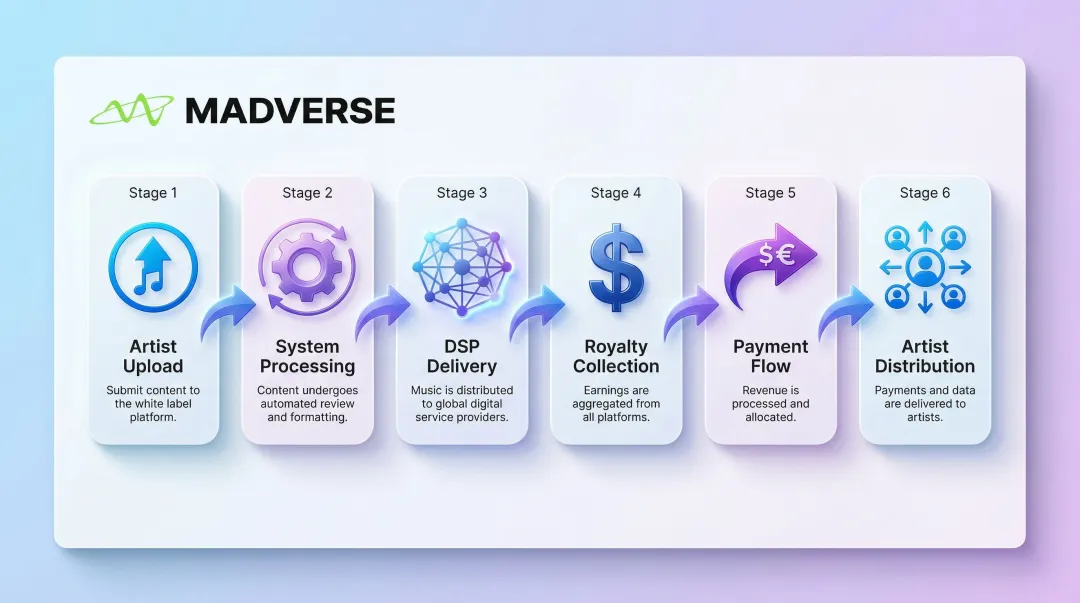
The operational flow follows this sequence:
- Artists upload music to your branded portal with metadata and artwork
- Your system processes files and validates technical specifications
- Your system delivers releases to DSPs using industry-standard protocols
- Streams generate royalties collected by the white label provider
- Payments flow through your infrastructure
- You distribute earnings to artists according to your deal terms
Business Model
White label platforms typically operate on SaaS pricing structures:
- Monthly or annual fees ranging from $59 to $500+ USD
- Per-release fees for some providers
- Small revenue percentages (5-15%)
Research shows that white label becomes cost-effective once monthly streaming revenue exceeds approximately $2,000 USD, making the fixed-cost model more profitable than traditional percentage-based commissions.
Legal and Administrative Responsibilities
As the distributor of record, you assume legal responsibility for rights clearance, artist contracts, royalty splits, tax documentation (including region-specific forms like 1099s in the US), and relationship management.
This means operating as a business entity—typically an LLC, corporation, or sole proprietorship—and maintaining proper documentation for all artist agreements and financial transactions.
Benefits for Independent Artists
Higher Royalty Retention
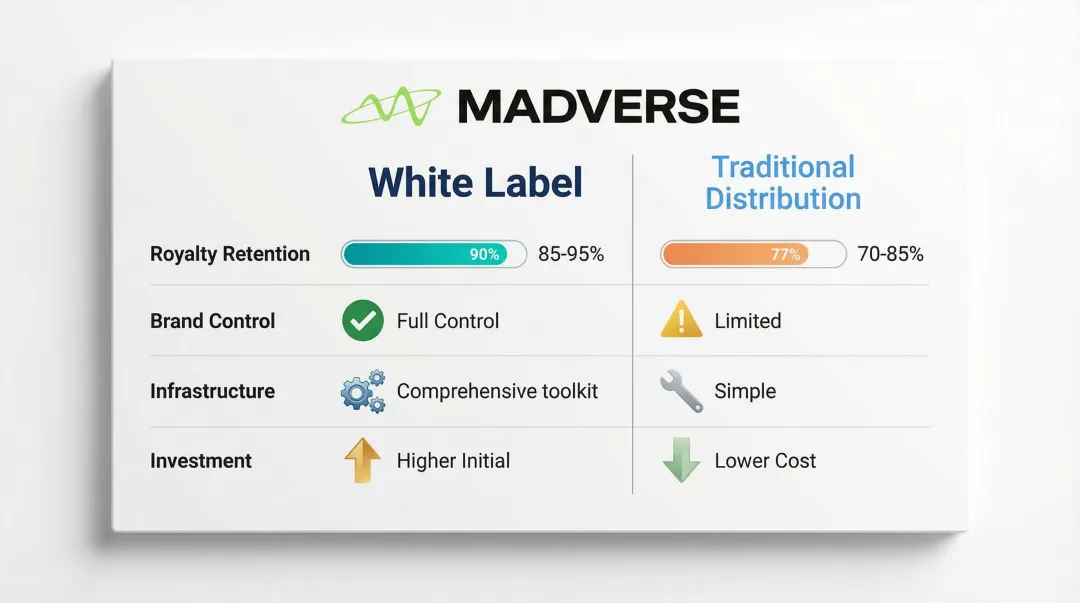
White label models allow you to keep 85-95% of master recording royalties, compared to 70-85% with traditional distributors. This difference compounds significantly over time.
For example, on ₹8,00,000 in monthly streaming revenue, a traditional distributor taking 20% costs you ₹1,92,000 annually. A white label platform charging ₹16,000/month costs roughly the same—but you control 100% of the remaining revenue to split with artists on your terms.
Complete Brand Control
Beyond financials, white label platforms let you own the artist relationship completely.
Present a professional, cohesive brand identity across every artist interaction—from distribution portals to analytics dashboards to payment notifications. This builds credibility with artists and creates loyalty to your label rather than a third-party distributor.
Artists see your brand exclusively, strengthening your position as a legitimate label operation rather than just another intermediary.
Professional Label Infrastructure
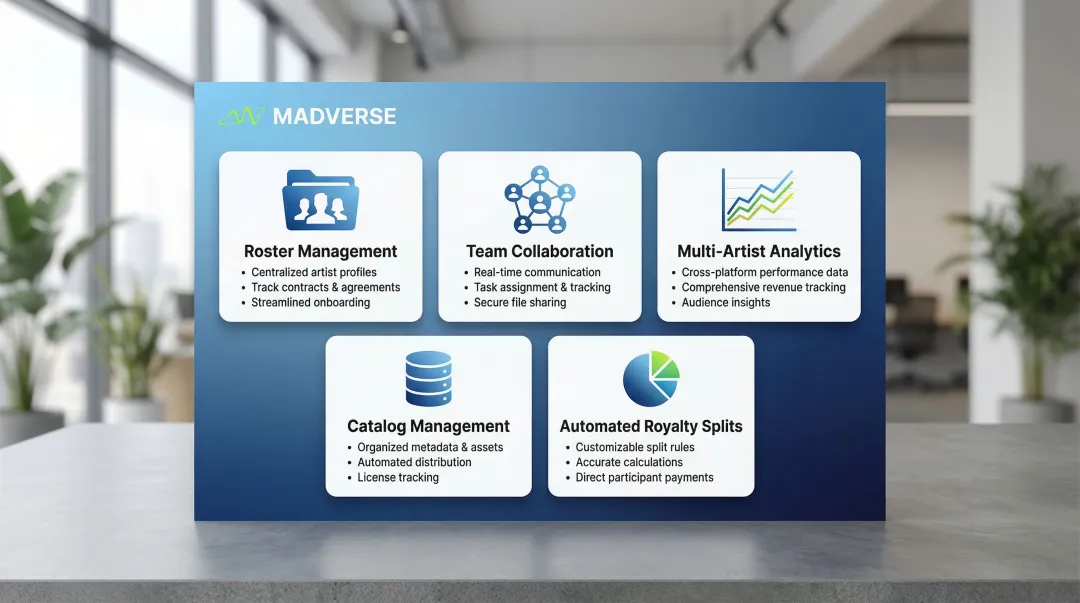
The right white label platform gives you tools previously available only to established labels:
- Track all artists in one centralized roster management dashboard
- Allow different departments to access relevant data through team collaboration features
- Compare performance across your catalog with multi-artist analytics
- Update multiple releases simultaneously with centralized catalog management
- Split payments at source through automated royalty accounting
This infrastructure level—including comprehensive roster management, advanced analytics, and team collaboration—transforms how you operate as a label.
Flexible Deal Structures
White label freedom extends to deal structures. Design custom royalty splits, advance terms, and contract structures for each artist without being constrained by a distributor's standard terms.
Common arrangements include:
- 50/50 net profit deals for developing artists
- 80/20 (artist favor) distribution-only deals for established acts
- Custom splits based on marketing investment and A&R support provided
- Hybrid models combining distribution, marketing, and publishing
Scalability and Growth
Perhaps most importantly, white label infrastructure scales with your ambitions.
Start with a few releases and scale to managing dozens of artists without changing platforms or losing historical data. The infrastructure grows with your operation, maintaining consistent workflows and preserving streaming analytics, playlist placements, and audience insights as you expand your roster.
White Label vs Traditional Distribution Models
| Feature | White Label Distribution | Traditional Distribution |
|---|---|---|
| Royalty Split | 85-95% to rights holder | 70-85% to artist |
| Branding | Your brand exclusively | Distributor's brand visible |
| Features | Full label management tools | Basic artist tools |
| Pricing Model | Monthly/annual SaaS fees (₹5,000-40,000+) | Per-release fees or annual subscriptions (₹2,000+) |
| Upfront Investment | Higher (setup fees, monthly costs) | Lower (pay-as-you-go options) |
| Target Users | Labels, collectives, multi-artist operations | Solo artists, occasional releases |
| Customization | Custom pricing, domain control, branded portals | Standardised service offerings |
| Control Level | Full operational control | Limited to distributor's systems |
Pricing Comparison
Understanding the cost structure differences helps you choose the right model for your situation.
Traditional distributors like DistroKid charge ₹2,000/year for unlimited uploads, making them highly cost-effective for solo artists. Traditional deals may take 15-30% commission on net revenue, which becomes expensive as revenue scales.
White label platforms require upfront investment but become more economical at higher revenue levels. A ₹5,000/month platform (₹60,000/year) breaks even against a 15% commission once annual revenue exceeds about ₹4 lakh—a threshold many active independent labels reach within their first year.
When to Choose Each Model
Choose traditional distribution if:
- You're a solo artist releasing primarily your own music
- Your release frequency is low (1-4 releases annually)
- You want minimal administrative overhead
- Your annual streaming revenue is under ₹4 lakh
Choose white label distribution if:
- You're managing 3+ artists or plan to within 12 months
- You want to build a recognisable label brand
- Your combined roster generates ₹4 lakh+ annually
- You need professional tools for roster and royalty management
Types of White Label Solutions
Full White Label Platforms
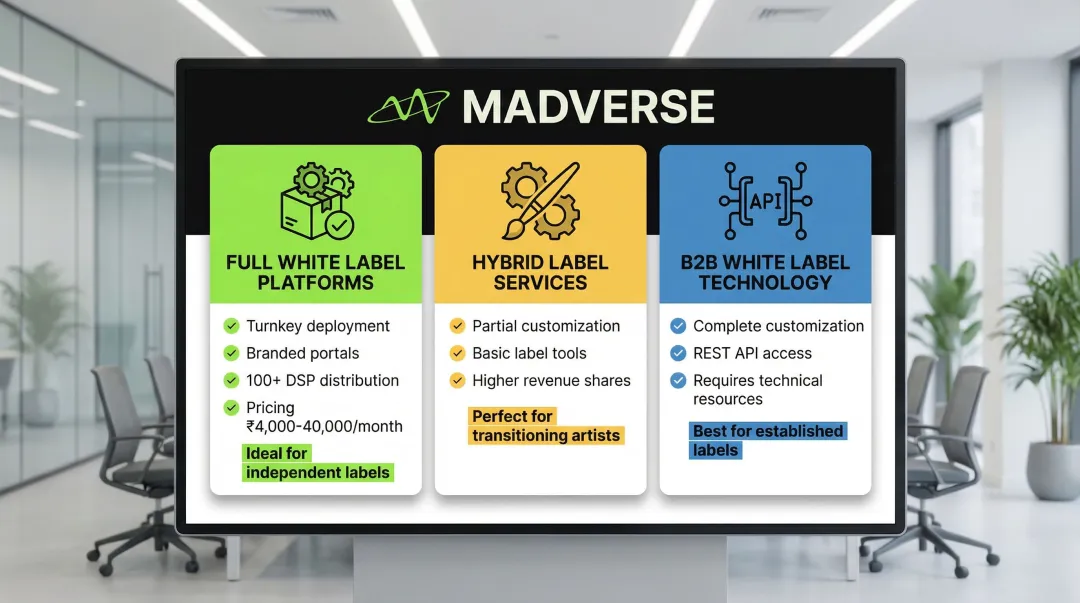
Comprehensive solutions like Madverse provide complete infrastructure including branded portals, roster management, distribution to 100+ DSPs, automated royalty accounting, and advanced analytics.
These turnkey solutions require no custom development and deploy immediately.
Typical pricing: Monthly or annual subscriptions ranging from ₹4,000-40,000/month depending on features, release volume, and number of artists managed. Madverse's Label plan, for example, offers unlimited artist management for ₹8,000/year while allowing labels to retain 95% of royalties.
Ideal for: Independent labels, music collectives, and artist managers who want immediate deployment without technical complexity.
Hybrid Label Services
Some platforms offer white label features combined with traditional distribution services. These solutions sit between consumer-facing distributors and full white label infrastructure, offering:
- Partial customization and basic label tools
- Provider branding that may remain partially visible
- Higher revenue shares than pure white label models
- Multi-artist dashboards with basic branding options
Examples: Traditional distributors offering "label accounts" with multi-artist dashboards and basic branding options, but without complete infrastructure control or domain customization.
Works well for: Artists transitioning from solo operations to small label management who want some branding control without full white label investment.
B2B White Label Technology
Enterprise solutions like LabelGrid and OpenPlay offer API-led platforms where technology providers license their distribution backend to larger operations. These provide complete customization, REST API access for custom integration, and full technical control, but require substantial technical resources and development investment to implement.
Best for: Established labels with technical teams, distributors building proprietary front-end experiences, or companies requiring deep integration with existing business systems.
Choosing the Right White Label Platform
Evaluate Your Current Stage and Needs
Assess your catalog and release frequency:
- How many releases do you plan annually—5 or 50?
- How many artists are currently on your roster?
- What's your growth projection for the next 12-24 months?
Determine your financial runway:
- Can you sustain monthly platform fees before releases generate income?
- What's your break-even point based on expected streaming revenue?
- Do you have capital for setup fees and initial investment?
Your platform should include:
- Multi-artist dashboards with centralized control
- Individual artist portals for self-service uploading
- Contract and agreement management tools
- Automated royalty splits at source
- Bulk catalog management and metadata editing
Analytics and Reporting
The platform should provide:
- Territory-level data showing where your music performs geographically
- Playlist tracking to monitor editorial and algorithmic placements
- Trend analysis identifying growth patterns
- Exportable reports for transparent artist communication
Integration and Advanced Features
Essential integrations include:
- Team collaboration tools allowing different staff members appropriate access levels
- Dolby Atmos support for spatial audio distribution
- YouTube Content ID for monetizing user-generated content
- API access if you need custom integrations with existing systems
- Migration support for transferring existing catalogs from other distributors
Technical Compliance
DDEX compliance is essential. Platforms must support current ERN versions (4.2/4.3) to ensure seamless delivery to major DSPs.
Without proper technical standards, you risk delivery failures, delayed releases, and streaming count preservation issues during catalog migrations.
Frequently Asked Questions
What's the difference between white label distribution and starting my own distribution company?
White label uses existing infrastructure and DSP relationships, saving years of development time. Starting from scratch requires building technology, negotiating with every DSP individually, and typically lakhs of rupees in capital investment over 2-3 years.
How much does white label music distribution typically cost?
Monthly fees range from ₹4,000-40,000 depending on features and volume, with some platforms charging per-release fees or taking 5-15% revenue share. Setup costs typically add ₹20,000-40,000 initially.
Do I need a business entity or label to use white label distribution?
Most white label platforms require you to operate as a business—LLC, corporation, or sole proprietorship—since you're acting as the distributor of record. This means handling tax documentation (1099s, VAT), artist contracts, and proper financial accounting for all royalty distributions.
Can I migrate my existing catalog to a white label platform?
Yes, but migration typically takes 2-4 weeks per release and requires careful planning. You must remove releases from your current distributor, then re-deliver through your white label platform with strict ISRC/UPC matching to preserve streams and playlists.
What royalty split should I offer artists on my white label platform?
Competitive independent deals range from 50/50 (net profit deals with full services) to 80/20 (artist favor for distribution-only deals). Industry benchmarks show that 95/5 (artist favor) is common for pure distribution, while 70/30 or 60/40 is typical when providing marketing, advances, and A&R support. Transparency is key to building lasting artist relationships.
Is white label distribution worth it for solo artists or only for labels?
White label makes most sense when managing multiple artists or building a label brand. Solo artists releasing only their own music typically benefit more from traditional distribution's lower upfront costs unless they plan to expand into label operations within 12-18 months. The break-even point usually requires managing 3+ artists with combined revenue exceeding ₹4,00,000 annually.