Introduction: Demystifying Music Publishing for Independent Artists
Your song just hit 500,000 streams on Spotify. The royalty statement arrives, but the numbers don't match your expectations. Where's the rest of your money?
This confusion costs independent artists thousands in uncollected royalties each year. The culprit? A lack of understanding about music publishing fundamentals.
According to the Independent Music Publishers' Forum, the global music publishing market was valued at $10.6 billion (approximately ₹88,200 crores) in 2023. This represents a massive revenue stream distinct from recorded music earnings. Yet most artists focus solely on distribution while leaving publishing royalties uncollected.
This guide breaks down music publishing in plain language: what it is, how royalties flow, which deals make sense for independent artists, and the industry secrets publishers don't advertise.
Whether you're releasing your first single or managing a growing catalog, understanding publishing is essential to collecting the royalties you've earned.
TLDR:
- Music publishing manages composition rights (lyrics/melody), separate from master recordings
- Three main royalty types: mechanical (streams/sales), performance (radio/venues), and sync (TV/film)
- Publishing deals range from 50/50 traditional splits to 10-15% admin fees with full ownership retention
- The Big 3 publishers control 60.6% of the market, but independent artists can self-publish effectively
- Payment timelines lag 6-18 months; royalty-splitting tools help track earnings efficiently
What Is Music Publishing? Understanding the Basics
The Business of Songwriting Rights
Music publishing is the business of managing, protecting, and monetizing musical compositions—the underlying song itself, not the recording. While distribution handles getting your recording onto Spotify or Apple Music, publishing ensures you're paid whenever someone uses your lyrics and melody.
Think of it this way: If you cover someone else's song and upload it to streaming platforms, you need permission from the music publisher (who controls the composition rights), not the record label (who controls the original recording). These are two separate copyrights in every song.
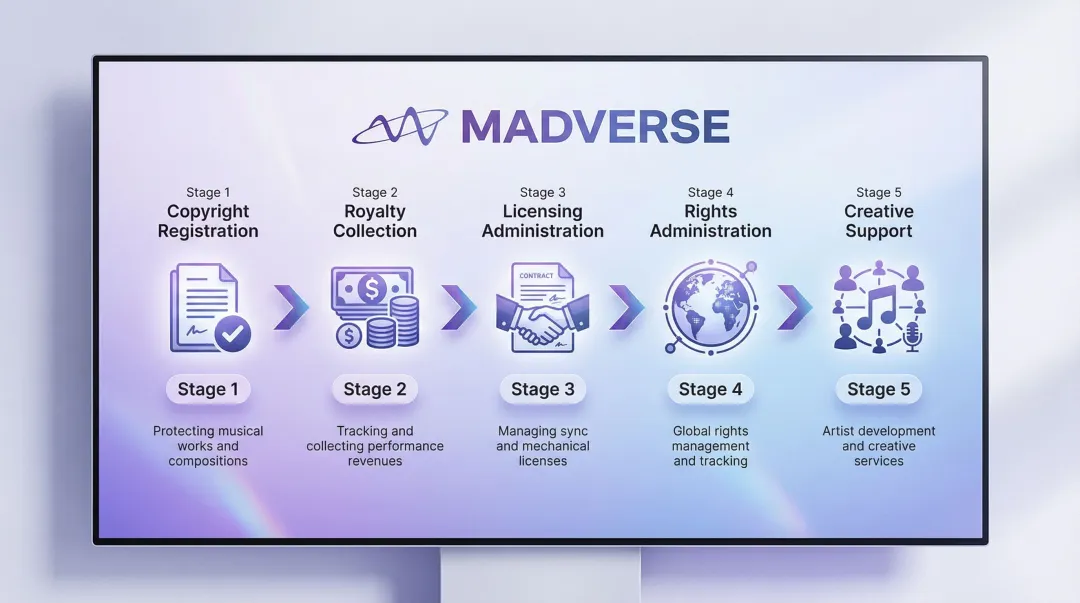
Core functions of music publishers include:
- Registering copyrights with national copyright offices
- Collecting royalties from streaming services, radio, venues, and sync placements
- Licensing compositions for commercial use (films, ads, covers)
- Administering rights across global territories
- Providing creative support through co-writing opportunities and industry connections
From Sheet Music to Streaming Royalties
Music publishing originated in the printing and distribution of sheet music, which was the primary revenue source before recorded music existed.
As technology evolved, the industry adapted to manage new revenue streams—from radio broadcasts requiring performance licenses to digital streaming requiring mechanical licenses.
Key milestones in publishing evolution:
- 1914: ASCAP formed to collect performance royalties for public performances
- 1940s-1960s: Publishing became central to the music business as radio and records grew
- 2021: The Music Modernization Act created the Mechanical Licensing Collective (MLC) to administer streaming mechanical royalties in the U.S.
A Multi-Billion Dollar Industry
The global music publishing market generated €9.8 billion ($10.6 billion/₹88,200 crores) in 2023.
The independent publishing sector alone contributed €2.57 billion ($2.78 billion/₹23,100 crores), representing a 5.7% year-over-year increase and a 105.6% increase since 2018.
This growth reflects the increasing value of composition rights. Every stream generates both a master recording royalty (paid to the label or artist) and a publishing royalty (paid to the songwriter and publisher).
Essential Music Publishing Terms Every Artist Should Know
The Three Core Rights
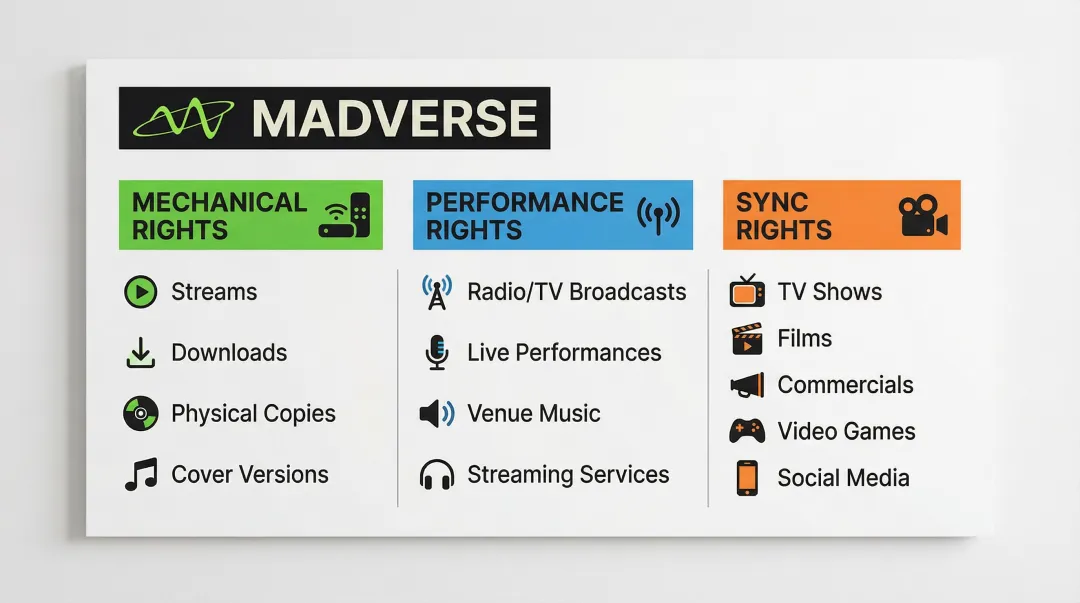
Mechanical Rights cover the reproduction and distribution of your composition. These rights are triggered when someone:
- Streams your song on Spotify, Apple Music, or YouTube Music
- Downloads your song from iTunes or Bandcamp
- Manufactures physical copies (CDs, vinyl, cassettes)
- Creates a cover version of your song
Performance Rights cover public performances of your composition, including:
- Radio and television broadcasts
- Live performances at venues, festivals, and concerts
- Background music in restaurants, retail stores, and gyms
- Interactive streaming (Spotify, Apple Music)
- Non-interactive streaming (Pandora, SiriusXM)
Synchronization (Sync) Rights cover pairing your composition with visual media:
- TV shows and streaming series
- Feature films and documentaries
- Commercials and brand campaigns
- Video games and mobile apps
- YouTube videos and social media content
- Movie trailers and promotional material
Understanding Publishing Splits
Understanding how revenue flows is crucial for evaluating any publishing deal you encounter.
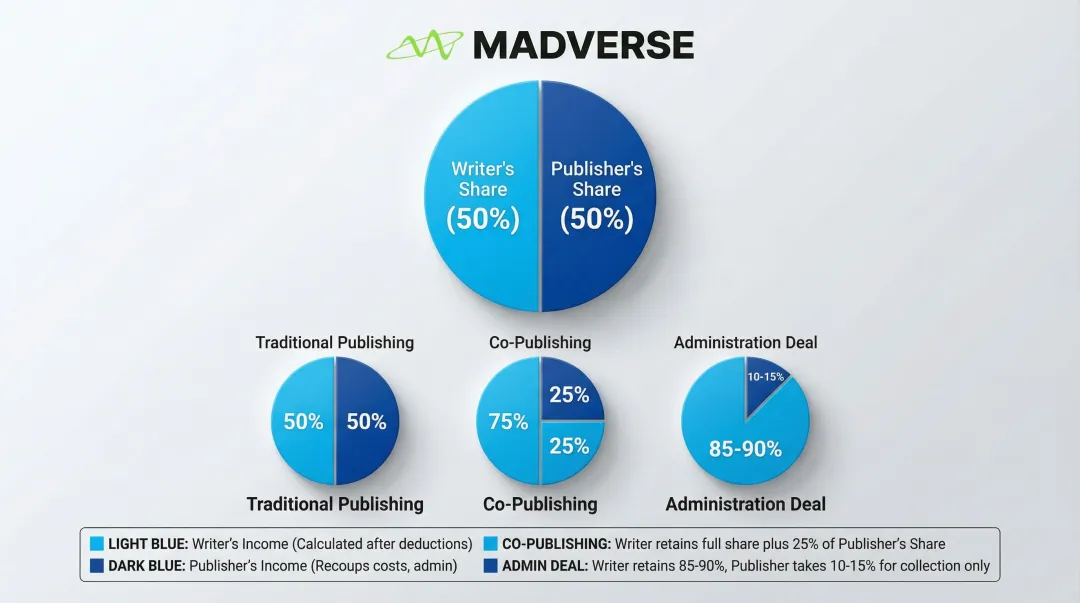
Music publishing revenue is traditionally divided into two equal halves:
- Writer's Share (50%): Belongs to the songwriter(s) and is rarely touched in deals
- Publisher's Share (50%): Where ownership transfers or commissions occur
When you see "75/25 co-publishing deal," it means the writer keeps 100% of their writer's share (50%) plus half of the publisher's share (25%), totaling 75% of all publishing income.
BMI uses a 200% calculation system (100% to writers + 100% to publishers) to simplify split accounting across multiple songwriters and publishers.
Key Organizations You Need to Know
PROs (Performing Rights Organizations) license public performances and collect performance royalties. As an independent artist, you must register with one PRO to collect performance royalties:
- ASCAP: Founded in 1914, represents over 900,000 members
- BMI: Represents over 22.4 million musical works
- SESAC: Invitation-only membership, offers monthly royalty payments
The MLC (Mechanical Licensing Collective) is a nonprofit designated by the U.S. Copyright Office to collect mechanical royalties from streaming services and pay publishers and songwriters. Created by the Music Modernization Act, the MLC manages blanket mechanical licenses for eligible streaming platforms.
Harry Fox Agency (HFA) represents music publishers for physical and download mechanical licensing, as well as lyrics and tabs licensing. It simplifies licensing for users and connects them with rights holders.
How Music Publishing Royalties Work: Following the Money
Streaming Mechanical Royalty Rates
The Copyright Royalty Board sets statutory rates for mechanical royalties. Under the "Phonorecords III" ruling, interactive streaming's headline rate reached 15.1% of revenue in 2022. Alternatively, publishers receive a percentage of Total Content Cost (26.2% of TCC in 2022)—whichever amount is greater.
Streaming services pay the higher of these two calculations:
- Percentage of revenue: 15.1% of service revenue
- Percentage of Total Content Cost: 26.2% of what they pay labels
These mechanical royalties are collected by the MLC (in the U.S.) and distributed to publishers and songwriters based on their ownership shares.
Performance Royalty Calculations
PROs use complex weighting formulas to determine payouts:
- Use Weight: Value assigned to the performance type (radio play, streaming, live venue)
- Licensee Weight: Reflects the license fee paid by the station or service
- Survey Methods: ASCAP and BMI survey performances rather than tracking every single play
ASCAP pays royalties based on performances from 6-9 months prior—for example, January-March performances are typically paid out in October.
Sync Licensing Fee Ranges
Sync fees vary widely based on media type and usage scope:
| Media Type | Typical Fee Range |
|---|---|
| Commercial Campaigns | $20,000 – $550,000+ (₹16.6L – ₹4.57Cr+) |
| Films | $10,000 – $80,000 (₹8.3L – ₹66.5L) |
| Trailers | $10,000 – $80,000 (₹8.3L – ₹66.5L) |
| TV Shows | $500 – $20,000 (₹41,500 – ₹16.6L) |
| Video Games | $2,000 – $10,000 (₹1.66L – ₹8.3L) |
| Theme Songs | $5,000 – $10,000 (₹4.15L – ₹8.3L) |
Beyond upfront fees, sync placements generate backend performance royalties when the content airs on TV or streams online—often exceeding the initial sync fee over time.
Payment Timelines and Lag
Publishing royalties typically lag 6-18 months behind actual usage:
- Streaming platforms report usage quarterly to the MLC
- The MLC processes and distributes royalties within 90 days
- PROs survey performances and pay 6-9 months later
- International royalties can take 12-18 months to flow through foreign collection societies
This lengthy timeline creates cash flow challenges for independent artists.
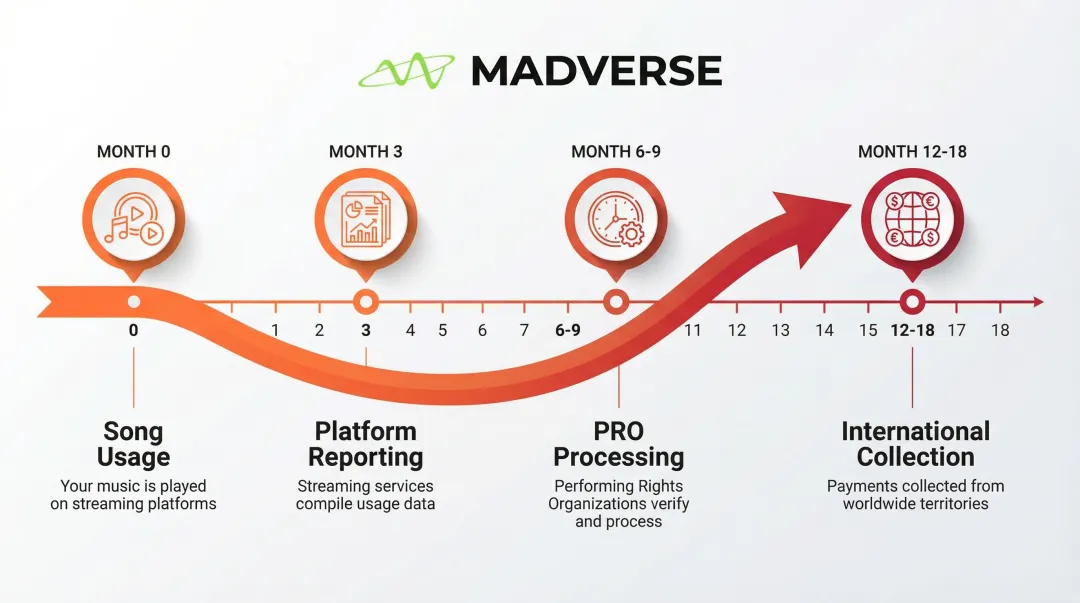
Platforms like Madverse address this lag by offering royalty splits at source, allowing artists to keep 95% of royalties and streamlining the payment process compared to traditional publishing deals that involve multiple intermediaries.
Types of Music Publishing Deals: What's Right for You?
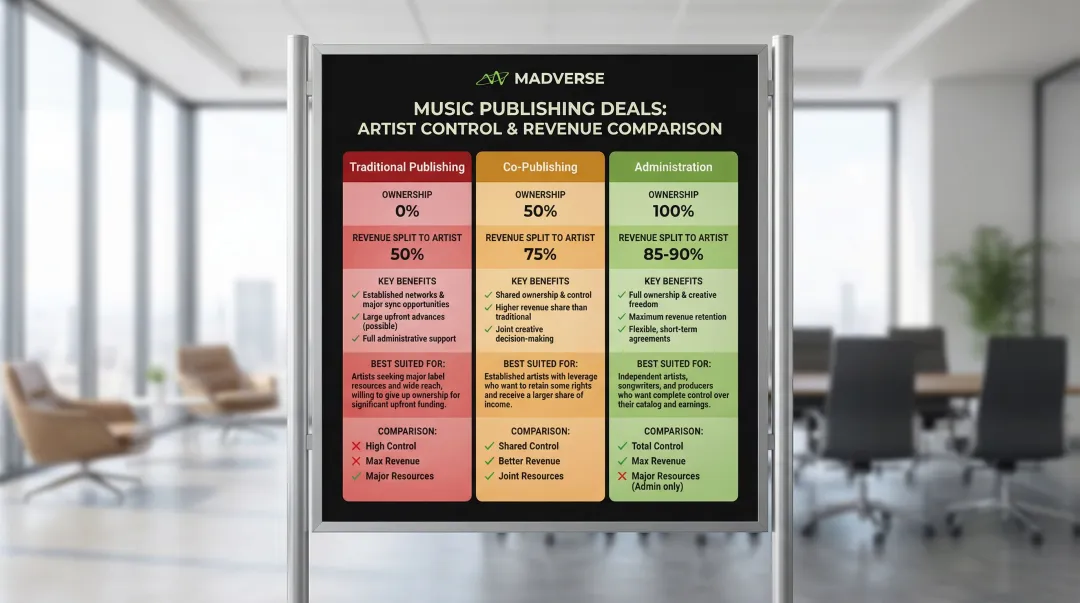
| Deal Type | Writer Ownership | Revenue Split | Key Features |
|---|---|---|---|
| Traditional/Full Publishing | 0% (publisher owns copyright) | 50% writer / 50% publisher | Publisher acquires 100% of copyright; writer receives 50% of income (writer's share only) |
| Co-Publishing | 50% (co-owns copyright) | 75% writer / 25% publisher | Writer keeps 100% of writer's share + 50% of publisher's share; common for established artists |
| Administration | 100% (writer retains ownership) | 85-90% writer / 10-15% admin fee | No ownership transfer; publisher handles collection and licensing for a fee |
Traditional Publishing Deals
Traditional publishing represents the most comprehensive—and most restrictive—deal structure. The publisher acquires your copyright entirely in exchange for active career support and upfront payment.
What you receive:
- Upfront advances against future royalties (must be recouped before additional payments)
- Co-writing sessions, producer connections, and career development
- Active sync pitching for TV, film, and commercial placements
- Global royalty collection across all territories
This structure works best for new songwriters who need financial support and industry connections, or catalog owners seeking a large upfront payment.
The trade-off: You give up ownership permanently (unless you negotiate a reversion clause), and you won't see royalties beyond your 50% writer's share until you recoup the advance.
Co-Publishing Deals
If you've built a track record, co-publishing offers a middle path. You split copyright ownership 50/50 with the publisher while keeping more revenue:
- 100% of the writer's share (50%)
- 50% of the publisher's share (25%)
- Total: 75% of all publishing income
Co-publishing deals are common for established artists who have proven earning potential and negotiating leverage. You retain partial ownership while still gaining promotional support and sync opportunities—making it ideal for mid-level to major songwriters.
Administration Deals
Administration deals let you keep 100% copyright ownership while outsourcing the administrative work. You pay a publisher 10-15% to handle:
- Global royalty collection
- Copyright registration
- Licensing administration
- Royalty accounting and reporting
DIY artists who want control and ownership but need help collecting royalties from international territories benefit most from this structure. You can terminate the agreement and switch administrators anytime without losing your copyrights.
Industry Secrets: What Publishers Don't Tell You
The Hidden Recoupment Trap
An advance is effectively a loan. In traditional deals, the publisher retains 100% of your royalties (both writer's and publisher's shares) until the advance is fully recouped.
In co-publishing deals, they typically collect your 75% share to pay down the debt. If you receive a ₹41.5 lakh advance but your songs only generate ₹24.9 lakhs in royalties over the contract term, you'll never see another payment—and the publisher still owns your copyrights.
Additional recoupable expenses often include:
- Demo recording costs
- Marketing and promotion expenses
- Legal fees for contract negotiations
- Administrative overhead charges
Always negotiate which expenses are recoupable and cap them at a specific amount.
Catalog Valuation Multipliers
Top catalogs have become "hot property," selling for seven figures or more. Publishers typically value catalogs at 10-15x annual earnings.
Example: If your catalog generates ₹10 lakhs annually, a publisher might offer ₹1-1.5 crores to acquire it.
If a publisher offers you a "generous" advance, calculate the implied valuation. A ₹50 lakh advance suggests they expect your catalog to earn ₹3.3-5 lakhs annually for many years.
This reveals they're confident in profiting significantly from your work.
The Reversion Clause Importance
A reversion clause returns your copyrights to you after a specified period (typically 10-20 years) or when certain conditions are met (advance recoupment, minimum earnings thresholds).
Copyright law in many countries grants creators reversion rights after 35 years, but negotiating a shorter term gives you control sooner. You can then re-license to another publisher, self-administer, or sell your catalog at its appreciated value.
Negotiation tip: Push for reversion after 7-10 years if the publisher hasn't recouped the advance or achieved minimum annual earnings (e.g., ₹5 lakhs/year).
Sync Licensing: The Gated Revenue Stream
Beyond catalog ownership, another major revenue stream remains largely inaccessible to independent artists. Traditional publishers often gate-keep sync opportunities, prioritizing their most profitable or well-connected songwriters. Sync fees range from ₹41,500 to ₹4.57 crores+ depending on usage.
Madverse offers independent artists direct access to sync licensing for TV, movies, and commercials without requiring a traditional publishing deal. This opens up a revenue stream that major publishers with established film and advertising relationships historically controlled.
Music Publishing vs. Distribution: Clearing Up the Confusion
Two Separate Copyrights
Every recorded song has two distinct copyrights:
- Composition (Publishing Rights): The lyrics, melody, and musical structure. Owned by songwriters and publishers.
- Master Recording (Distribution Rights): The specific recorded performance. Owned by the label or independent artist.
Example: If you want to use The Beatles' "Yesterday" in a film, you need:
- Publishing license from Sony Music Publishing (who controls the composition)
- Master license from Universal Music Group (who owns the original recording)
What Distributors Don't Collect
Your distributor (CD Baby, DistroKid, TuneCore, or Madverse) delivers your recordings to streaming platforms and collects master recording royalties. They don't collect:
- Performance royalties from PROs (radio play, live venues, streaming)
- Certain mechanical royalties that flow through the MLC or international societies
- Sync fees for the composition side of licensing deals
Common misconception: "My distributor collects all my royalties."
Reality: You need both distribution (for master recording revenue) and publishing administration (for composition royalties) to collect 100% of what you're owed.
Why You Need Both
Independent artists who only use a distributor leave money on the table.
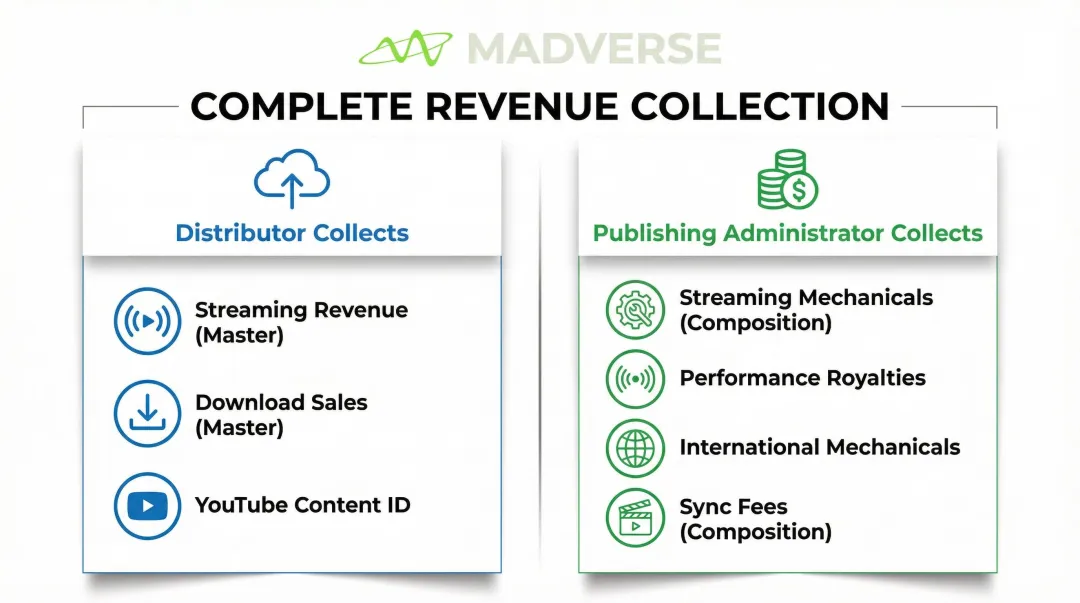
Here's what each service collects:
Distributor collects:
- Streaming revenue (master recording share)
- Download sales (master recording share)
- YouTube Content ID (master recording revenue)
Publishing administrator collects:
- Streaming mechanical royalties (composition share)
- Performance royalties from PROs
- International mechanical royalties
- Sync licensing fees (composition share)
Services that offer both distribution and publishing administration (like Madverse) help artists capture revenue from both copyrights without juggling multiple platforms.
Frequently Asked Questions
Who are the big 3 music publishers?
The "Big 3" publishers control approximately 60.6% of the global market: Sony Music Publishing, Universal Music Publishing Group, and Warner Chappell Music. These companies own catalogs from thousands of songwriters and represent the majority of commercially successful compositions worldwide.
What is the difference between music publishing and music distribution?
Distribution handles your master recording and collects recording royalties from streams. Publishing manages your composition rights and collects mechanical, performance, and sync royalties. Both are required to capture all revenue.
How do music publishers make money?
Publishers take percentage splits of mechanical royalties (streams, downloads), performance royalties (radio, venues), and sync fees (TV, film). Traditional deals: 50%; co-publishing: 25%; administration: 10-20%.
Do I need a music publisher as an independent artist?
You need publishing administration to collect all royalties, but not necessarily a traditional publishing deal. You can self-publish by joining a PRO and the MLC directly, or use an admin service (10-15% fee) to handle global collection while keeping 100% ownership.
What percentage do music publishers typically take?
Traditional deals: 50% (full copyright ownership). Co-publishing: 25% (shared ownership, you get 75%). Administration: 10-20% (you keep ownership, they handle collection). Choose based on whether you need creative support, advances, or just administrative help.
What are mechanical royalties in music publishing?
Mechanical royalties are payments for reproducing your composition through streams, downloads, and physical sales. Streaming services pay 15.1% of revenue to publishers and songwriters, collected by the MLC in the U.S.
Distribution gets your music heard, but publishing ensures you're paid for every use of your compositions—from streaming and radio to film placements and cover versions. Whether you choose self-publishing, administration, or a traditional deal, the key is making an informed decision that aligns with your goals, financial needs, and desire for creative control.
For independent artists seeking both distribution and publishing solutions, platforms like Madverse combine music distribution with publishing administration, letting you keep 95% of royalties while accessing sync licensing opportunities. By understanding the terminology, deal structures, and industry practices outlined in this guide, you're equipped to negotiate better agreements and maximize revenue from your music.