
Introduction
Most independent artists leave thousands of rupees uncollected each year because they don't understand publishing royalty rates. While streaming counts grab attention, the real money comes from knowing how publishing royalties work.
Royalty rates vary dramatically by type (performance vs mechanical vs sync), territory, and collection method.
Industry data suggests that approximately 30% of independent artists fail to collect the publisher's share of their royalties. This uncollected money sits in "black box" funds worth hundreds of millions globally.
This guide breaks down the four main types of publishing royalty rates, how they're calculated, what factors influence them, and how to maximize your earnings—whether you're just starting out or managing an established catalog.
Key Takeaways
- Four royalty types exist: performance, mechanical, sync, and print—each with different rate structures
- Territory, platform, and publishing deal type drastically affect your actual payout
- Register with collection societies before release to avoid permanent revenue loss
- Direct distribution platforms let independent artists retain 95%+ of royalties
- Incomplete royalty collection—not low rates—causes most "streaming pays nothing" complaints
What Are Music Publishing Royalty Rates?
Music publishing royalty rates are the percentage or fixed amount paid to songwriters and publishers when their musical compositions are used—whether performed, reproduced, synchronized, or printed.
These rates apply to the composition (the song itself), not the sound recording (the specific recording of that song).
The Critical Distinction:
- Publishing royalties = payments for the composition (melody, harmony, lyrics)
- Master recording royalties = payments for the actual recording
This guide focuses exclusively on publishing royalties.
The 50/50 Split Concept
PROs typically divide performance royalties equally:
- Writer's Share (50%): Paid directly to the songwriter(s). This cannot be assigned to a publisher.
- Publisher's Share (50%): Paid to the publisher or the entity administering the publishing rights.
Why Independent Artists Lose Money
Understanding this split reveals a critical gap in how many independent artists collect royalties.
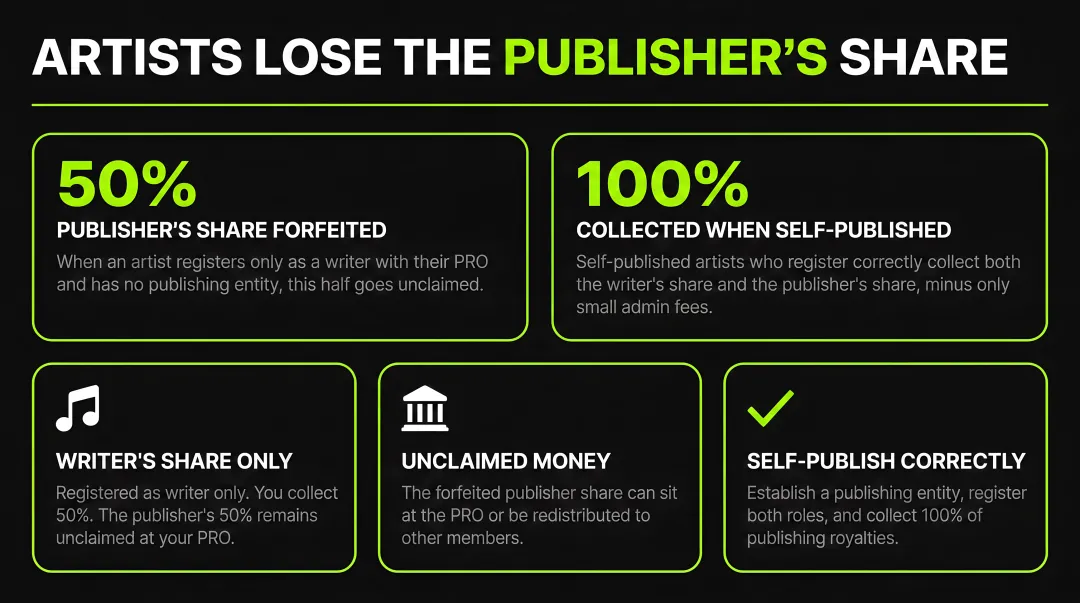
If you register only as a "writer" with your PRO (Performing Rights Organization) but don't establish a publishing entity, you forfeit the 50% publisher's share. This money can remain unclaimed at the PRO or eventually be distributed to other members.
The solution is straightforward: Self-published artists who register correctly can collect both shares (100% of publishing royalties), minus only small administration fees. This is one of the most important steps you can take to maximize your income.
The 4 Main Types of Publishing Royalties & Their Rates
Publishing royalties fall into four distinct categories, each with different rate structures, collection methods, and earning potential.
Performance Royalties (Radio, TV, Streaming, Live Venues)
Your composition generates performance royalties whenever it's publicly performed—broadcast on radio, streamed online, played in venues, or aired on TV. PROs like BMI, ASCAP, and SESAC in the US (or PRS in the UK) collect these payments on your behalf.
Rate Structure: PROs calculate performance royalties as a percentage of the music user's revenue rather than a fixed per-play rate. Streaming services typically dedicate 10-15% of total streaming revenue to performance rights.
Key Variations:
- Terrestrial radio generates higher per-play rates than streaming
- European PROs (GEMA, PRS, SACEM) often pay higher rates than US PROs due to different copyright frameworks
- Interactive streaming (Spotify, Apple Music) generates both performance and mechanical royalties
- Non-interactive streaming (Pandora Radio, SiriusXM) generates performance royalties only
Mechanical Royalties (Physical Sales, Downloads, Streams)
You earn mechanical royalties when your composition is reproduced and distributed—whether on CDs, vinyl, digital downloads, or interactive streams.
US Statutory Rates (2026):
- Physical/Download: ₹11 per song (for songs 5 minutes or less)
- Per-minute rate: ₹2.10 per minute of playing time
- Streaming: 15.1% of streaming revenue (after performance royalty deduction)
The Copyright Royalty Board's Phonorecords IV decision established this 15.1% headline rate through 2027, with a Total Content Cost (TCC) floor of ₹92 per subscriber to protect songwriter income.
International Rate Variations:
| Territory | Rate Structure |
|---|---|
| UK | 8.5% of wholesale price for physical |
| Germany | 13.75% of wholesale price |
| France | 11% of wholesale price |
Synchronization (Sync) Royalties (Film, TV, Ads, Games)
Sync licensing works differently from other royalty types. When your composition is synchronized with visual media—TV shows, films, commercials, video games, or YouTube videos—you negotiate a one-time upfront fee.
Unlike the other royalty types, sync rates aren't standardized. Every deal is fully negotiable based on usage, budget, and media reach.
Typical Sync Fee Ranges:
- Indie film: ₹40,000–₹4 lakh
- TV episode: ₹1.7 lakh–₹17 lakh
- National commercial: ₹8 lakh–₹2 crore+
- AAA video game: ₹8 lakh–₹42 lakh
Dual Revenue Stream: Sync deals create two revenue opportunities:
- Upfront negotiated fee (one-time payment)
- Backend performance royalties when the media airs on TV or streams on platforms that report to PROs
The backend income can sometimes exceed your upfront fee for widely broadcast content.
Print Music Royalties (Sheet Music, Lyrics, Merchandise)
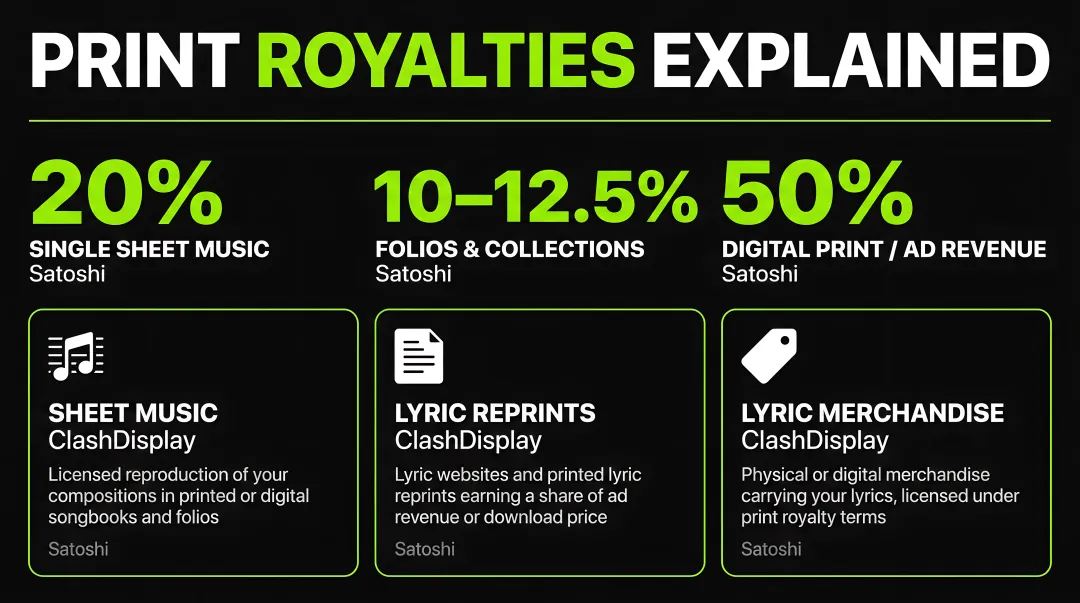
Print royalties come from licensed reproduction of your compositions in printed or digital form—sheet music, songbooks, lyric reprints, or merchandise with lyrics.
Typical Rate Structures:
- Single sheet music: 20% of retail price
- Folios (collections): 10-12.5% of retail price
- Digital print/lyric websites: 50% of ad revenue or percentage of download price
While print royalties represent a smaller revenue stream for most contemporary artists, they remain significant for composers in classical, jazz, and educational music markets.
How Publishing Royalty Rates Are Calculated
Understanding calculation methods is essential for verifying payments and identifying underpayments.
Performance Royalty Calculation Methods
PROs use complex formulas based on:
- Total license fees collected from music users
- Census data or statistical sampling of performances
- Weighting factors (prime-time TV weighted higher than late-night)
- Your song's share of total performances
Example: If a PRO collects ₹8,30,00,000 (₹8.3 crore) in a quarter and your song accounts for 0.001% of all weighted performances, you'd earn approximately ₹83,000 (split 50/50 between writer and publisher shares).
Critical Note: Streaming performance royalties calculate separately from streaming mechanical royalties.
Streaming platforms allocate a percentage of revenue to performance (paid via PROs) versus mechanical (paid via mechanical rights organisations).
Mechanical Royalty Calculation for Streaming
Streaming mechanical calculations vary by region, with the US using a complex "All-In" formula that many platforms apply globally.
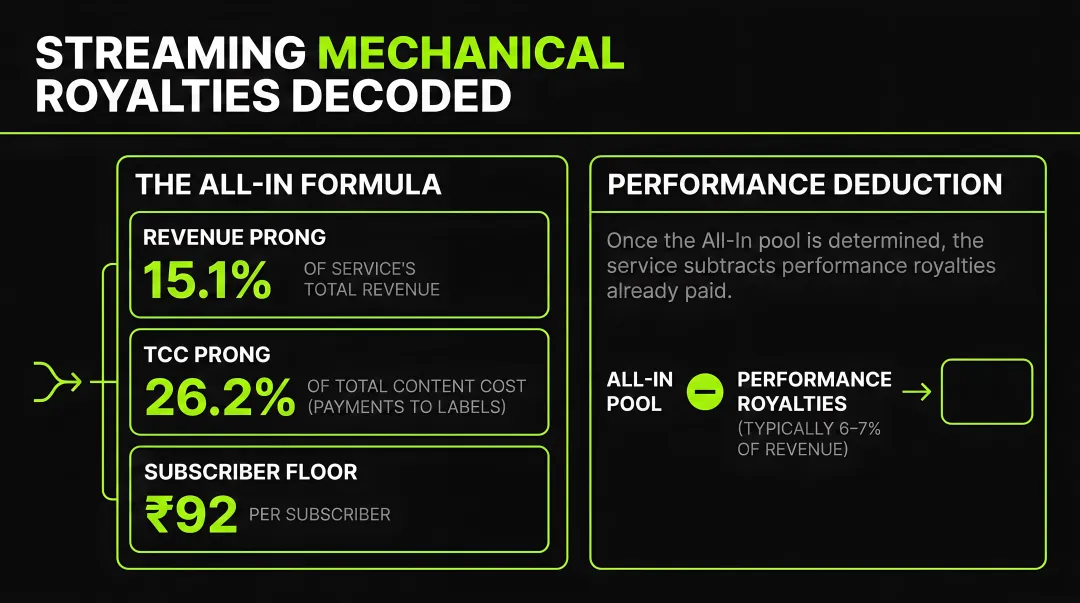
The All-In Formula: The total royalty pool is the greater of:
- Revenue Prong: 15.1% of service's total revenue
- TCC Prong: 26.2% of Total Content Cost (payments to labels)
- Subscriber Floor: ₹92 per subscriber
The Performance Deduction: Once the All-In pool is determined, the service subtracts performance royalties already paid (typically 6-7% of revenue).
Formula: Mechanical Royalty = All-In Pool - Performance Royalties Paid
Here's how 1 million streams typically break down:
- Total revenue generated: ~₹3,32,000
- All-In publishing pool (15.1%): ~₹50,100
- Performance deduction (~6%): -₹19,900 (paid via PRO)
- Mechanical remainder: ~₹30,200 (paid via MLC)
- Total publishing payout: ~₹50,100 (performance + mechanical)
The master rights holder receives ₹2,49,000-₹3,32,000 from the same streams. Understanding both revenue streams helps you track whether you're receiving proper payments through your distributor.
Mechanical Royalty Calculation for Physical & Downloads
This calculation is more straightforward: for each unit sold (CD, vinyl, download), the mechanical royalty is the statutory rate (₹10.90 in 2026) multiplied by copies sold.
If your album has 10 songs and sells 1,000 CDs at full statutory rate:
- Calculation: ₹10.90 × 10 songs × 1,000 copies = ₹1,09,000
- Split between songwriter and publisher
The Controlled Composition Clause: Many record deals include this clause, where labels negotiate to pay only 75% of the statutory rate (₹8.20 instead of ₹10.90). This significantly reduces your publishing income, so negotiate carefully.
Sync Fee Negotiation Factors
Sync licensing offers opportunities beyond streaming revenue. Fees depend on several variables:
- Media type and scope: Local vs national vs global distribution
- Production budget: Higher budgets typically mean higher fees
- Term length: 1 year vs perpetuity
- Exclusivity requirements: Exclusive use commands premium rates
- Usage type: Background vs featured placement
- Song's existing popularity: Established hits command higher fees
Most sync deals are structured as flat fees rather than percentage-based royalties, though some include backend royalties tied to box office performance or streaming views.
Factors That Influence Your Royalty Rates
Your Deal Structure (Independent vs Signed)
Your publishing deal structure dramatically impacts your effective royalty rate:
Deal Type Comparison:
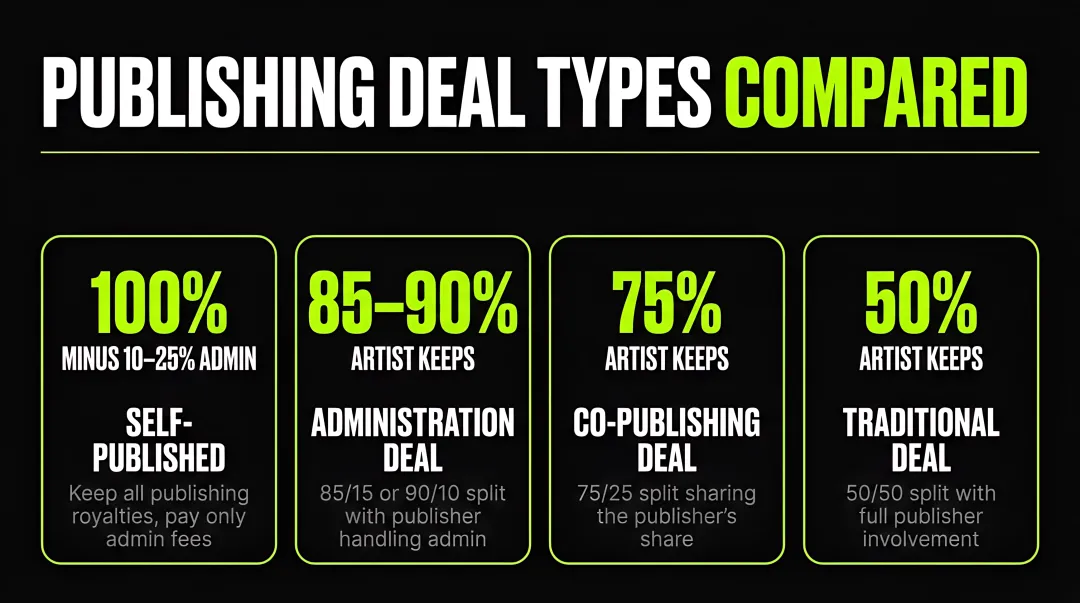
- Self-published/Independent: Keep 100% of publishing royalties minus admin fees (10-25%)
- Administration deal: Keep 85-90% (85/15 or 90/10 split)
- Co-publishing deal: Keep 75% (75/25 split)
- Traditional publishing deal: Keep 50% (50/50 split)
Independent artists using modern distribution platforms can keep significantly more of their earnings while still accessing professional collection infrastructure. Platforms offering 95% royalty retention with built-in splits at source allow you to maximize income without sacrificing distribution reach.
Territory and Collection Society Differences
Royalty rates and collection efficiency vary significantly by country. European territories generally have stronger copyright protections and higher rates than the US.
Some developing markets have limited collection infrastructure, making international registration critical.
Here's how mechanical rates differ across major territories:
- Germany (GEMA): 13.75% mechanical rate on wholesale price
- UK (MCPS/PRS): 8.5% mechanical rate on wholesale price
- France (SACEM/SDRM): 11% mechanical rate on wholesale price
- US: $0.131 (approximately ₹11) per-song statutory rate for physical/downloads
Critical Action: Register with global collection societies or use a publishing administrator with international relationships to avoid leaving foreign royalties uncollected. Many artists lose substantial income from international streams simply because they haven't registered properly.
Platform Type and Licensing Agreements
Different platforms generate different effective rates:
Interactive vs Non-Interactive Streaming:
- Interactive streaming (Spotify, Apple Music): Users choose specific songs, generating both performance and mechanical royalties
- Non-interactive streaming (Pandora Radio, SiriusXM): Users cannot choose specific songs, generating performance royalties only
Terrestrial Radio: Typically pays higher per-play performance royalties than streaming services, though it doesn't generate mechanical royalties.
Direct licensing deals between platforms and publishers can result in rates different from legal minimums, though statutory rates serve as the industry benchmark.
How to Maximize Your Publishing Royalty Income
Register with All Necessary Collection Societies
Essential registrations to complete:
- PRO in your home territory (BMI, ASCAP, SESAC, PRS, etc.) for performance royalties
- Mechanical Rights Organization (MLC in the US, MCPS in the UK) for mechanical royalties
- Publishing administrator for global collection if you're independent
- Neighboring rights society (SoundExchange, PPL) for certain performance royalties
Register BEFORE your music is released and used. Late registrations result in permanent loss of royalties for performances that occurred before registration. PROs like ASCAP do not pay retroactively for unregistered works.
Platforms like Madverse simplify the collection process for independent artists by handling royalty collection with transparent 95% royalty retention and built-in royalty splits at source, eliminating the complexity of managing multiple collection relationships.
Set Up Your Own Publishing Entity
Once you've registered with collection societies, consider establishing your own publishing company—even as a sole proprietor.
Key benefits:
- Collect the full publisher's 50% share instead of leaving it unclaimed
- Maintain control over licensing decisions
- Build an asset with resale value
- Professional credibility in sync licensing negotiations
Basic Steps:
- Choose a unique publishing name (different from your artist name)
- Register it with your PRO
- Obtain necessary business licenses if required in your jurisdiction
- Ensure all your songs are registered under your publishing entity
Important: Setting up a publishing entity does NOT require signing with a major publisher. Independent artists can self-publish and use administration services to handle operational complexity while retaining ownership.
Audit Your Statements and Pursue Unclaimed Royalties
After establishing your publishing infrastructure, regular auditing ensures you're collecting everything you've earned.
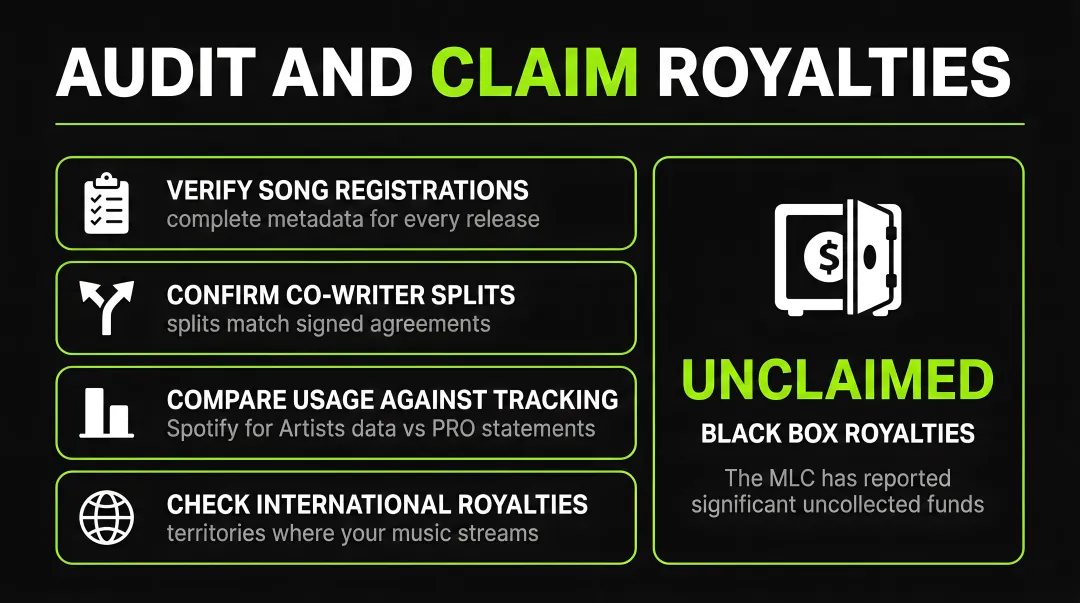
Regular audit checklist:
- Verify all songs are registered correctly with complete metadata
- Confirm co-writer and co-publisher splits match your agreements
- Compare reported usage against your own tracking (Spotify for Artists data vs PRO statements)
- Check for missing international royalties from territories where your music streams
Black Box Royalties: The MLC has reported holding over ₹1,756 crore in unmatched royalties. These funds often belong to independent artists who haven't registered their data properly.
Action Steps:
- Conduct periodic audits (annually or bi-annually)
- Use royalty tracking tools to identify potential underpayments
- Work with a music royalty specialist if you suspect significant underpayment, especially with high-performing catalog
Common Misconceptions About Publishing Royalty Rates
"Streaming Pays Nothing" - Understanding the Reality
While per-stream rates are fractional (often ₹0.25-₹0.40 for masters), high-volume streams can generate substantial income when you're collecting ALL available royalties.
Most complaints about low streaming income stem from incomplete collection rather than low rates. Many artists only collect master recording royalties from their distributor and miss out on performance and mechanical publishing royalties because they haven't registered properly.
Complete Picture for 1 Million Streams:
- Master recording payout: ₹2,50,000-₹3,30,000
- Publishing performance royalties: ₹20,000
- Publishing mechanical royalties: ₹30,000
- Total potential revenue: ₹3,00,000-₹3,80,000
If you're only collecting the master share, you're leaving 15-20% on the table.
"All Royalty Rates Are Fixed by Law"
That's only half the story. While mechanical rates for physical products and downloads in the US are set by statute, many other rates are negotiable:
What's Actually Statutory:
- US mechanical rates for physical/downloads (₹10.80 per song)
- US streaming mechanical rates (15.1% headline rate)
What's Negotiable:
- Performance royalties (based on blanket licenses between PROs and music users)
- Sync fees (entirely negotiable)
- International rates (set by different regulatory bodies with different frameworks)
- Controlled composition clauses (can reduce statutory rates to 75%)
"Publishers Take Half Your Money for Nothing"
Another common frustration concerns publisher splits, though this oversimplifies what publishers actually deliver. Traditional publishers provide services in exchange for their share:
Traditional Publisher Services:
- Pitching for sync opportunities
- Licensing administration
- Global royalty collection
- Copyright protection and enforcement
- Advance funding
The Value Equation:
- Traditional publishing deal: You assign copyright, receive 50/50 split plus services
- Administration deal: You retain copyright, pay 10-25% admin fee, handle pitching yourself
- Self-publishing: You do all work yourself, keep 100% minus direct costs
When Each Makes Sense:
- Traditional works best when you need advances, lack industry connections, or want full-service support
- Administration fits when you want to retain control but need collection systems
- Self-publishing suits artists with time, knowledge, and resources to manage everything
Conclusion
Music publishing royalty rates are complex, varying by type (performance, mechanical, sync, print), territory, platform, and deal structure. Understanding these rates is essential to capturing your full earning potential as a songwriter.
The good news? Independent artists have more control than ever. By registering with the right collection societies, setting up publishing entities, and using transparent distribution platforms like Madverse (which offers 95% royalty retention and splits at source), you can maximize your income without sacrificing ownership.
The key is proactive management: regularly audit your royalty statements, stay informed about rate changes, and don't assume your royalties are being collected automatically.
Taking control of your publishing rights is one of the most important business decisions you can make as a songwriter. It's the difference between leaving money on the table and building a sustainable music career.
Frequently Asked Questions
What is a good royalty rate for music?
For self-published independent artists, keeping 85-95% of gross royalties (after distribution/admin fees) is excellent. Traditional publishing typically uses a 50/50 writer/publisher split, though emerging artists may negotiate 75/25 co-pub deals. Sync rates should reflect fair market value—research comparable placements to establish benchmarks.
What royalties do music publishers get?
Publishers typically receive 50% of performance royalties, 50% of mechanical royalties, and 50% of sync fees (unless negotiated otherwise). In traditional deals, they also control licensing decisions and copyright administration, taking a share of print royalties.
How can I check my music royalties?
Check your PRO account (BMI, ASCAP, PRS) for performance royalties, your mechanical rights organization portal (MLC, SongTrust) for mechanicals, and your distributor's dashboard for master recording royalties. Payments are typically made quarterly with a 3-6 month lag.
What does 7.5% royalty mean?
A 7.5% royalty rate typically refers to mechanical royalties calculated as a percentage of wholesale price (common for CDs and downloads in some territories) or streaming revenue. Always clarify what the percentage applies to—gross revenue, wholesale price, or net receipts—before agreeing.
What is the 25% rule for royalties?
The 25% rule suggests a licensee should pay approximately 25% of expected profits as royalties to the licensor. Originating in patent licensing, it's sometimes applied in music sync negotiations but isn't a legal requirement—actual rates vary based on bargaining power.
What is the 80/20 rule in songwriting?
The 80/20 rule means 80% of your royalty income will come from 20% of your catalog—your hit songs or most-licensed works. This highlights the importance of focusing on quality and promotion for your strongest songs, which generate disproportionate income.