Introduction: Navigating Music Royalty Payments in 2026
Most independent artists don't fully understand where their money comes from. A 2026 Copyright Royalty Board ruling increased streaming mechanical rates to 15.3%, yet many creators still leave thousands uncollected by missing key registration steps. The challenge isn't just getting your music on Spotify—it's capturing revenue from performance royalties, neighboring rights, sync placements, and Content ID across dozens of territories.
This guide breaks down the four major royalty types, payment timelines from platforms to your account, and which services collect what (with their actual costs).
Whether you're releasing your first single or managing a catalog, you'll learn exactly which services to register with and how to avoid the most common collection gaps.
TLDR:
- Three registrations unlock 100% of your revenue: distributor, PRO, and publishing admin
- Streaming payments typically arrive 2-3 months after the stream occurs
- Use split-at-source features to automate collaborator payments and avoid tax headaches
- 2026 streaming mechanical rates jumped to 15.3% of platform revenue
- Modern distributors now offer 90-95% royalty retention with automated splits
Understanding Music Royalty Payment Types
Mechanical Royalties
Mechanical royalties are generated whenever your composition is reproduced—whether through physical sales, downloads, or streams.
The 2026 Copyright Royalty Board ruling set the statutory rate at 13.1¢ per track for physical formats and permanent downloads (or 2.52¢ per minute for tracks over 5 minutes).
For streaming, the 2026 mechanical rate is 15.3% of service revenue, distributed among all songwriters whose tracks were played.
Your distributor collects mechanical royalties from streams and downloads of your master recording. However, if you're also the songwriter, you need a publishing administrator to capture mechanical royalties from other artists covering your songs.
Performance Royalties
Performance royalties are owed when your composition is performed publicly—on radio, in venues, on streaming services, or in businesses. These are collected by Performing Rights Organizations (PROs) like ASCAP, BMI, and SESAC in the US.
PROs collect for the composition, not the recording. Key details about performance royalties:
- Split 50/50 between songwriter and publisher
- Independent artists must register both writer and publisher accounts
- Your distributor cannot collect these—PRO registration is mandatory and separate
Neighboring Rights
While performance royalties cover your composition, neighboring rights cover the public performance of your sound recording—the actual track itself.
In the US, SoundExchange is the sole organization that collects digital performance royalties from non-interactive platforms like Pandora, SiriusXM, and internet radio.
Important distinctions for SoundExchange payments:
- Pays featured artists and sound recording copyright owners
- Does not pay songwriters or publishers (that's the PRO's job)
- Requires separate registration to capture this revenue stream
If you're an independent artist who owns your masters, registering with SoundExchange captures an entirely separate revenue stream that many artists overlook.
Sync Licensing Royalties
Sync royalties are negotiated fees for using your music in visual media. Unlike other royalty types with statutory rates, sync fees vary dramatically based on usage:
- Film festival rights: ~₹84,000
- Indie film with distribution: ₹8.4L – ₹67L
- TV episode (cable): ₹1.7L – ₹8.4L
- National ad campaign: ₹8.4L – ₹2.1Cr+
Sync licensing requires direct negotiation or representation through a sync agent. Some distributors like Madverse offer sync licensing services that pitch your catalog to music supervisors for TV, film, commercials, and video games.
YouTube Content ID and Social Media Royalties
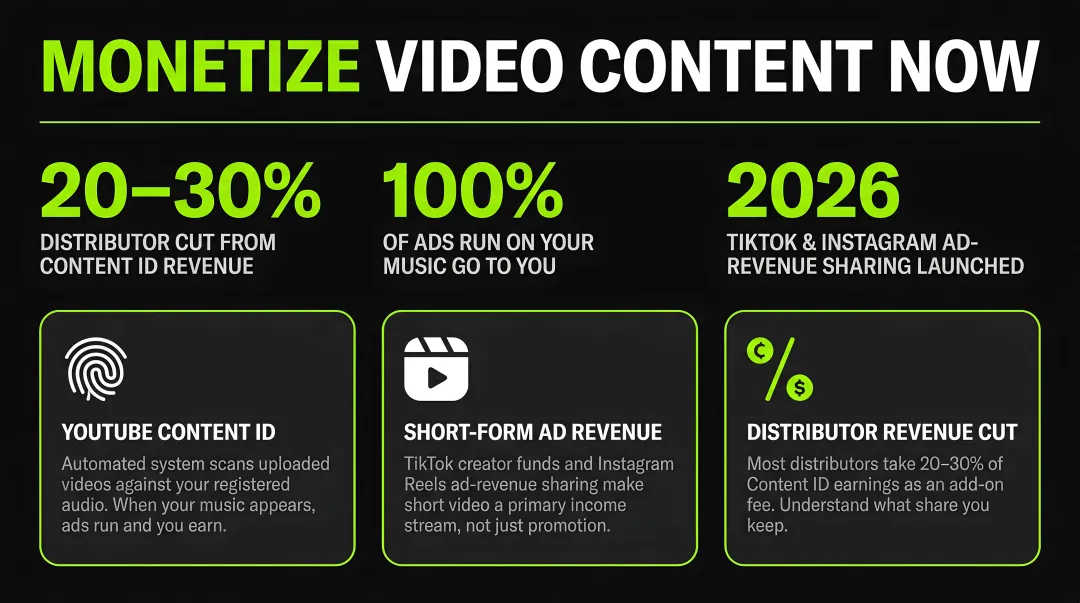
YouTube Content ID is an automated system that scans uploaded videos against a database of registered audio. When your music appears in someone else's video, you can monetize it by running ads. Most distributors offer Content ID as an add-on service, typically taking 20-30% of the revenue generated.
In 2026, TikTok and Instagram have launched creator funds and ad-revenue sharing for Reels, making short-form video a primary revenue stream rather than just promotional.
Services like Madverse include YouTube Content ID, enabling artists to capture revenue from user-generated content across social platforms.
How Music Royalty Payments Work: The Complete Flow
The Journey from Stream to Payment
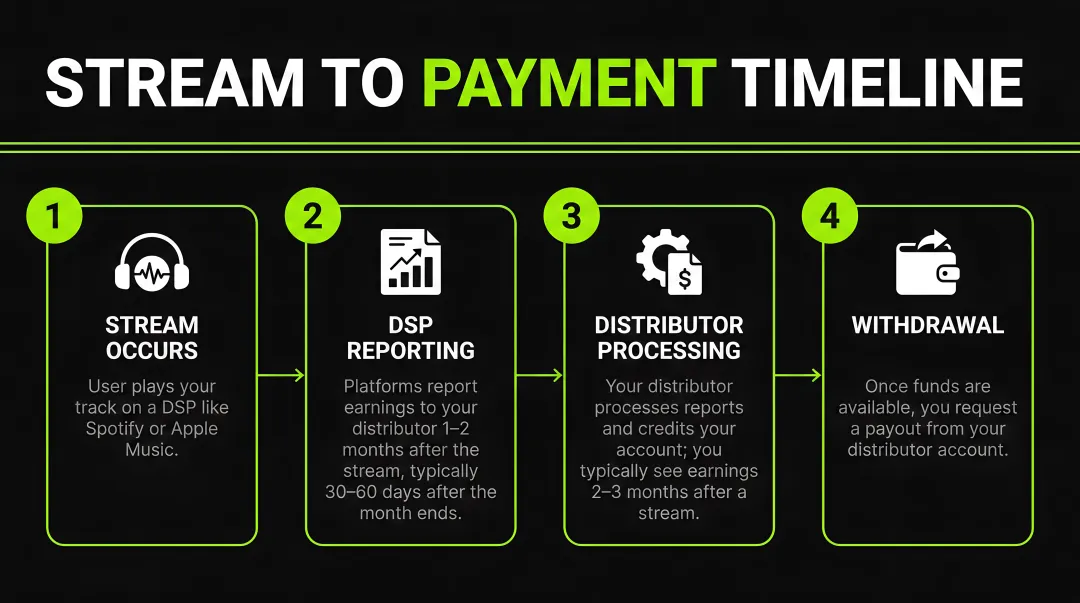
When someone streams your track on Spotify, the payment doesn't arrive immediately. Here's the typical timeline:
- Stream occurs – User plays your track on a DSP like Spotify or Apple Music
- DSP reporting – Platforms report earnings to your distributor 1-2 months after the stream (typically 30-60 days after the month ends)
- Distributor processing – Your distributor processes reports and credits your account, meaning you typically see earnings 2-3 months after a stream
- Withdrawal – Once funds appear in your dashboard, withdrawal time varies by method (PayPal is fastest, wire transfers take longer)
This lag is industry-standard, though some distributors now offer faster payouts once funds reach your account.
Distributors vs. Publishing Administrators vs. PROs
Understanding these three service types is essential—each collects different royalty streams, and you need all three for complete coverage:
Distributors deliver your sound recording to streaming platforms and collect master recording revenue from streams and downloads.
Services like Madverse (which lets you keep 95% of royalties), DistroKid, and TuneCore capture mechanical royalties from streams of your recording.
Publishing administrators (Songtrust, Sentric) register your compositions globally to collect mechanical and performance royalties that PROs and distributors miss—especially international performance royalties and mechanical royalties from covers of your songs.
PROs (ASCAP, BMI, SESAC) collect performance royalties when your composition is played publicly, broadcast, or streamed. PRO registration is mandatory and cannot be replaced by a distributor.
Payment Schedules and Thresholds
Once DSP funds reach your distributor account, payment frequency and minimum thresholds vary significantly:
| Service | Schedule | Minimum Threshold |
|---|---|---|
| Madverse | Varies | Contact for details |
| DistroKid | Twice-weekly | ₹500 (~$6) |
| CD Baby | Weekly | ₹830 (~$10) |
| Ditto | Monthly | ₹2,700 (~£25) |
| ASCAP | Monthly (domestic writers) | None stated |
| BMI | Quarterly | ₹165 (~$2 direct deposit) |
Lower thresholds and faster payments improve cash flow, especially for emerging artists. Services offering twice-weekly or weekly payouts give you quicker access to your earnings once funds arrive from DSPs.
International Royalty Collection
Collecting royalties across borders adds another layer of complexity to the payment flow:
- Currency conversion – Many distributors charge 2-3% FX fees when converting foreign earnings
- Withholding taxes – International income may be subject to withholding taxes unless tax treaties are applied
- Collection society delays – PROs have reciprocal agreements with foreign societies (PRS in UK, GEMA in Germany), but this adds processing time
Publishing administrators with direct partnerships in 150+ territories capture international performance royalties that domestic PROs often miss.
Royalty Splits for Collaborations
Collaborations complicate the payment flow. When multiple artists work together, splits can be handled two ways:
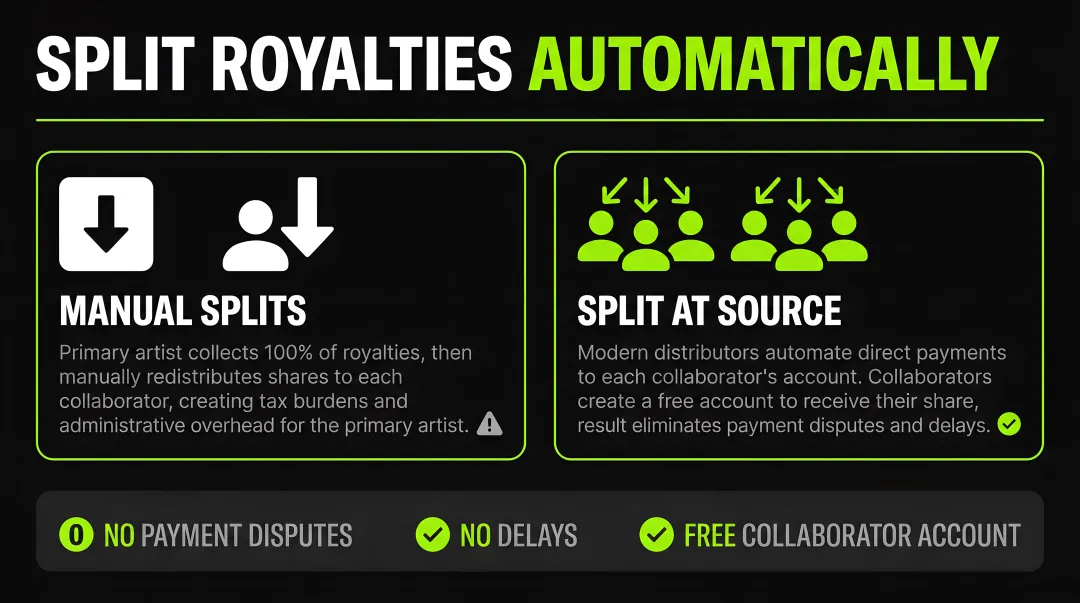
Manual splits: The primary artist receives 100% of royalties and manually distributes shares to collaborators—creating tax burdens and administrative work.
Split-at-source: Modern distributors automate this by sending each collaborator's share directly to their account. Collaborators create a free account to receive their split, eliminating payment disputes and delays.
Madverse offers this feature with its 95% royalty retention model, as do DistroKid and Ditto. This is now the industry best practice for 2026.
Top Music Royalty Payment Services Compared
Distribution + Royalty Services
| Service | Pricing Model | Artist Keeps | Payment Frequency | Min Payout | Key Features |
|---|---|---|---|---|---|
| Madverse | Contact for pricing | 95% | Varies | Contact | Split-at-source, sync licensing, YouTube Content ID, Dolby Atmos, VEVO distribution |
| DistroKid | ₹1,900/yr (Musician) | 100% | Twice-weekly | $6 (~₹500) | Spotify verification, social media pack (20% cut) |
| TuneCore | ₹1,900/yr (Rising Artist) | 100% | Monthly | Not stated | Publishing admin add-on, sync pitching |
| CD Baby | ₹840/single (one-time) | 91% | Weekly | $10 (~₹840) | Physical distribution, sync licensing (40% cut) |
| Ditto | ₹1,600/yr (Starter) | 100% | Monthly | £25 (~₹2,700) | Automatic splits, chart registration |
When to choose what:
- For comprehensive services with 95% royalty retention, Madverse includes split-at-source functionality, sync opportunities, and Content ID
- DistroKid works for high-volume releases with its unlimited upload model and fastest payout frequency
- Artists preferring one-time payments over annual subscriptions should consider CD Baby
- TuneCore/Ditto offer standard 100% retention with solid feature sets
Publishing Administration Services
Beyond distribution, publishing administrators capture mechanical and performance royalties globally that your distributor and PRO miss:
| Service | Pricing | Royalties Collected | Global Reach |
|---|---|---|---|
| Songtrust | ₹8,400 one-time + 15% commission | Performance, mechanical, YouTube composition | 150+ territories |
| Sentric | No signup fee + 20% commission | Performance, mechanical, sync (opt-in) | 200 territories, 28-day rolling contract |
| CD Baby Pro | Discontinued | Performance, mechanical | Legacy users only |
When you need publishing admin:
Add publishing administration when:
- You're earning 10,000+ monthly streams
- Other artists cover your songs
- You're leaving international mechanical and performance royalties uncollected
The commission pays for itself when you're capturing previously missed revenue.
Performance Rights Organizations (PROs)
PRO registration is mandatory for collecting performance royalties:
| PRO | Collection Scope | Membership Cost | Notes |
|---|---|---|---|
| ASCAP | Public performance | ₹4,200 publisher fee (writers free) | Monthly payments for domestic writers |
| BMI | Public performance | Free for writers; ₹12,600-21,000 for publishers | Quarterly distributions |
| SESAC | Public performance | Invitation only | Must be invited/vetted |
Register for both writer and publisher accounts to collect both halves of performance royalties. International artists should register with their local PRO (PRS in UK, GEMA in Germany, etc.).
YouTube & Social Media Monetization
The final piece of your royalty collection strategy is social media monetization. Content ID captures revenue from user-generated content:
- Through distributors: Most distributors offer Content ID as an add-on, taking 20-30% of revenue. Madverse includes YouTube Content ID as part of their service
- TikTok/Instagram monetization: In 2026, these platforms offer formalized creator funds and ad-revenue sharing on Reels. Ensure your distributor delivers to TikTok's Commercial Music Library to capture this revenue
Key Features to Look for in Royalty Payment Services
Transparent Reporting and Analytics
Understanding exactly where your royalties originate helps you make smarter marketing decisions. The best payment services break down your earnings across multiple dimensions:
- Territory breakdowns – See which countries generate the most revenue to target marketing
- Platform-level data – Identify whether Spotify, Apple Music, or YouTube drives your earnings
- Real-time tracking – Daily reports help you catch viral trends early and adjust promotional campaigns within 24 hours
For example, Madverse's advanced analytics include roster performance analysis, letting labels compare artist performance across territories and identify which platforms to prioritize for each release.
Beyond tracking where money comes from, how quickly you receive it matters just as much.
Payment Frequency and Thresholds
Faster payments and lower thresholds improve cash flow for independent artists:
- Twice-weekly payouts – Some services offer rapid payment schedules once DSPs release funds to distributors
- Low thresholds (₹500-₹840) mean you're not waiting months to reach minimum payout
- Multiple payment methods – PayPal, direct deposit, wire transfer, and local options reduce withdrawal delays
Global Collection Capabilities
If you earn royalties internationally, collection infrastructure becomes essential:
- Multi-currency support – Automatic conversion with transparent FX fees
- Local collection society partnerships – Direct relationships with IPRS (India), GEMA (Germany), JASRAC (Japan), and other societies capture royalties that reciprocal agreements miss
- 150+ territory coverage – Comprehensive global reach ensures you're not leaving international money uncollected
Maximizing Your Royalty Payments in 2026
Register with the Right Combination of Services
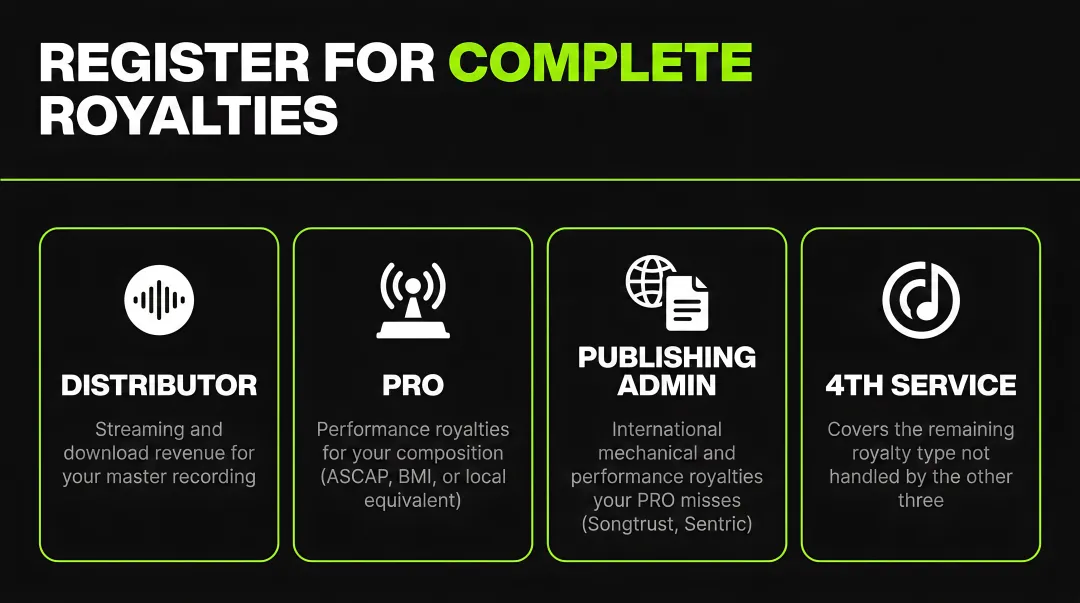
Complete royalty collection requires four separate registrations. Each service handles different royalty types from different sources—there's no overlap.
Essential services to register with:
- Distributor (Madverse, DistroKid, etc.) – Streaming and download revenue for your master recording
- PRO (ASCAP, BMI, or local equivalent) – Performance royalties for your composition
- Publishing administrator (Songtrust, Sentric) – International mechanical and performance royalties your PRO misses
- SoundExchange – Neighboring rights from non-interactive digital radio
Missing even one registration means leaving money on the table.
Set Up Royalty Splits Properly from the Start
Use split-at-source features to avoid payment disputes:
- Automated distribution – Collaborators receive their share directly without manual accounting
- Tax benefits – You're not receiving 100% and then redistributing, which creates tax complications
- Clear agreements – Set percentages upfront before release to prevent disputes later
Services like Madverse offer splits at source as a core feature, making collaboration seamless for independent artists and labels managing multiple artists.
Track Your Analytics Monthly
Detailed reporting helps you optimize strategy:
- Identify top territories to focus marketing efforts (40% streams from Brazil? Try Portuguese content)
- Compare platform performance to prioritize high-revenue channels
- Spot growth trends to identify which releases gain momentum
Set a monthly review schedule to analyze your dashboard and adjust promotional efforts based on actual revenue data, not assumptions.
Beyond traditional streaming, your analytics reveal opportunities in emerging revenue channels that didn't exist a few years ago.
New Revenue Streams Worth Activating
2026 offers expanded monetization opportunities:
- Sync licensing through platforms like Madverse (placements range from ₹1.7L to ₹2.1Cr+)
- YouTube Content ID to capture revenue from user-generated content
- TikTok and Instagram Reels ad-revenue sharing programs
- Dolby Atmos distribution for spatial audio (offered by Madverse)
Frequently Asked Questions
How long does it take to receive royalty payments from streaming services?
Typically 2-3 months from stream to payment. DSPs report earnings to distributors 30-60 days after month-end, who then process payments to your account. Withdrawal speed depends on your payment method.
What's the difference between mechanical royalties and performance royalties?
Mechanical royalties cover reproduction and distribution of your composition (streams, downloads, sales), while performance royalties cover public performances (radio, venues, streaming). You need different services to collect each type.
Do I need separate services for distribution and royalty collection?
Yes, you need multiple registrations. Your distributor collects master recording revenue, while PROs collect performance royalties and publishing administrators handle mechanical and international royalties.
Can I collect royalties from multiple countries?
Yes, but global collection capabilities vary by service. Publishing administrators like Songtrust (150+ territories) and Sentric (200 territories) have direct partnerships with international collection societies. PROs collect internationally through reciprocal agreements, though this process introduces delays. Choose services with strong global reach.
What happens to my royalties if I switch distribution services?
Review contract terms carefully before switching. Some services continue earning from releases distributed during your contract period, even after you leave. Ensure proper catalog migration to avoid revenue gaps.
How do royalty splits work for collaborations?
Split-at-source features automate payments by sending each collaborator's share directly to their account—Madverse, DistroKid, and Ditto offer this capability. This eliminates the tax burden and administrative work of manual distribution. Set percentages upfront before release to avoid disputes.
Word count: 2,847