
Introduction
With 106,000 tracks uploaded daily to streaming platforms in 2026, the music industry has never been more accessible. Independent artists now account for 96.2% of all daily uploads.
Yet this democratization comes with harsh reality: 88% of tracks received 1,000 or fewer streams in 2025, and nearly half of the 253 million tracks available received fewer than ten streams all year.
Choosing the right music distributor is one of the most critical decisions for an artist's career. It affects royalty earnings, playlist placement, rights ownership, and catalog security.
With streaming fraud crackdowns intensifying—Spotify removed over 75 million tracks in 2024-2025, and Apple Music doubled penalties for artificial streaming—selecting a distributor with proper fraud prevention and industry credibility has become essential.
TLDR: Key Takeaways
- DistroKid leads in speed (24-72 hours) but removes music if subscription lapses unless you pay legacy fees
- Commission models (AWAL 15%, CD Baby 9%, ONErpm 15%) can cost more than subscriptions at scale
- Free options work for beginners but often exclude key platforms like TikTok
- Free distributors typically have 4-week delays compared to paid services
- Payment splitting, YouTube Content ID, and fraud prevention are now essential features, not extras
- No single "best" distributor exists—choice depends on release frequency, career stage, and geographic focus
Overview of Music Distribution in 2026
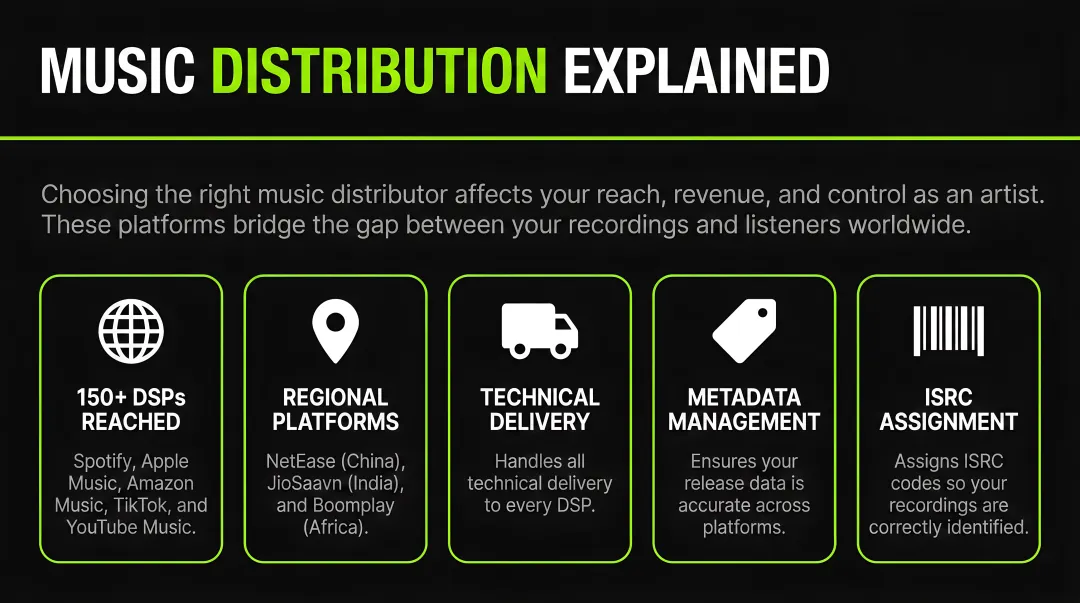
Choosing the right music distributor affects your reach, revenue, and control as an artist. These platforms bridge the gap between your recordings and listeners worldwide.
Music distributors deliver your tracks to 150+ digital service providers (DSPs) including Spotify, Apple Music, Amazon Music, TikTok, and YouTube Music. They also reach regional platforms like NetEase (China), JioSaavn (India), and Boomplay (Africa).
They handle technical delivery, metadata management, ISRC code assignment, and royalty collection on your behalf.
However, the digital landscape in 2026 brings new challenges:
- Streaming fraud epidemic: Platforms now impose financial penalties (often ₹750+ per track) for artificial streaming, which distributors pass directly to artists
- Quality control tightening: Some distributors now require 5-10 day review periods to check releases before delivery
- AI-powered features: Automated mastering, playlist pitching algorithms, and fraud detection are becoming standard
Critical clarification: All distributors reviewed here are non-exclusive. You retain **100% ownership** of your master recordings and copyrights, only sharing revenue through commissions or paying flat fees for the distribution service itself.
Top Music Distribution Companies in 2026
We evaluated distributors based on pricing transparency, commission structure, distribution reach (including emerging markets), payment splitting capabilities, customer support quality, delivery speed, and additional services like sync licensing and publishing administration. Here's how the top platforms compare.
DistroKid
Background: Founded in 2013, DistroKid now distributes over 30% of the world's new music. The platform pioneered the unlimited uploads model with annual subscription pricing, prioritizing speed and simplicity over hands-on support.
Standout features:
- Fastest distribution in the industry (24-72 hours to Spotify)
- Unlimited uploads for flat annual fee
- Payment splitting with recoupment options
- HyperFollow pre-save pages
- Spotify Discovery Mode integration
- Keep 100% of streaming royalties
| Feature | Details |
|---|---|
| Pricing | ₹1,900-₹7,500/year depending on artist count and features |
| Commission | 0% on streaming; 20% on YouTube Content ID (optional ₹415/year add-on) |
| Best For | Prolific artists releasing frequently who prioritize speed; those comfortable with self-service |
Drawbacks: Music is removed if subscription lapses unless you pay the annual "Leave a Legacy" fee (₹2,400 per single, ₹4,100 per album). Payment splitting costs ₹830/year per non-DistroKid collaborator.
Customer support relies heavily on AI chatbots. Users report slow response times and difficulty resolving complex issues like account lockouts.
TuneCore
Background: Founded in 2005 and acquired by Believe in 2015, TuneCore is one of the oldest DIY distributors. The platform overhauled its pricing in 2022, introducing three annual subscription tiers to compete with DistroKid's unlimited model.
Standout features:
- Industry-leading analytics and revenue reports with detailed territory breakdowns
- Territory carving (useful for artists with regional deals)
- Revenue advances based on streaming history
- TuneCore Publishing for administration services (separate ₹6,250 setup fee, 20% commission)
- Keep 100% of streaming royalties
| Feature | Details |
|---|---|
| Pricing | ₹1,250-₹4,150/year for unlimited releases across three tiers |
| Commission | 0% on streaming; 20% on social platforms (YouTube, TikTok, Instagram, Facebook) |
| Best For | Data-driven artists who want detailed analytics; artists needing territory carving for regional deals |
Drawbacks: The 20% commission on social platforms significantly reduces earnings for YouTube or TikTok-focused artists. Distribution speed averages 7 days—slower than competitors.
Automated support systems struggle with nuanced issues, leading to user frustration.
CD Baby
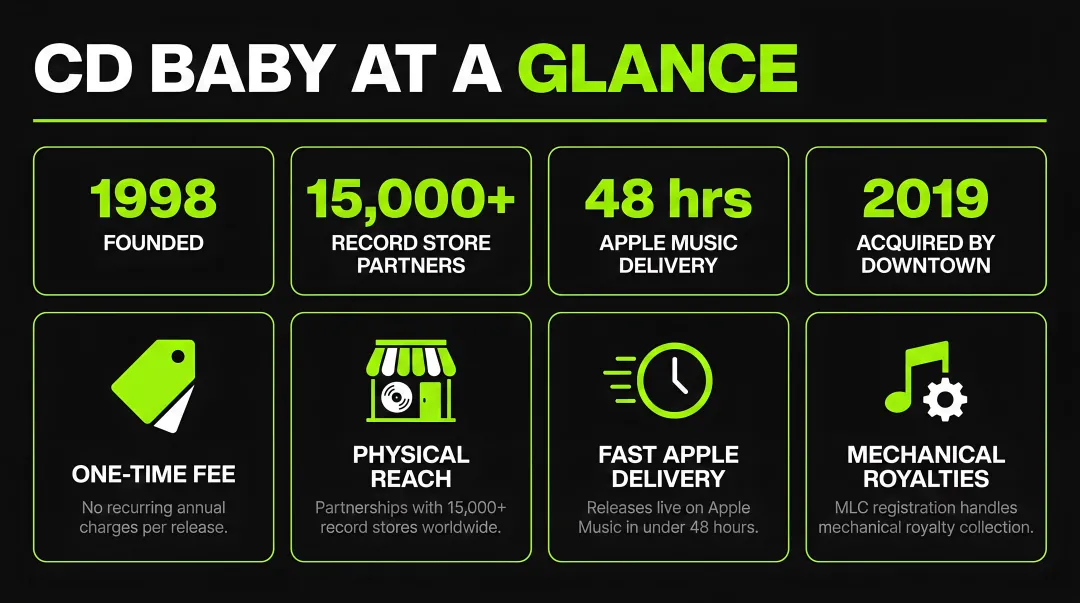
Background: Founded in 1998, CD Baby is the oldest digital distributor and was once the most beloved option for independent artists. Since its 2019 acquisition by Downtown Music Holdings, the platform has declined in service quality and innovation.
Standout features:
- One-time fee per release (no recurring annual charges)
- Physical distribution partnerships with 15,000+ record stores
- Fast delivery to Apple Music (under 48 hours)
- Mechanical royalty collection via MLC registration (with ₹3,330/year Boost add-on)
| Feature | Details |
|---|---|
| Pricing | ₹830 per single, ₹2,415 per album (one-time fees); optional ₹3,330/year Boost add-on |
| Commission | 9% of all streaming revenue; 30% of YouTube Content ID revenue |
| Best For | Artists with infrequent releases who prefer one-time payments; those needing physical distribution |
Drawbacks: The 9% commission adds up quickly. At ₹8,30,000 annual earnings, you pay ₹74,700 versus ₹1,650-2,500 with subscription models.
Customer support has deteriorated dramatically. Users report "absent customer service" and AI replacing humans. CD Baby discontinued its Pro Publishing service in August 2023, leaving legacy clients without full administration.
No payment splitting capability exists.
AWAL
Background: Owned by Sony Music but operating independently, AWAL is an invite-only, application-based distributor with three tiers: Core (entry), AWAL+ (upstreamed with enhanced services), and AWAL Recordings (full label services). It focuses on artists with existing traction rather than beginners.
Standout features:
- Label-level services including dedicated A&R, playlist pitching, and marketing campaigns
- Sync licensing opportunities and radio promotion
- Sony's industry connections and resources
- Data-driven artist selection process
| Feature | Details |
|---|---|
| Pricing | Free to join (application required) |
| Commission | ~15% standard (Core tier); AWAL+ and Recordings deals are custom-negotiated (often 50/50 splits) |
| Best For | Established artists with consistent streaming (10,000+ monthly listeners); those wanting label support without giving up masters |
Drawbacks: Application required—not open to all artists. The 15% commission grows with earnings: at ₹41,50,000 annual revenue, you pay ₹6,22,500 versus ₹1,650-8,300 with subscription models.
No automatic payment splitting exists (only calculation tools). Some artists report minimal support despite the premium positioning.
Amuse
Background: Co-founded by will.i.am in 2015, Amuse pioneered the freemium distribution model. The platform uses data-driven A&R to identify promising artists from its free tier for potential label deals through Amuse Records.
Standout features:
- Genuinely free plan with 100% royalties (up to 12 releases/year)
- Fast approval on paid tiers
- Payment splitting included on Artist Plus and Professional plans
- Revenue advances based on streaming data
- Artist-friendly mobile-first interface
| Feature | Details |
|---|---|
| Pricing | Free (12 releases/year); ₹2,000/year Artist; ₹3,330/year Artist Plus; ₹4,985/year Professional |
| Commission | 0% on paid plans; 15% fee for non-subscriber collaborators on Artist plan only |
| Best For | New artists testing distribution without financial risk; those releasing 1-2 singles per year |
Drawbacks: Free plan requires 4-week review period (submit one month before release date), making it unsuitable for responding to viral moments. No lyrics distribution.
The free tier excludes TikTok and Instagram distribution—a major limitation given these platforms' importance for discovery. Payment splitting on the Artist tier charges 15% fees for non-members.
Madverse
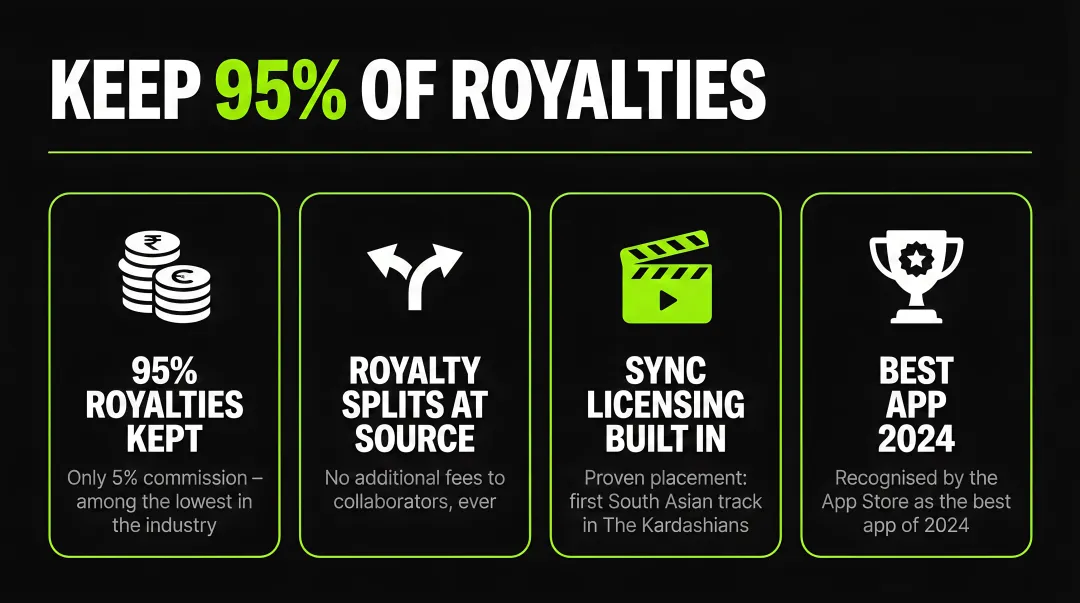
Background: Based in New Delhi, India, Madverse serves the global market with particular strength in South Asian music. AppStore rated Madverse the best app in 2024, and the platform gained recognition for syncing the first South Asian track in The Kardashians.
Standout features:
- Keep 95% of royalties (only 5% commission—among the lowest in the industry)
- Royalty splits at source with no additional fees to collaborators
- Built-in sync licensing opportunities with proven placements
- Editorial playlist pitching
- YouTube Official Artist Channel setup
- Team collaboration tools and comprehensive roster management for labels
- Dolby Atmos distribution
- Hassle-free catalog migration assistance
| Feature | Details |
|---|---|
| Pricing | No upfront fees |
| Commission | 5% (artists keep 95%—one of the highest retention rates available) |
| Best For | Independent artists and labels wanting label-level services while keeping maximum royalties; artists interested in sync licensing; labels managing multiple artists with complex royalty arrangements |
Drawbacks: Less brand recognition than legacy distributors in Western markets, though growing rapidly. Some premium features may require application or approval.
Standard distribution remains open to all artists.
Symphonic Distribution
Background: Independent distributor with offices across the US, Latin America, and internationally. Symphonic operates a two-tier model serving both DIY artists (Starter Plan) and established acts (invite-only Partner Plan).
Standout features:
- Starter Plan offers unlimited releases for ₹1,665/year with 0% commission
- Partner Plan provides label services (15% commission) with dedicated support
- Free payment splitting on all plans
- Strong presence in Latin, urban, and electronic genres
- Beatport distribution for electronic artists
- Physical distribution available
- SoundExchange and neighboring rights collection
| Feature | Details |
|---|---|
| Pricing | ₹1,665/year Starter (unlimited releases); Partner Plan by application (custom terms) |
| Commission | 0% on Starter Plan; 15%+ on Partner Plan (varies by services provided) |
| Best For | Artists with regular release schedules wanting affordable unlimited distribution; electronic/Latin artists needing Beatport; labels wanting white-glove services on Partner tier |
Drawbacks: Partner Plan requires application and isn't open to all artists. YouTube Content ID and Beatport distribution require higher tiers or additional costs.
Support is email-only with no live chat option.
LANDR
Background: Originally launched in 2014 as an AI mastering service, Canadian company LANDR expanded into an all-in-one creative platform. It now bundles distribution with mastering, samples, plugins, and collaboration tools.
Standout features:
- Unlimited AI mastering included in Studio plan
- 3 million+ royalty-free samples
- Over ₹1,66,000 worth of plugins included
- Collaboration tools for producers
- Free payment splitting
- Cover song licensing (₹1,250 one-time fee per track)
- YouTube Content ID on Pro plan
- Keep 100% royalties while subscribed (music stays live at 15% commission if cancelled)
| Feature | Details |
|---|---|
| Pricing | ₹2,000/year Distribution Basic; ₹8,235/year Studio plan (includes mastering, samples, plugins) |
| Commission | 0% while subscribed; 15% if subscription cancelled (music stays live) |
| Best For | Bedroom producers wanting all-in-one production and distribution; artists who value bundled creative tools; cover song artists needing simple licensing |
Drawbacks: No full instrumentalist credits (only featured artists, producers, writers). The 15% commission kicks in if you cancel, though this beats DistroKid removing music entirely.
Higher annual cost (₹8,235) if you only need distribution without the production tools.
Ditto Music
Background: UK-based distributor founded in 2005, positioned as a DistroKid competitor with similar pricing. Ditto has developed a mixed reputation for customer service and reliability in recent years.
Standout features:
- Affordable pricing (₹1,900/year)
- Unlimited uploads
- Payment splitting included
- Spotify Discovery Mode integration
- Pre-save links
- Worldwide chart registration available
- Beatport distribution on Pro/Label plans
| Feature | Details |
|---|---|
| Pricing | ₹1,900/year Standard; ₹2,415+/year Pro/Label plans |
| Commission | 0% |
| Best For | UK/European artists wanting local distributor; budget-conscious artists needing basic distribution |
Drawbacks: Significant customer service complaints including delayed responses, unexpected music takedowns, and processing time issues. YouTube Content ID only available on Pro/Label plans.
Mixed reviews on promotional add-ons' effectiveness. Some users report difficulty resolving support tickets and withheld royalties during security checks.
ONErpm
Background: Founded in 2010 by Emmanuel Zunz without outside investor money, ONErpm has grown to nearly 300-550 employees across 40+ offices globally. The platform specializes in emerging markets, particularly Latin America, Africa, and Brazil.
Standout features:
- Free distribution with 15% commission model
- Massive YouTube Multi-Channel Network (MCN) generating 300 million+ daily views
- Exceptional international reach (dominant in Brazil, strong in Colombia, Mexico, Nigeria, Russia)
- Label services tier available with enhanced marketing and playlist pitching
- Payment splitting included
- Strong regional expertise and local market knowledge
| Feature | Details |
|---|---|
| Pricing | Free |
| Commission | 15% standard; custom rates for label services deals |
| Best For | Artists targeting Latin American, African, or emerging markets; YouTube-focused artists wanting MCN benefits; artists preferring no upfront costs |
Drawbacks: The 15% commission can exceed annual subscription costs once you earn significant revenue. At ₹83,000 annual earnings, you pay ₹12,450 versus ₹1,650-2,500 for subscriptions.
Less hands-on support for standard free tier users compared to paid plans elsewhere. Label services tier is invite/application-based.
How We Chose the Best Music Distributors
Our evaluation focused on factors that directly impact artist success and earnings:
- Pricing transparency – Clear fee structures without hidden costs for essential features like payment splitting, YouTube Content ID, or collaborator accounts
- Total cost of ownership – Break-even analysis showing subscription models (DistroKid, TuneCore, Symphonic Starter) become more cost-effective than commission models (CD Baby 9%, AWAL 15%, ONErpm 15%) for artists earning ₹1,50,000+ annually
- Distribution reach – Verified delivery to emerging markets like China (NetEase, Tencent), Latin America, Africa, and specialized platforms like Beatport
- Payment splitting – Automatic splits at source and whether collaborators must pay for accounts
- Customer support – Response times and quality gaps between dedicated account managers versus AI chatbots
Understanding these criteria helps you avoid the common pitfalls artists face when selecting distributors:
- Choosing based solely on lowest upfront price without calculating long-term costs
- Ignoring customer support quality until problems arise (like account lockouts or withheld royalties)
- Not understanding commission versus subscription trade-offs
- Failing to verify if distributor reaches target geographic markets
- Overlooking payment splitting capabilities when working with collaborators
The "best" distributor varies by artist needs.
New artists (0-5,000 monthly listeners) may prioritize free options like Amuse or commission-based models like ONErpm. Prolific releasers benefit from unlimited annual plans.
Established artists (50,000+ monthly listeners) should evaluate label services tiers or high-royalty-retention options like Madverse's 95% model. Data-driven artists need robust analytics, while international-focused artists should choose distributors strong in target regions.
Key Factors to Consider When Choosing Your Distributor
Career Stage and Release Frequency
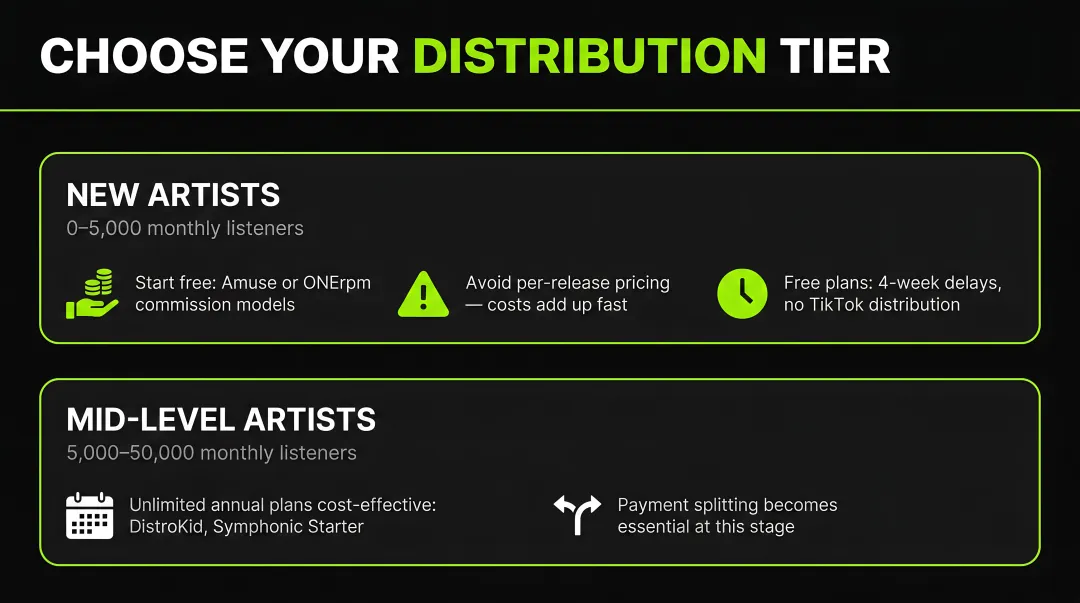
New artists (0-5,000 monthly listeners):
- Start with free options like Amuse or commission-based models like ONErpm to test distribution without financial risk
- Avoid per-release pricing (CD Baby) when experimenting—costs add up quickly
- Free plans often have limitations like 4-week delays and missing TikTok distribution
Mid-level artists (5,000-50,000 monthly listeners):
- Unlimited annual plans become cost-effective (DistroKid, Symphonic Starter)
- Payment splitting becomes essential as you collaborate more
- Prioritize distributors with solid customer support as stakes increase
Established artists (50,000+ monthly listeners):
- Evaluate label services tiers (AWAL, Symphonic Partner, Madverse) for marketing support
- Commission models may be worthwhile if services justify the cost
- High-royalty-retention models (like Madverse at 95%) balance DIY control with professional support
Release frequency matters: Annual unlimited plans save money when releasing 10+ songs per year, while one-time fees or commission models suit artists releasing 1-2 songs yearly.
Beyond pricing, your location and genre influence which distributor best serves your needs.
Geographic and Genre Focus
Regional considerations:
- China: Confirm distributor delivers to NetEase and Tencent—many don't reach the world's second-largest music market
- Latin America: ONErpm and Symphonic offer regional expertise with local offices and playlist curator relationships
- Africa: ONErpm maintains strong presence in Nigeria and other markets with dedicated teams
Genre-specific platforms:
- Electronic/Dance: Beatport distribution is essential (available through Symphonic, Ditto Pro), often generating more revenue than mainstream platforms
- Hip-hop producers: BeatStars may be more relevant than traditional distributors
- Sync-focused artists: Built-in licensing programmes (Madverse, AWAL, Symphonic Partner) actively pitch to supervisors
Technical Requirements and Collaboration Needs
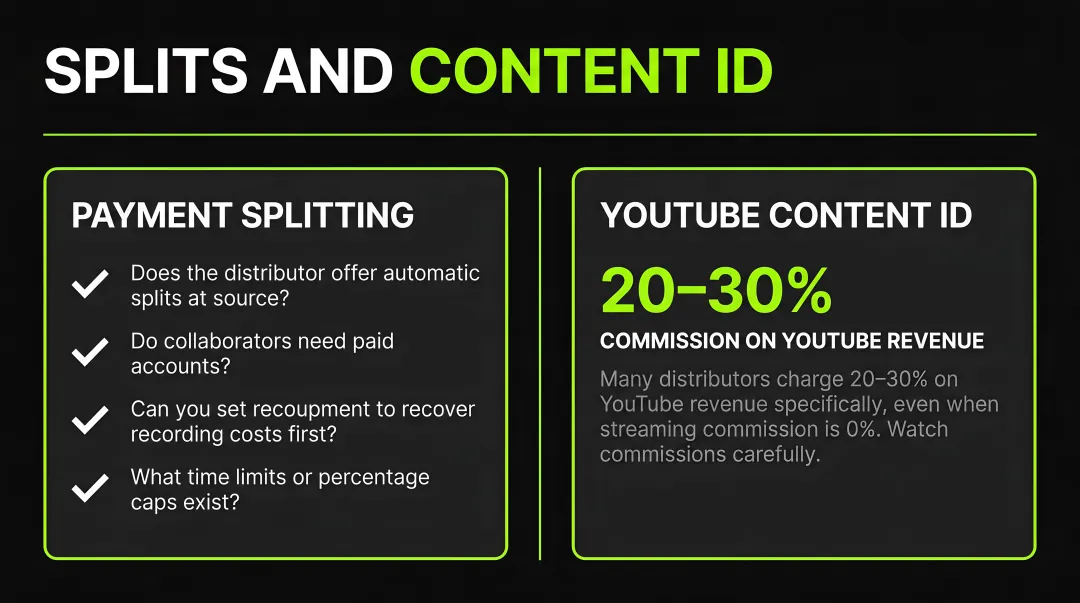
Payment splitting: Now essential if working with producers, co-writers, or session musicians. Key questions to ask:
- Does the distributor offer automatic splits at source?
- Do collaborators need paid accounts? (Some charge per collaborator)
- Can you set recoupment to recover recording costs first?
- What time limits or percentage caps exist?
YouTube Content ID: Generates additional revenue but watch commissions—many charge 20-30% on YouTube revenue specifically, even when streaming is 0%.
Lyrics distribution: Becoming a standard expectation. Confirm your distributor sends lyrics to all major platforms.
Full credits distribution: Matters for proper credit on Amazon Music, Pandora, and Tidal. Some distributors (LANDR) only support featured artists and producers, not full instrumentalist credits.
ISRC code management: Important for tracking and royalty collection. Confirm your distributor assigns ISRCs properly for accurate tracking.
Catalogue migration support: If switching distributors, some offer migration assistance to avoid takedowns and maintain streaming counts.
Conclusion
The music distribution landscape in 2026 offers more options than ever: from completely free services to premium label-style support.
Success requires choosing a distributor that aligns with your specific career stage, release frequency, budget, and long-term goals rather than simply picking the most popular or cheapest option.
Which model makes sense for your situation?
- Prolific artists releasing frequently: Subscription models like DistroKid (₹1,900/year) or Symphonic Starter (₹1,650/year) offer unlimited uploads with 0% commissions
- Artists wanting label services with maximum royalties: Madverse's 5% commission model lets you keep 95% while accessing sync licensing, playlist pitching, and dedicated support
- Established artists seeking full label support: AWAL's 15% commission may be justified by comprehensive marketing and A&R services
Distribution is just the first step. The distributor gets your music on platforms, but what you do next determines whether anyone actually hears it.
Pair your distribution choice with effective promotion: playlist pitching, social media marketing, building direct fan relationships, and pursuing sync licensing opportunities.
Madverse fits into the emerging category of distributors offering label-level services (sync licensing, playlist pitching, team collaboration tools, dedicated support) while letting artists keep 95% of royalties and 100% ownership.
This middle ground between pure DIY and traditional labels is where the industry is heading for ambitious independent artists and labels who want professional support without sacrificing control or earnings.
Frequently Asked Questions
Which music distributors allow artists to keep 100% of their royalties?
Subscription distributors (DistroKid, TuneCore, Symphonic Starter) take 0% commission but charge annual fees. Commission-based options include CD Baby (9%), AWAL (15%), ONErpm (15%), and Madverse (5%)—which offers the highest retention rate at 95% among commission models.
How do independent artists distribute their music?
Artists use digital distributors to deliver music to 150+ platforms (Spotify, Apple Music, TikTok). Upload your audio and artwork, add metadata, select a release date, and the distributor handles delivery and royalty collection. Most deliver within 2-7 days.
Which music distributor is best for beginners?
Start with Amuse's free plan or ONErpm (no upfront costs) to learn risk-free, though Amuse excludes TikTok/Instagram. If you can invest ₹1,600-2,400/year, DistroKid or Symphonic Starter offer unlimited releases and faster distribution. Avoid per-release pricing when experimenting.
What are the best music distribution companies overall?
It depends on your needs: DistroKid for speed, TuneCore for analytics, AWAL for established artists. Madverse balances high retention (95%) with label services like sync licensing. Your choice depends on career stage and priorities.
Which platforms are most profitable for independent musicians?
Subscription models (DistroKid, TuneCore) are most profitable for high earners—you keep 100% beyond the flat fee. Commission models reduce profits at scale, though Madverse's 5% rate offers a strong middle ground. Note that YouTube Content ID can be profitable, but many distributors take 20-30% commission on that revenue.
How important is payment splitting and what should I look for?
Payment splitting is critical when working with producers, co-writers, or session musicians. Look for automatic splits at source (Madverse, Symphonic, LANDR) and recoupment support to recover recording costs. Avoid distributors charging collaborators for accounts (DistroKid charges ₹800/year per collaborator).