
Yet this democratization brings its own challenges. Artists face an overwhelming maze of distribution options, pricing models, and platform requirements. Should you pay an annual fee or give up a commission percentage? Which distributor reaches the platforms where your audience actually listens? How do you split royalties with collaborators without becoming an accountant?
This guide cuts through the noise. You'll understand the current market landscape, distribution models, emerging trends reshaping the industry, regional growth opportunities, and practical frameworks for choosing the right distribution strategy for your music career stage.
TLDR: Key Takeaways
- Global music distribution market projected to reach $56.2 billion by 2031, expanding opportunities for independent artists
- 69% of global music revenues now come from streaming—digital distribution is essential for artist success
- Over one million independent artists now use distribution platforms, capturing 31.5% of market share in 2023
- India and Asia-Pacific show 24.7% annual growth through 2031 via mobile streaming
What is Music Distribution and Why It Matters
Getting your music heard means getting it everywhere your audience listens. Music distribution is the process of delivering your recordings to digital streaming platforms (DSPs), download stores, and social media platforms where fans discover and stream music.
Distributors handle the technical infrastructure—converting files, managing metadata, and delivering your tracks to hundreds of global outlets. Without distribution, your music stays trapped on your hard drive.
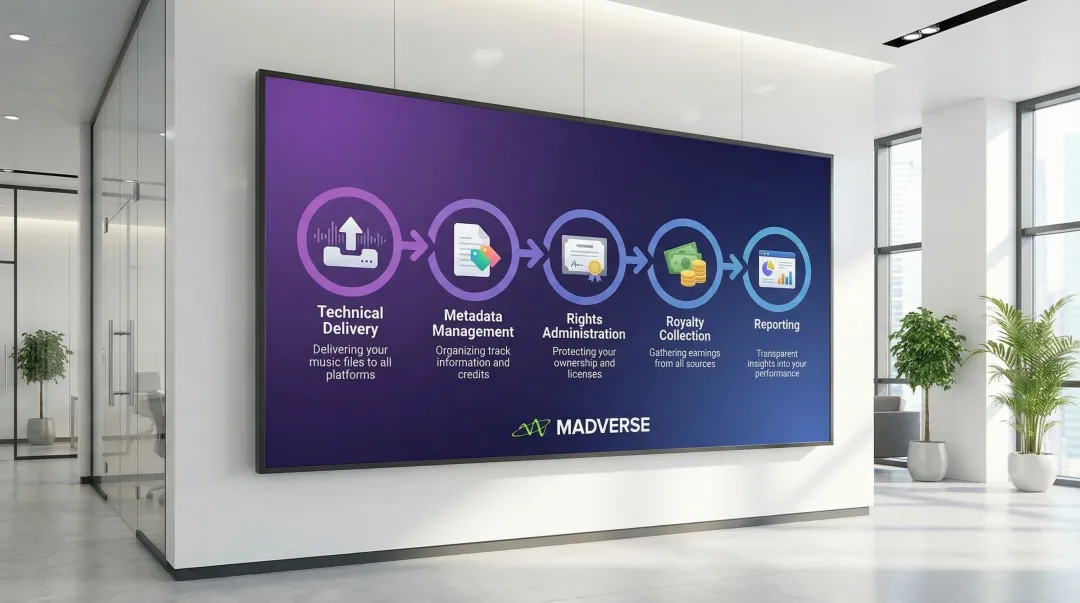
What distributors handle:
- Technical delivery - Converting and uploading files in platform-specific formats
- Metadata management - Ensuring artist names, song titles, genres, and credits display correctly across all platforms
- Rights administration - Assigning ISRC codes and UPC barcodes for tracking
- Royalty collection - Gathering streaming and download revenue from platforms globally
- Reporting - Providing dashboards showing streams, earnings, and listener demographics
What you retain:
Unlike traditional record deals, modern distribution keeps you in control. You maintain 100% ownership of your master recordings and copyrights. The distributor is purely a service provider, not a rights holder.
Most modern distributors reach 150-450+ digital outlets globally, including major platforms like Spotify, Apple Music, and Amazon Music, plus regional services like JioSaavn (India), Anghami (Middle East), and Boomplay (Africa).
This extensive reach ensures your music is available wherever your potential audience listens.
The Music Distribution Market: Size, Growth & Key Drivers
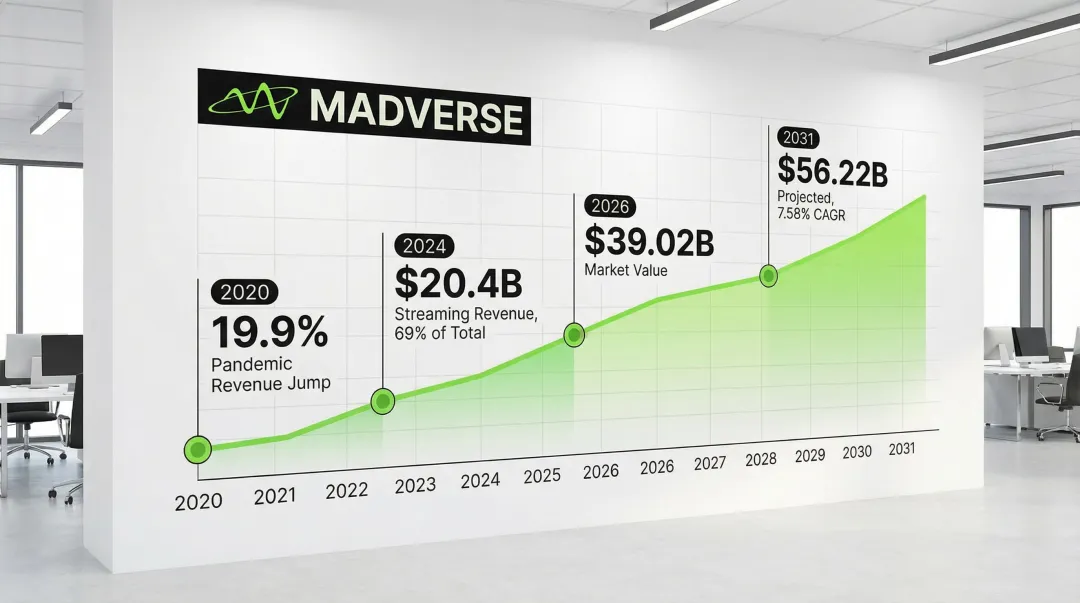
The digital music distribution sector has evolved from a niche service into a multi-billion-dollar industry. Market research values the sector at $39.02 billion in 2026, with projections reaching $56.22 billion by 2031—representing a 7.58% compound annual growth rate.
Why the Market is Exploding
Several converging trends fuel this rapid expansion:
Streaming dominance: Streaming revenues hit $20.4 billion in 2024, accounting for 69% of all recorded music revenue. This format shift has made digital distribution essential rather than optional.
Artists who don't distribute digitally simply don't exist in the market.
Mobile broadband penetration: Over 85% global mobile broadband adoption has created seamless access to streaming platforms.
Listeners in emerging markets can now access the same catalog as developed markets, expanding the potential audience for every release.
The "artist direct" segment—musicians releasing without traditional labels—generated $1.78 billion in 2022, growing 16.6% year-over-year.
Independent artists and labels now control 31.5% of market share, with that figure reaching 46.7% when measured by ownership rather than distribution deals.
The pandemic permanently shifted music creation and release workflows. With live venues shuttered, streaming became the primary revenue source, driving a 19.9% revenue jump in 2020.
Artists embraced remote production and increased release frequency, habits that persist today.
Understanding Distribution Models: From DIY to Label Services
Not all distribution services operate the same way. Understanding the core models helps you match your needs to the right service tier.
Aggregator-Based Distribution (DIY)
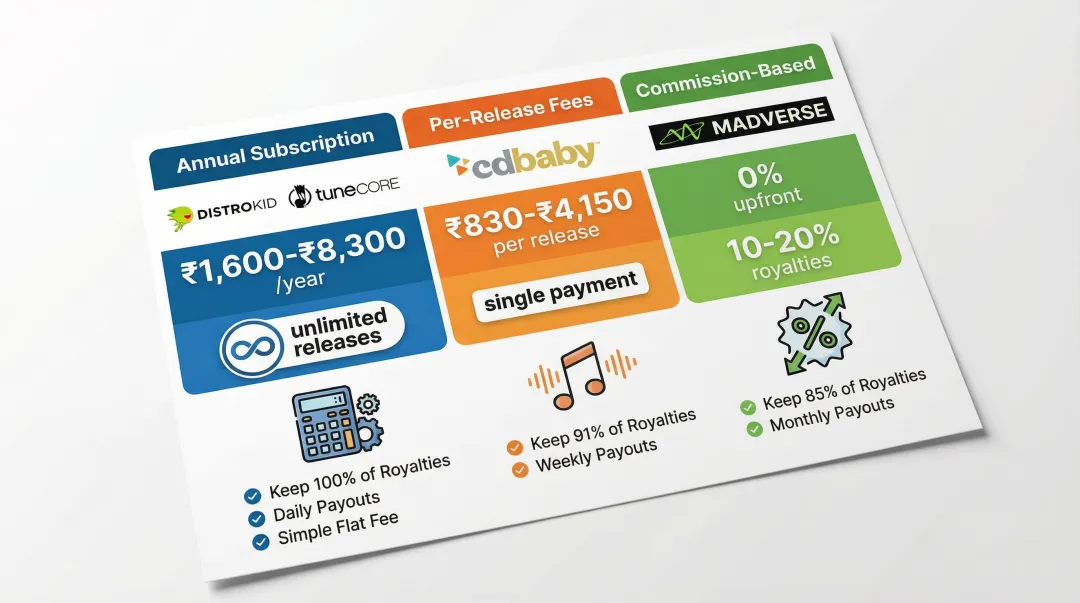
These platforms accept all submissions without curation, charging either annual fees or per-release costs while allowing you to keep 100% of royalties. They're the most accessible entry point for independent artists.
Typical features:
- Delivery to 150+ streaming platforms and download stores
- ISRC code assignment for tracking
- Release date scheduling (including pre-save campaigns)
- Basic royalty reporting dashboards
Pricing models:
- Annual subscription: ₹1,600-₹8,300/year for unlimited releases (DistroKid: ₹1,900/year, TuneCore: ₹1,250-₹4,150/year)
- Per-release fees: ₹830-₹4,150 per single or album (CD Baby: ₹830/single, ₹2,400/album)
- Commission-based: Free upfront, but 10-20% of royalties (RouteNote: 15%)
This model works best for prolific artists releasing frequently, as the unlimited upload structure maximizes value.
Commission-Based Distribution
Services taking a percentage of your royalties (typically 10-20%) in exchange for no upfront costs. This structure appeals to new artists with limited budgets or those testing the waters before committing to annual subscriptions.
When it makes sense:
- Releasing your first tracks with uncertain release frequency
- Managing cash flow without upfront costs
- Needing personalized guidance during the upload process
Here's the simple math: if your annual royalties exceed ₹8,300-₹41,500 (depending on commission rate), a flat-fee model saves you money.
Label Services / Hybrid Models
These premium tiers combine distribution with advanced marketing tools. They typically require demonstrated traction—existing streaming history, social media following, or artistic merit review.
Enhanced features:
- Direct playlist pitching to editorial teams at major DSPs
- Marketing campaign support and promotional strategy
- Sync licensing opportunities for TV, film, and advertising placements
- Advances against future royalties for qualifying artists
- Dedicated account managers for personalized guidance
Some platforms bridge the gap between pure distribution and full label services. For example, Madverse offers distribution while artists keep 95% of royalties, plus access to sync licensing opportunities.
The company achieved notable success placing the first South Asian track in The Kardashians, demonstrating how strategic licensing amplifies distribution.
Payment Splitting & Royalty Management
Modern distributors have automated one of the most tedious aspects of music collaboration: paying collaborators.
How it works:
- During upload, you set collaborator percentages (producer: 15%, featured artist: 10%, etc.)
- The distributor automatically splits royalties at the source, paying each collaborator directly
- You eliminate manual accounting, invoicing, and payment administration
Advanced features:
- Recoupment designation: Specify that certain costs (mixing, mastering, marketing) come out of your share before collaborators receive splits
- Transparent reporting: All parties see real-time earnings and payment schedules
- Tax documentation: Distributors handle 1099 forms and international tax compliance
This functionality transforms collaborative releases from administrative nightmares into streamlined processes.
Key Industry Trends Shaping Music Distribution
Three major technological shifts are redefining how music reaches listeners and how distributors add value beyond basic delivery.
AI-Powered Audience Targeting
Artificial intelligence has moved beyond music creation into the operational backbone of distribution. Modern distributors now integrate machine learning to help artists make data-driven decisions. Platforms use these tools for:
- Predictive release timing: Algorithms analyze listener behavior patterns to recommend optimal release dates and times
- Automated playlist targeting: AI identifies which playlists match your sound profile and listener demographics
- Promotional optimization: Systems adjust ad spend and targeting in real-time based on engagement metrics
Research shows that external traffic from social media acts as a "powerful signal" to streaming algorithms, triggering increased algorithmic recommendations. Distributors are building tools that take advantage of this connection.
Multi-Format Distribution Convergence
Music discovery has decoupled from music consumption. Listeners now discover tracks in one place and stream them elsewhere.
30% of users engage with short-form video apps, where music is central to 63% of viewing time. A viral TikTok moment can drive millions of streams before a song officially releases.
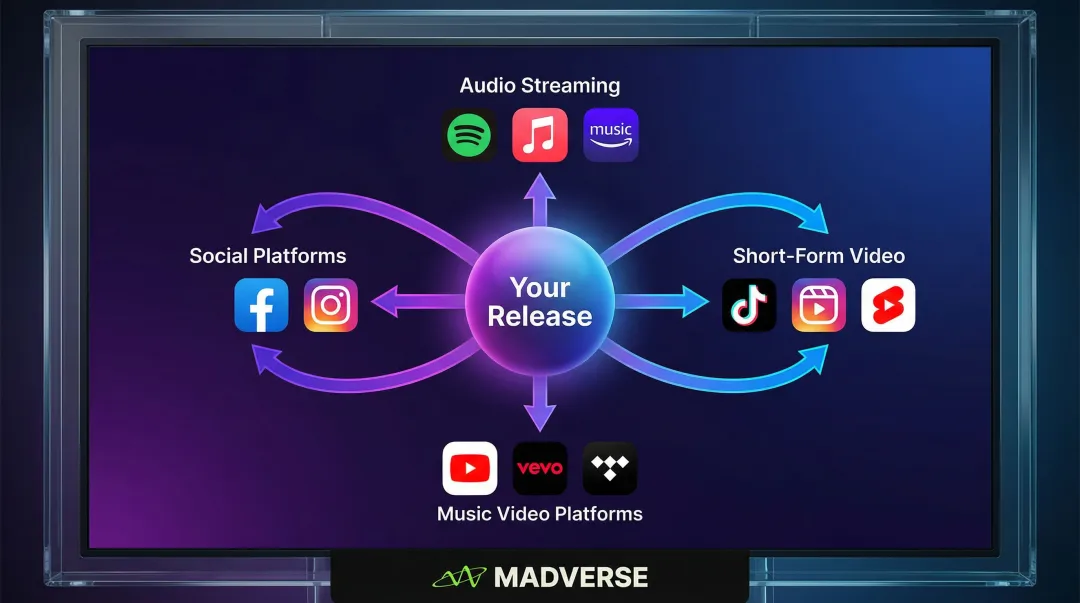
Modern distribution now requires simultaneous delivery across:
- Audio streaming (Spotify, Apple Music, Amazon Music)
- Short-form video (TikTok, Instagram Reels, YouTube Shorts)
- Music video platforms (YouTube, VEVO, Tidal)
- Social platforms (Facebook, Instagram audio library)
This convergence transforms distributors from audio-only services into multi-format content delivery networks. Distributors like Madverse now handle music videos to VEVO, Apple Music, and Tidal alongside traditional audio streaming.
How Fraud Prevention Has Evolved
As streaming payouts grow, so does the incentive for artificial streaming manipulation. Platforms are escalating enforcement .
Recent enforcement actions:
- Apple Music doubled penalties for streaming fraud in 2026, now fining 10-50% of royalties associated with fraudulent activity
- Apple removed billions of manipulated streams in 2025 alone
- Spotify charges distributors per-track fees when "flagrant" artificial streaming is detected
These platform crackdowns have forced distributors to implement stricter safeguards:
Distributor responses:
- Stricter ID verification during account creation
- AI monitoring systems detecting bot-driven listening patterns
- Proactive content review before delivery to platforms
- Immediate account suspension for fraud violations
Artists must choose distributors with strong fraud prevention, as platform penalties can result in permanent catalog removal and blacklisting.
Regional Market Insights: Where Distribution is Growing
North America and Europe remain revenue leaders, but the fastest growth is happening in emerging markets where mobile-first populations are adopting streaming rapidly.
Asia-Pacific: The Growth Engine
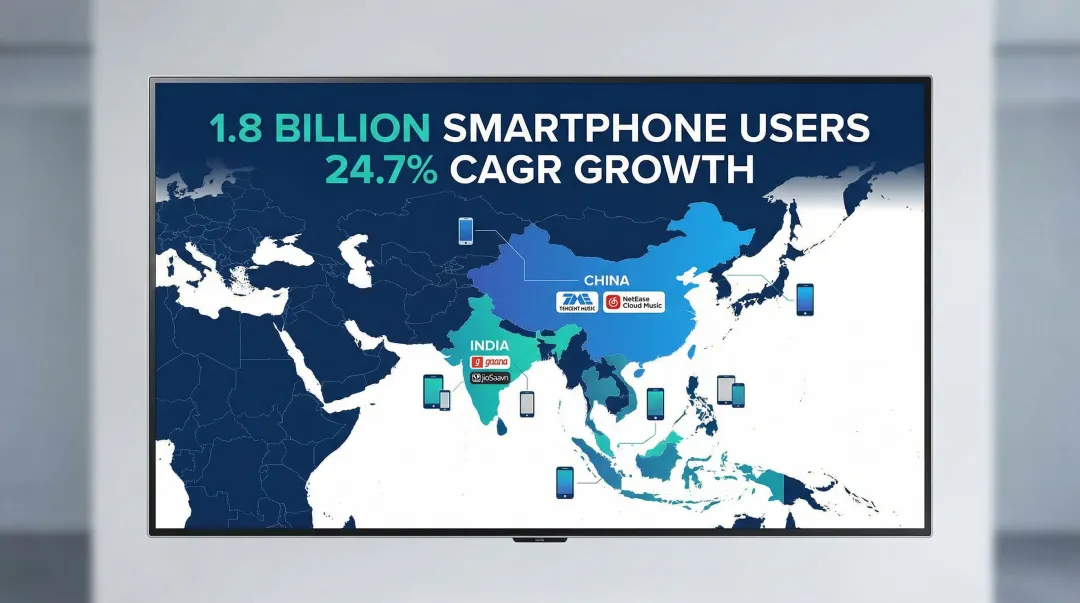
Asia-Pacific is projected to grow at 24.7% CAGR through 2031, making it the fastest-expanding region globally. This growth is driven by massive populations in China, India, and Southeast Asia gaining affordable smartphone access.
Key market dynamics:
- Mobile-first consumption: Over 1.8 billion smartphone users in 2024, with 75%+ downloading music streaming apps
- Localized payment systems: Credit card penetration remains low, making carrier billing critical—APAC accounts for 42% of global direct carrier billing
- Platform diversity: Success requires distribution to regional giants like Tencent (QQ Music, Kugou), NetEase Cloud Music, JioSaavn, and Gaana—not just Spotify and Apple Music
Artists entering these markets need distributors with established regional platform partnerships and integrated local payment systems. For independent artists targeting India and Southeast Asia, services like Madverse provide direct access to regional streaming giants alongside global platforms.
North America & Europe: Mature but Evolving
North America retained 33.75% of digital music market revenue in 2025, with Europe close behind. These markets feature near-universal internet access (87-91% penetration) and high streaming adoption.
Market characteristics:
- Subscriber saturation: Growth has slowed, with Apple Music and Amazon adding just six million combined subscribers in 2024
- Revenue per user focus: Platforms are increasing prices and launching high-fidelity tiers rather than chasing subscriber volume
- Advanced analytics demand: Artists in mature markets expect sophisticated data on listener behavior, playlist performance, and geographic trends
In these mature markets, distribution strategy shifts from breadth to depth. Detailed reporting, playlist relationships, and marketing tools matter more than basic delivery. Artists prioritize distributors offering advanced analytics and editorial playlist pitching services.
Emerging Markets: Latin America, Middle East, Africa
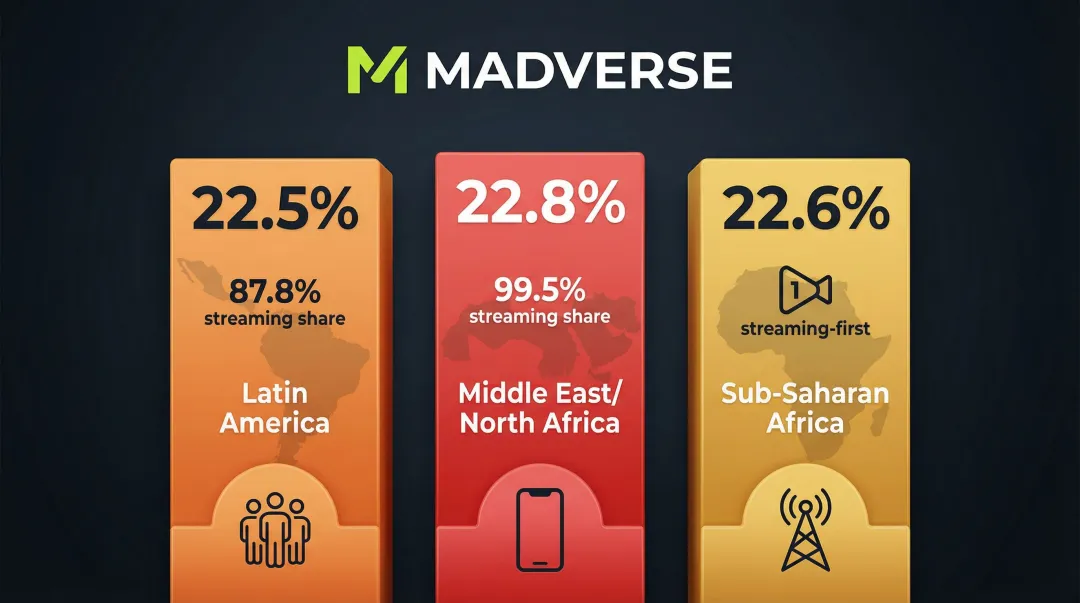
These regions posted the highest growth rates in 2024: MENA grew 22.8%, Sub-Saharan Africa 22.6%, and Latin America 22.5%. All three are characterized by young populations, improving broadband infrastructure, and almost entirely digital consumption.
Growth drivers:
- Youth demographics: Large populations of digital natives entering prime music consumption years
- Smartphone adoption: Rapid expansion of affordable Android devices
- Streaming-first markets: Physical and download revenues are negligible—streaming accounts for 99.5% of MENA revenues and 87.8% in Latin America
Independent artists find less competition in these emerging markets compared to saturated Western territories. With lower barrier to entry and growing audiences hungry for diverse content, these regions offer significant opportunities for artists willing to invest in localized marketing strategies.
How to Choose the Right Distribution Strategy
Selecting a distributor isn't just about price—it's about matching features to your career stage, release frequency, and growth goals.
Key Decision Factors
Evaluate based on:
- Budget constraints: Can you afford annual subscriptions, or do you need commission-based models?
- Release frequency: Prolific artists (6+ releases/year) benefit from unlimited upload plans
- Promotional support needs: Do you need just delivery, or playlist pitching and marketing help?
- Collaborator payments: How many tracks involve splits? Automated payment splitting saves significant administrative time
- Regional focus: Which geographic markets matter most for your genre and audience?
- Analytics requirements: Do you need basic reporting or sophisticated listener behaviour insights?
Framework for Evaluation
Compare distributors on:
- Pricing structure: Calculate your break-even point between flat-fee and commission models based on expected royalties
- Platform reach: Verify coverage of platforms where your audience listens—especially regional services
- Payment splitting: Confirm automatic collaborator payments if you frequently work with producers, featured artists, or co-writers
- Delivery speed: Check typical processing times and recommended advance upload windows
- Customer support: Review support quality through artist forums and reviews—you'll need help at some point
Once you've evaluated these factors, match your choice to where you are in your music career.
Matching Distribution to Career Stage
Beginners (first 1-5 releases): Commission-based distributors remove upfront costs while you test release strategies and build an audience. The 15% commission serves as a learning investment.
Established independents (consistent release schedule): Annual subscription platforms like DistroKid or TuneCore maximise value if you release 3+ times yearly, with unlimited uploads paying for themselves quickly.
Artists with traction (10,000+ monthly listeners): Label services tiers offer playlist pitching, marketing support, and sync licensing opportunities. Platforms like Madverse provide these benefits while artists retain 95% of royalties.
The Future of Music Distribution: What's Next
The music distribution landscape is consolidating around two fundamental shifts that will reshape how artists manage their careers and revenue.
Consolidated Royalty Collection
Distributors are expanding beyond sound recording royalties to handle publishing royalties (mechanical, performance, and sync) in a single platform. This consolidation addresses a major pain point: artists currently navigate separate systems for recording and composition income.
What's coming:
- One-stop shops managing both master and publishing rights globally
- Automated registration with performance rights organizations (ASCAP, BMI, PRS)
- Unified reporting showing all income sources in one dashboard
This evolution will particularly benefit singer-songwriters who own both their recordings and compositions. This evolution will particularly benefit singer-songwriters who own both their recordings and compositions. Platforms like Madverse are already moving in this direction, offering publishing services alongside distribution with royalty splits handled at source.
Data-Driven Decision Making
Artists now demand more than basic streaming counts. The next generation of distributors will provide sophisticated behavioral insights that inform which cities to tour, when to release singles, and where marketing budgets deliver the highest return.
Next-generation analytics:
- Playlist impact measurement: Quantify exactly how much traffic each playlist placement drives
- Geographic performance tracking: Identify emerging markets where your music is gaining traction before competitors notice
- Listener journey mapping: Understand how fans discover your music and which songs convert casual listeners to followers
- Predictive modeling: Forecast potential performance based on early streaming patterns
Distributors that deliver actionable insights—not just raw data—will lead the market as artists increasingly make data-informed decisions about their careers.
Frequently Asked Questions
What is the difference between a music distributor and a record label?
Distributors handle delivery and royalty collection without taking ownership. Record labels typically take 50-85% ownership in exchange for funding, marketing, and career development.
How much does music distribution typically cost?
Pricing models include free with 10-20% commission, annual subscriptions of ₹1,500-₹8,000 for unlimited releases, or per-release fees of ₹800-₹4,000. Label service tiers vary based on support level.
Can I use multiple distributors for different releases?
Yes, but each individual release must use only one distributor to avoid duplicate listings that confuse platforms and split streaming counts.
How long does it take for music to appear on streaming platforms?
Typical delivery times range from 1-7 business days for major platforms like Spotify and Apple Music. Most distributors recommend uploading 2-4 weeks before your release date to ensure approval and allow time for playlist pitching.
What is payment splitting and why is it important?
Payment splitting automatically pays collaborators their agreed percentages directly from royalties, eliminating manual accounting. This ensures producers, featured artists, and co-writers receive transparent, timely payments.
Which regions offer the most growth potential for independent artists?
Asia-Pacific leads with 24.7% projected CAGR through 2031, driven by mobile adoption in China and India. Latin America, Middle East, and Africa follow with 22%+ annual growth as streaming infrastructure improves and young populations embrace digital music consumption.