
Introduction
The music industry has undergone a seismic shift. Twenty years ago, getting your music heard meant convincing a record label to manufacture CDs and persuade record stores to stock them. Today, independent artists upload tracks from their bedrooms and reach listeners in 180+ countries within weeks.
Yet this democratization brings confusion. Many artists struggle with fundamental questions:
- Which distributor should I choose?
- How do I actually get my music on Spotify?
- Why am I not seeing all the royalties I expected?
- Will I lose ownership of my music?
This guide cuts through the confusion. You'll learn what digital music distribution actually is, how the process works from upload to payout, and how to choose the right distributor for your needs.
Whether you're releasing your first single or migrating an established catalog, you'll finish knowing exactly what to do next.
TLDR: Key Takeaways
- Digital distributors deliver your music to streaming platforms and collect recording royalties on your behalf
- Platforms like Spotify don't accept direct uploads—you need a distributor to act as intermediary
- Revenue share models matter more than platform count—prioritize automatic royalty splits and detailed analytics
- Distribution covers only master recording royalties, not composition royalties from publishing
- Plan 4-6 weeks lead time before release for proper platform delivery and playlist pitching opportunities
What Is Digital Music Distribution?
Definition and Core Function
Digital music distribution is the process of delivering your finished recordings from your studio to streaming platforms like Spotify, Apple Music, Amazon Music, YouTube Music, and Tidal.
Distributors act as intermediaries between you and these platforms, which don't accept direct uploads from independent artists.
Two distinct copyrights exist in every song:
- Sound recording (the master)—the actual recorded audio file you created
- Composition (the publishing)—the underlying musical work and lyrics
Distribution handles only the sound recording copyright. Publishing administration, which collects composition royalties, is a separate service.
Distributors format your music to meet each platform's technical specifications, deliver the files, and ensure proper metadata attachment. They collect streaming royalties generated when people listen, then pay those royalties to you according to their payment schedule.
The Evolution of Music Distribution
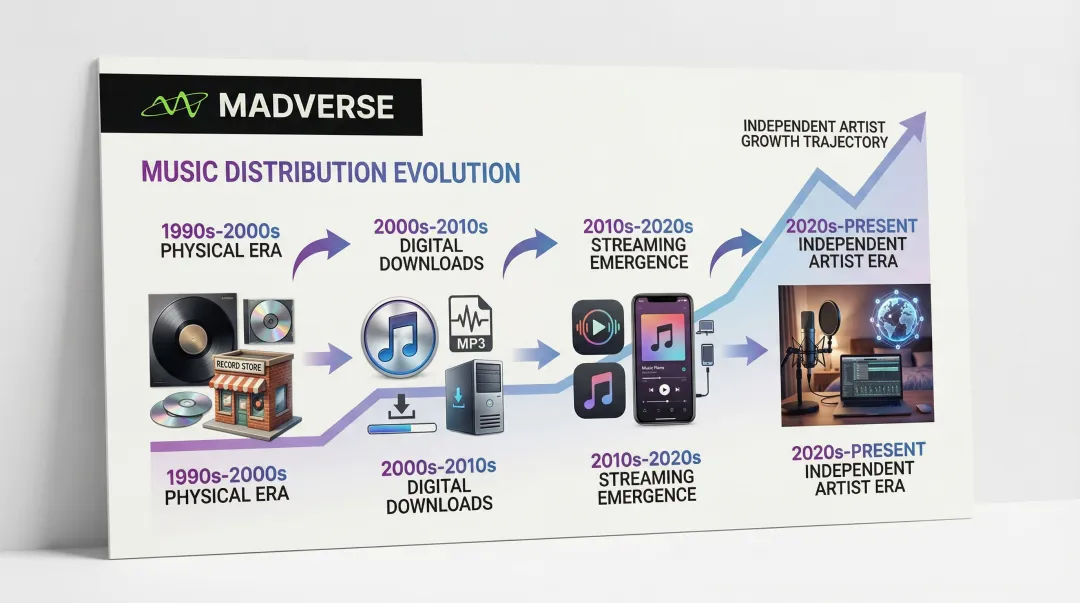
Traditional distribution required physical manufacturing and retail relationships. Labels pressed vinyl or CDs, shipped them to distributors, who then placed them in record stores.
Independent artists were locked out unless they secured label deals.
Streaming has fundamentally reshaped this landscape. The shift has opened doors for independent creators:
- Global streaming revenues reached US$20.4 billion in 2024, representing 69% of all recorded music revenue
- Paid subscriptions account for over 50% of the music industry's total income
- Approximately 112,000 tracks are uploaded daily, mostly from independent artists
This shift opened access to everyone. Digital distributors emerged to serve independent artists, eliminating the need for label relationships or physical inventory.
What Distribution Is NOT
Understanding distribution's limitations helps set realistic expectations.
Distribution makes your music available—it doesn't promote it. Distributors don't run marketing campaigns, pitch to radio, or guarantee playlist placements. Those responsibilities remain yours.
Publishing royalties require separate collection. Mechanical royalties (from reproductions), performance royalties (from public performances including streams), and sync licensing fees (from TV/film placements) need PROs and publishing administrators.
Delivery to streaming platforms doesn't guarantee listeners will find your music. Visibility requires marketing, audience building, and strategic release planning.
How Digital Music Distribution Works
The Distribution Workflow
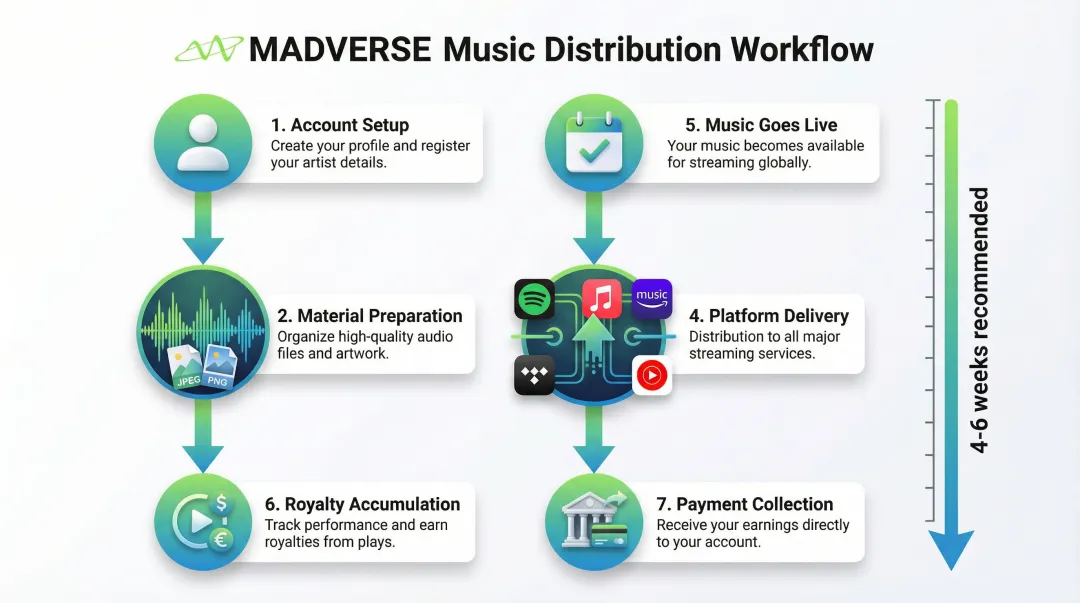
The distribution process follows a predictable sequence:
- Sign up with a distributor and create your account
- Prepare materials: finalise audio files, create cover art, gather metadata
- Submit release through the distributor's platform
- Distributor delivers formatted files to all selected platforms
- Music goes live on your chosen release date
- Royalties accumulate as listeners stream your music
- Distributor collects royalties from platforms and pays you
Timeline matters. Spotify recommends submitting at least 7 days before release for playlist pitching consideration. Most distributors recommend 4-6 weeks total lead time to ensure smooth delivery across all platforms and allow time for promotional planning.
This timeline accounts for backend processing: distributors must encode your audio to each platform's specifications, verify quality standards, and format metadata to meet varying requirements across Spotify, Apple Music, Amazon, and other services.
What You Need to Submit
Every distributor requires these core materials:
Audio files:
- WAV format (uncompressed)
- 16-bit/44.1kHz minimum (CD quality)
- 24-bit/48kHz or higher recommended
Cover art:
- 3000x3000 pixels minimum (most platforms)
- JPG or PNG format
- RGB colour mode
- No text mentioning streaming platforms or pricing
Metadata:
- Artist name (exactly as you want it displayed)
- Track titles and album/EP name
- Genre and subgenre
- Release date
- Primary artist and featured artists (formatted correctly)
- Songwriter and producer credits
- Explicit content flags
- Copyright information
Metadata accuracy is critical. Errors cause attribution problems, delay releases, and create royalty collection issues that can take months to resolve.
ISRCs and UPCs Explained
Every track needs an ISRC (International Standard Recording Code), a permanent unique identifier that follows that specific recording for its entire lifetime. Albums and EPs need a UPC (Universal Product Code) to identify the release as a product.
These codes enable accurate royalty tracking across platforms and territories. The International ISRC Database contains over 150 million unique ISRCs, forming the backbone of global music rights management.
Reputable distributors generate both ISRCs and UPCs automatically at no extra charge. Never release music without them, as this creates royalty tracking problems that take months to resolve.
Platform Delivery and Approval
Distributors typically deliver to 150+ platforms, though revenue concentrates heavily on the major players:
- Spotify
- Apple Music
- Amazon Music
- YouTube Music
- Tidal
- Deezer
- Pandora
- Instagram/Facebook
- TikTok
Delivery doesn't guarantee approval. Platforms reject releases for quality issues (distortion, clipping, poor mastering) or content policy violations.
Processing times vary by platform:
| Platform | Processing Time |
|---|---|
| Spotify | 2-5 days |
| Apple Music | 1-7 days |
| Amazon Music | 1-2 days |
| YouTube Music | 1-2 days |
Royalty Collection Process
Streaming generates royalties based on complex calculations. Spotify doesn't pay a fixed per-stream rate; royalties depend on "streamshare," your proportion of total platform streams in a given period. Rates vary by subscription tier, territory, and platform.
Your distributor collects royalties from every platform where your music appears, combines them into a single payment, and transfers funds according to their schedule.
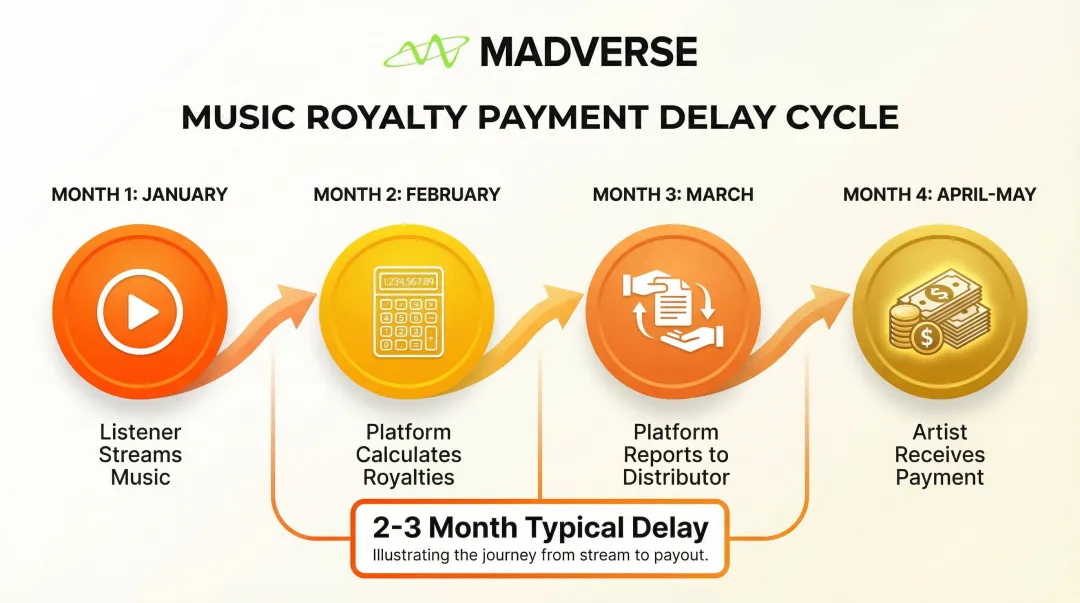
Expect delays. Platforms typically report royalties 2-3 months after the streaming month ends. If someone streams your song in January, you might not see payment until April or May.
Revenue Splits and Payments
Distributors use different business models:
- Percentage-based models let you keep 85-95% of royalties while the distributor takes 5-15%
- Annual subscription plans charge a flat fee and let you keep 100% of earnings
- Per-release pricing requires one-time payment per single or album, with full royalty retention
Payment thresholds vary. Some distributors pay once you reach ₹1,000, others have no minimum.
Payment methods include direct bank deposit, PayPal, wire transfer, and platform-specific payment systems.
Types of Digital Music Distributors
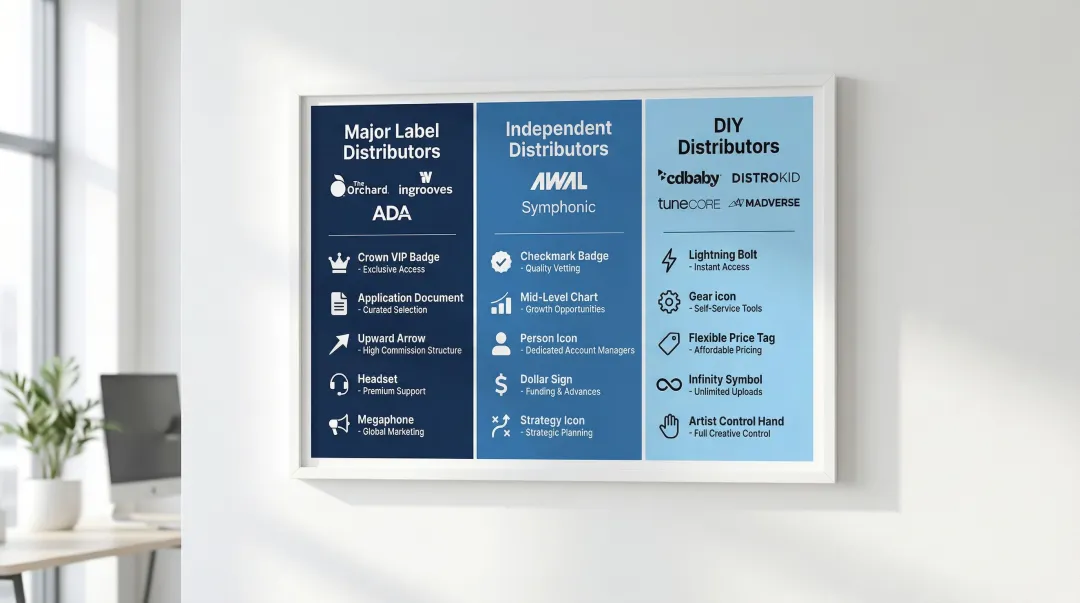
Major Label Distributors
Major distributors like Sony's The Orchard, Universal's Ingrooves, and Warner's ADA serve established artists and major labels. Access requires:
- Existing success metrics or streaming history
- Active label deals
- Application approval from distribution team
Independent artists starting out won't qualify for these channels.
Independent Distributors
Between major distributors and DIY platforms, mid-tier services like AWAL and Symphonic occupy the middle ground. They serve indie labels and selective independent artists through an application review process.
AWAL offers global release planning, digital strategy, and funding but accepts artists selectively based on streaming history and growth potential.
What you get in exchange for higher commission rates:
- Dedicated account managers
- Marketing support and strategy
- Funding advances for qualified artists
- More personalized service than DIY platforms
DIY/Aggregator Distributors
DIY distributors serve the majority of independent artists. Platforms like CD Baby, DistroKid, TuneCore, and Madverse offer self-service distribution with no approval gatekeeping—sign up and start distributing immediately.
For instance, Madverse allows artists to retain 95% of royalties while offering Dolby Atmos distribution, YouTube Content ID, and royalty splits at source.
This category shows the widest variation in pricing models, features, and service levels. Some charge per release, others offer unlimited uploads for annual fees. Feature sets range from basic distribution to advanced analytics, automatic royalty splits, and sync licensing opportunities.
How to Choose the Right Digital Distributor
Debunking Common Myths
Myth 1: Price is the most important factor
Distribution pricing has leveled out. Most services charge ₹800-₹4,000 annually or ₹400-₹2,000 per release. These differences matter less than you think over a multi-year career.
Focus instead on features that compound value: royalty split automation, detailed analytics, customer support quality, and additional revenue opportunities.
Myth 2: Number of platforms matters
All major distributors deliver to 150+ platforms. The reality? 99% of streaming revenue comes from roughly 20 major platforms that every reputable distributor covers.
Platform count is marketing noise. What matters is delivery reliability, metadata accuracy, and how quickly platforms process your releases.
Key Features to Evaluate
Revenue share models
The pricing structure impacts your long-term earnings:
- Madverse: Keep 95% of royalties
- DistroKid: Keep 100%, pay ₹1,900-₹7,400 annually
- TuneCore: Keep 100%, pay ₹1,900-₹4,100 annually
- CD Baby: Keep 91%, pay ₹800-₹2,400 per release
Calculate your break-even point. If you earn ₹40,000 annually in royalties, a 5% commission costs ₹2,000—potentially less than a flat annual fee.
Royalty splits at source
Advanced distributors like Madverse offer automatic royalty splitting. Designate percentages for collaborators, producers, or featured artists, and the distributor pays each party directly.
This eliminates manual calculations and payment coordination—critical when working with multiple collaborators across releases.
Payment speed and transparency
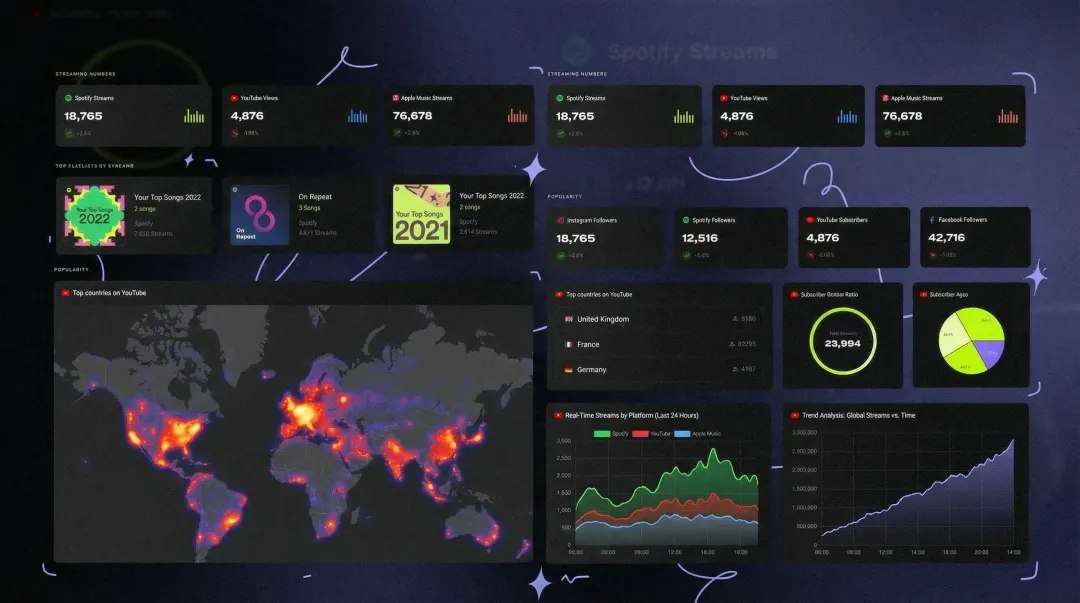
Some distributors pay monthly, others quarterly. Reporting transparency varies dramatically. Look for real-time analytics dashboards showing streams by platform, territory, and demographic.
Advanced Distribution Services
YouTube Content ID
This service scans YouTube for videos using your music and monetizes them automatically. Content ID identifies user-generated content matching your recordings and applies ads, generating revenue from covers, remixes, and unofficial uploads.
Music video distribution
Beyond audio streaming, some distributors deliver music videos to VEVO, Apple Music, Tidal, and other video platforms. This expands your presence and creates additional revenue streams.
Dolby Atmos and spatial audio
Premium formats continue growing. Apple Music and Amazon Music Unlimited both support Dolby Atmos, offering immersive listening experiences. Distributors supporting these formats position you for emerging consumption trends.
Editorial playlist pitching
Some distributors offer direct relationships with platform editorial teams, increasing playlist placement odds. While no one guarantees placements, established distributor relationships help.
Analytics and Insights
Detailed analytics separate good distributors from great ones. The most valuable dashboards provide:
- Real-time streaming data (not 2-3 month delays)
- Geographic breakdowns showing where listeners concentrate
- Demographic data (age, gender when available)
- Platform-by-platform performance comparison
- Playlist inclusion tracking
- Trend analysis showing growth trajectories
For labels and managers, roster management tools that aggregate data across multiple artists become essential.
Support and Migration
Customer support quality
Support options vary significantly across distributors:
- Dedicated account managers (premium services)
- Email ticket systems (standard)
- Live chat availability
- Response time commitments
- Knowledge base comprehensiveness
Madverse offers dedicated account managers for labels, providing personalized support that scales with your catalog size.
Catalog migration
Switching distributors requires careful planning. Look for services offering migration assistance—they'll coordinate takedowns from your old distributor and re-delivery through their system while preserving release dates, play counts, and playlist placements when possible.
Contract terms
Before committing, review these critical details:
- Do you retain 100% ownership of your masters?
- Can you remove releases anytime, or are you locked in?
- What happens to your music if you stop paying subscription fees?
- Are there takedown fees if you switch distributors?
Maximizing Revenue from Digital Distribution
Understanding the Full Royalty Picture
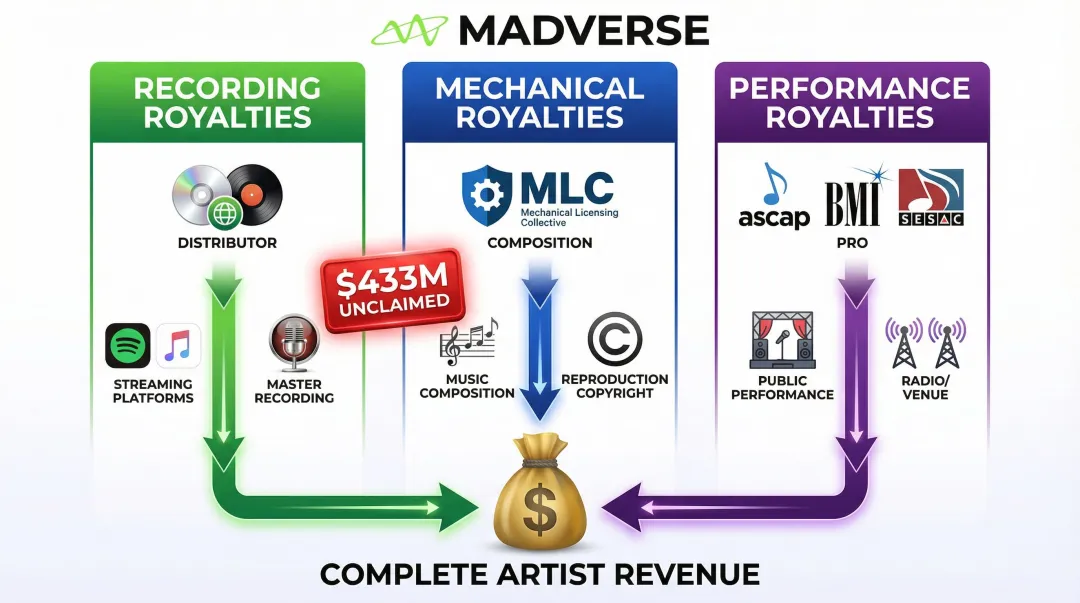
Streaming generates multiple royalty types, but distribution captures only one. Many artists collect only recording royalties, leaving significant money unclaimed.
The three main royalty streams:
- Recording royalties (distributor collects): Generated from the master recording
- Mechanical royalties (MLC collects in the US): Generated from composition reproduction
- Performance royalties (PROs collect): Generated from public performance of composition
The Mechanical Licensing Collective held approximately $433 million (approximately ₹3,600 crore) in unmatched royalties as of early 2024—money belonging to songwriters who haven't properly registered.
Publishing Administration Integration
Beyond distribution, you need to collect publishing royalties. Here's how:
- Register with your local PRO (IPRS in India; ASCAP, BMI, SESAC in the US; PRS in UK; APRA AMCOS in Australia)
- Register with The MLC if you're a US-based songwriter
- Register with SoundExchange for digital performance royalties
- Consider publishing administrators like Songtrust or Sentric for comprehensive global collection
Each registration takes 15-30 minutes but can unlock thousands in unclaimed royalties.
Leveraging Distribution for Sync Licensing
Some distributors offer sync licensing services, pitching your music for placement in TV shows, films, commercials, and video games. These placements generate upfront sync fees plus ongoing royalties.
Madverse's sync licensing team achieved a notable milestone by placing the first South Asian track in The Kardashians, demonstrating the reach possible through distributor sync relationships.
Sync opportunities require:
- High production quality
- Instrumental versions
- Cleared samples
- Quick turnaround capability
Platform Optimization Strategies
Distribution gets you on platforms—optimization gets you heard. Once your music is live, platform tools become your promotional engine.
Claim artist profiles:
- Spotify for Artists
- Apple Music for Artists
- Amazon Music for Artists
- YouTube Official Artist Channel
Use platform tools:
- Spotify Canvas (looping visuals)
- Apple Music Motion Artwork
- Lyrics synchronisation
- Artist playlists
Analyse performance data:
Use distributor analytics to identify:
- Which territories show strongest growth
- Which platforms drive most streams
- Listener demographics for targeting
- Optimal release timing based on past performance
Getting Started with Digital Music Distribution
Pre-Release Checklist
Before submitting to your distributor:
- Finalize and professionally master all audio files
- Create compliant cover art at correct dimensions
- Compile complete metadata (all credits, genres, dates)
- Register with a PRO and obtain your IPI number
- Consider publishing administration setup
- Plan promotional strategy and timeline
Action Steps for First-Time Distributors
Step 1: Research distributors
Compare 3-5 options based on:
- Revenue share model matching your release frequency
- Features you'll actually use (splits, analytics, video distribution)
- Support quality and responsiveness
- Migration policies if you later switch
Step 2: Sign up and explore
Create your account 6-8 weeks before your planned release. Use this lead time to familiarize yourself with the platform interface, upload requirements, and submission process.
Step 3: Submit your release
Upload with 4-6 weeks lead time:
- Double-check all metadata for accuracy
- Verify audio file quality (no clipping, proper levels)
- Confirm cover art meets specifications
- Select all desired platforms
- Set release date strategically (avoid major release Fridays when competing with major label drops)
Post-Release Best Practices
Once your music goes live, focus on three key areas:
Monitor your analytics:
- Check daily during release week to understand initial response
- Identify which promotional efforts drive streams
- Adjust your strategy based on real performance data
Engage with platform tools:
- Upload Spotify Canvas within the first week
- Add lyrics to Apple Music
- Create artist playlists featuring your release alongside complementary tracks
Maintain release momentum:
Consistency matters more than perfection. Spotify paid nearly $4.5 billion to independent rights holders in 2023, rewarding artists who maintain active release schedules and growing audiences.
Build momentum by releasing regularly—singles every 6-8 weeks, EPs annually, albums every 18-24 months.
Frequently Asked Questions
What does a digital music distributor do?
Digital music distributors deliver your music to streaming platforms like Spotify and Apple Music, handle technical formatting, and collect royalties on your behalf. They act as intermediaries since most platforms don't accept direct uploads from independent artists.
What are examples of digital distribution?
Major distributors include CD Baby, DistroKid, TuneCore, and Madverse. They distribute music to platforms like Spotify, Apple Music, Amazon Music, YouTube Music, Tidal, and 150+ other streaming services worldwide.
How much does digital music distribution cost?
Pricing varies by model: per-release fees (₹400-₹2,000), annual subscriptions (₹800-₹4,000), or percentage-based commissions (5-15% of royalties). Some services like Madverse let you keep 95% of royalties, while others charge flat fees but let you keep 100%.
How long does it take to get my music on streaming platforms?
Most platforms process releases in 1-7 days after submission, but distributors recommend 4-6 weeks total lead time. This allows time for delivery, approval, promotional planning, and editorial playlist pitching.
Can I distribute my music to multiple distributors?
No—this creates duplicate releases, metadata conflicts, and royalty splitting issues. Platforms may reject duplicates, so choose one distributor per release until you migrate your entire catalog.
What's the difference between a distributor and a publisher?
Distributors handle sound recordings and collect streaming royalties from master recordings. Publishers handle musical compositions and collect mechanical, performance, and sync royalties from the underlying songwriting. You need both to capture all revenue streams.