
Introduction
Picture this: An independent artist gets a call that their song has been selected for a major Netflix series. Within weeks, their streaming numbers explode, their social media following triples, and they earn more from that single placement than from an entire year of streaming royalties. This isn't fantasy—it's the reality of sync licensing, where a single placement can generate the equivalent of 2-3 million Spotify streams in upfront fees alone.
For independent artists, understanding sync vs master rights directly impacts your earnings potential. While streaming pays roughly ₹0.25-₹0.40 per stream, sync placements can range from ₹40,000 for indie projects to ₹40 lakh+ for major commercials.
Yet many artists unknowingly sign away these lucrative rights without understanding what they're giving up. The difference? Tens of thousands of rupees from a single opportunity.
This guide covers what sync and master rights are, who controls them, how they generate income, and how to capture these opportunities while retaining maximum ownership.
Key Takeaways
- Sync licenses cover the composition (the song); master licenses cover the recording
- Most placements need both licenses, typically controlled by different rights holders
- Independent artists who own both rights can negotiate as a "one-stop" and keep 100% of licensing fees
- Placements generate upfront fees plus backend royalties through PROs
- Prepare instrumental versions, clean metadata, and PRO registration to secure opportunities
Sync vs Master Rights: Quick Comparison
Understanding the difference between sync and master rights is essential when licensing music for media projects. Here's a side-by-side breakdown:
| Element | Sync License | Master License |
|---|---|---|
| What It Covers | Musical composition (melody, lyrics, arrangement) | Specific sound recording (performance, production) |
| Rights Holder | Songwriter, composer, or publisher | Record label or recording owner |
| What It Permits | Use of the underlying song regardless of version | Use of the exact recorded version only |
| Income Generated | Upfront sync fee + backend performance royalties | Upfront master fee (no backend royalties) |
| Negotiated With | Music publisher or PRO | Record label or independent artist |
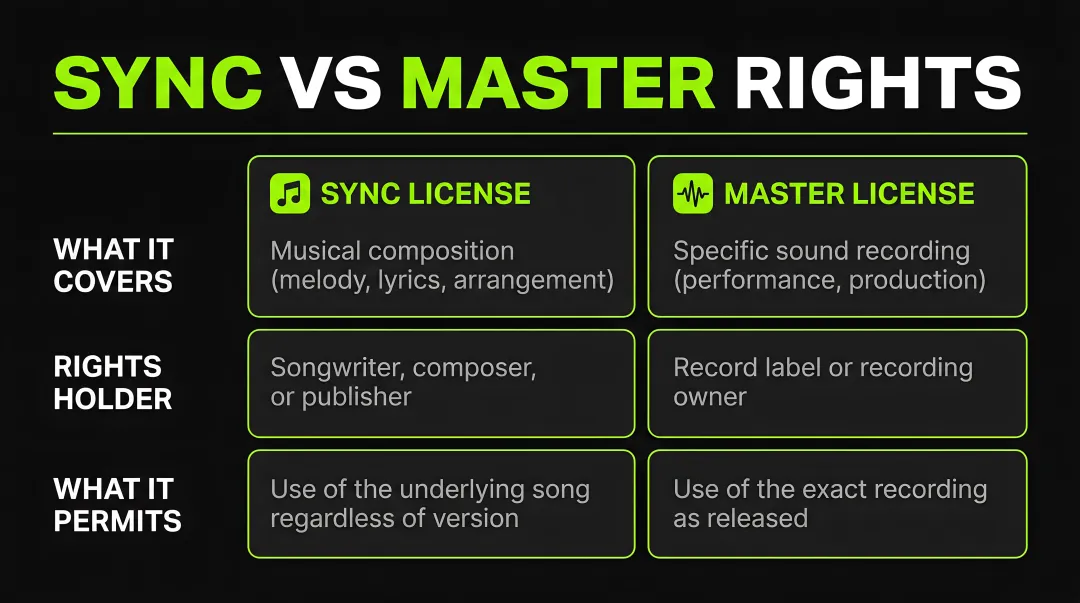
The key distinction: sync licenses cover the composition itself, while master licenses cover the specific recording. Both are typically required for most media placements.
For independent artists who own their recordings, this means you control both rights—giving you flexibility in licensing negotiations and the ability to retain a larger share of licensing revenue.
What is a Sync License?
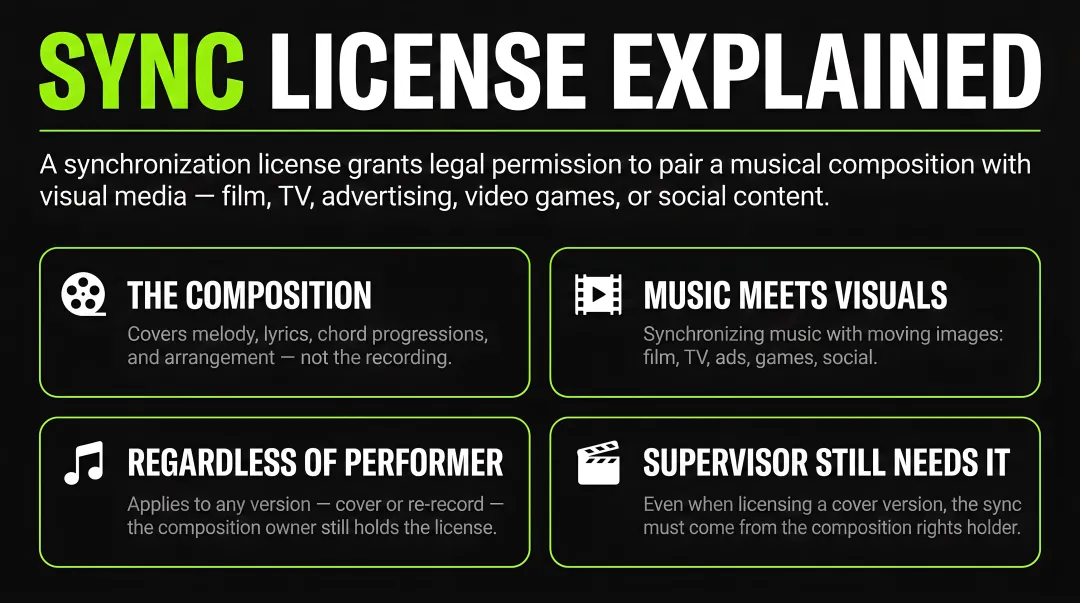
A synchronization license grants legal permission to pair a musical composition with visual media—film, TV, advertising, video games, or social content. The term "sync" refers to synchronizing music with moving images.
Sync licenses cover the underlying composition: the melody, lyrics, chord progressions, and arrangement. This means the license applies regardless of who performs the song.
If a supervisor wants to use a cover version or re-record, they still need the sync license from whoever controls the composition rights.
Who controls sync rights:
- The songwriter or composer (if they retain publishing)
- The music publisher (if rights were assigned)
- A publishing administrator or PRO in some cases
Income streams from sync licenses:
Sync licenses generate two distinct revenue streams for rights holders.
One-time sync fees are negotiated based on usage scope and vary dramatically:
- Indie films: ₹40,000-₹4 lakh
- Network TV episodes: ₹80,000-₹8 lakh
- Major commercials: ₹8 lakh-₹1.2 crore+
According to the IFPI Global Music Report 2024, global sync revenues reached US$632 million in 2023, showing steady growth.
Performance royalties provide ongoing income whenever the content airs publicly. Performance Rights Organisations (PROs) like ASCAP, BMI, or SESAC collect these and distribute them to songwriters and publishers.
For hit shows that air globally and enter syndication, backend royalties can eventually exceed the initial sync fee.
Use Cases of Sync Licenses
TV and streaming series use sync licenses for:
- Background scoring during emotional scenes or montages
- Opening and closing theme songs
- Featured placements where lyrics drive narrative
Film placements range from indie festival films to major studio releases, with fees scaling accordingly based on budget and prominence.
Commercials and brand campaigns represent the highest-paying opportunities. A single national commercial can generate ₹8-40 lakh+ because brands value the association with specific songs that resonate with their target audience.
Video games, YouTube content, and social campaigns increasingly require sync licenses, creating new revenue streams for independent artists.
Real breakthrough example: Canadian indie artist Feist saw her career transform after Apple used "1234" in an iPod Nano commercial. Weekly downloads skyrocketed from 2,000 to 73,000, the song hit No. 8 on the Billboard Hot 100, and her album sales jumped to 19,000 units per week.
What is a Master License?
A master license grants legal permission to use a specific sound recording of a song—the actual audio file with its unique performance, production, and sonic characteristics.
Master rights cover everything captured in the recording session: the vocalist's performance, instrumental arrangement, production choices, mixing, and mastering. Sync rights apply to any version of a composition. Master rights? They're tied to one specific recording.
Who controls master rights:
- Record labels (in traditional deals)
- Independent artists who recorded and own their masters
- Whoever funded and owns the recording session
Why Both Licenses Matter
To use a track in visual media, licensees need permission to use both the composition (sync license) and the specific recording (master license). This dual-clearance requirement means music supervisors must negotiate with two separate rights holders—unless the artist owns both.
Artists who own their masters control 100% of master licensing decisions and keep the full master fee. In traditional label deals, labels typically retain 50-80% of master licensing income.
Those distributing through platforms like Madverse maintain complete ownership, allowing them to respond quickly to licensing requests and negotiate directly without label approval processes.
Use Cases of Master Licenses
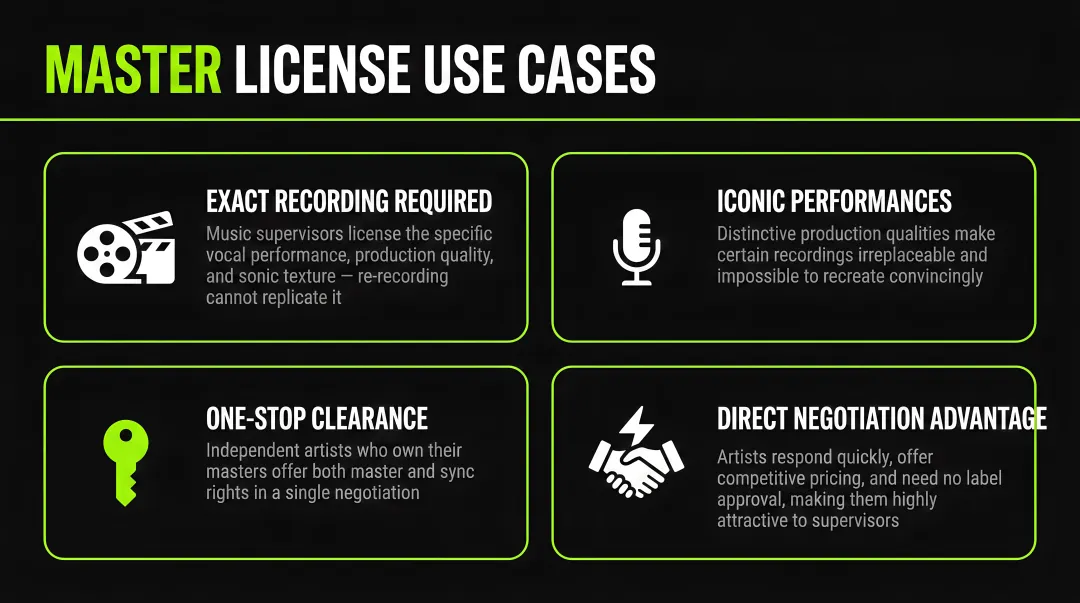
Music supervisors need master licenses when they want the exact recording—the specific vocal performance, production quality, and sonic texture. Re-recording isn't always an option. Iconic performances with distinctive production qualities can't be easily replicated.
Independent artists who own their masters offer "one-stop" clearance. They respond quickly to licensing requests, offer competitive pricing, and negotiate directly without label approval processes. This makes them attractive to supervisors working under tight deadlines.
Master ownership significantly impacts long-term earning potential. Artists on traditional deals might see only 20-50% of master licensing fees after label recoupment. Independent artists retain 100% when they own their recordings.
Platforms like Madverse allow artists to distribute globally while retaining 100% ownership of their masters and keeping 95% of royalties, positioning them to maximize sync licensing income.
Sync vs Master Rights: Which Do You Need?
Music supervisors and content creators typically need BOTH licenses for a single placement. Which rights you control depends on your role:
Songwriter who didn't record it: You control sync rights only. You'll earn the sync fee and backend performance royalties, but someone else controls the master.
Recording artist who didn't write the song: You control master rights only. You'll earn the master fee but not sync fees or performance royalties.
Both songwriter and recording artist: You control both rights (typical for independent artists). This "one-stop" clearance is a competitive advantage—you can negotiate a single combined fee, respond faster, and keep 100% of the total payment.
Once you understand which rights you control, preparing your catalog properly makes the difference between landing placements and getting passed over.
Preparing Your Catalog for Licensing
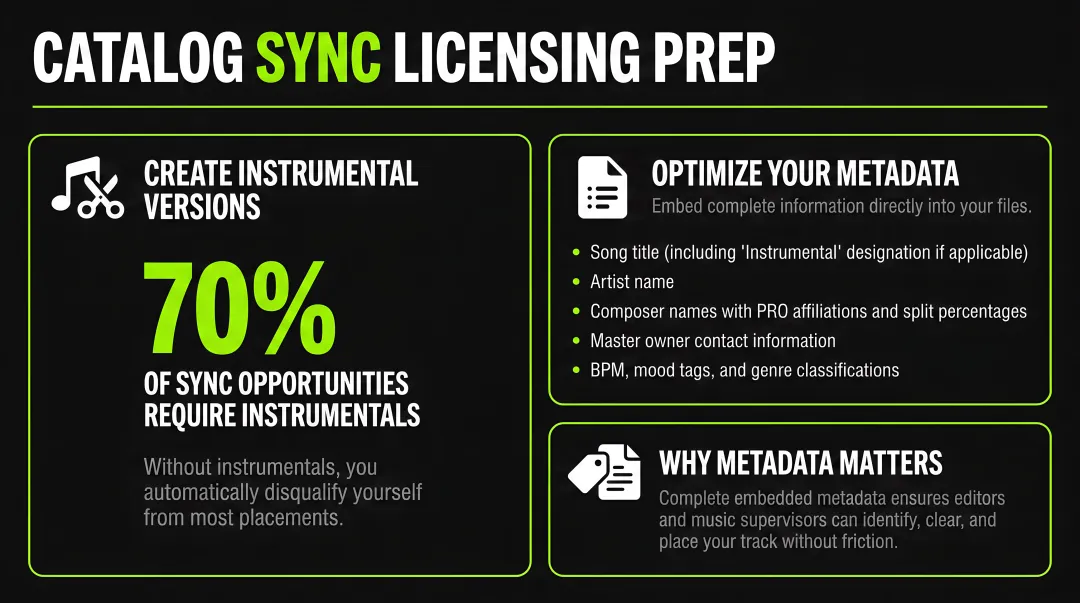
Create instrumental versions: Up to 70% of sync opportunities require instrumentals so editors can mix music under dialogue. Without instrumentals, you automatically disqualify yourself from most placements.
Optimize metadata: Embed complete information directly into your files:
- Song title (including "Instrumental" designation if applicable)
- Artist name
- Composer names with PRO affiliations and split percentages
- Master owner contact information
- BPM, mood tags, and genre classifications
Register with a PRO: Join ASCAP, BMI, SESAC, or your local PRO to collect backend performance royalties. Without registration, you forfeit ongoing income from airplay.
Deliver high-quality files: Maintain WAV or AIFF versions (lossless) for final delivery, alongside high-quality MP3s (320kbps) for pitching.
Work with distribution platforms offering sync services: For independent artists controlling both rights, services like Madverse streamline the entire sync process—accessing opportunities, pitching to supervisors, handling licensing paperwork—while you retain ownership and keep 95% of royalties. This one-stop approach makes you more attractive to music supervisors seeking fast, simple clearance.
Real World Examples and Case Studies
Case Study: Madverse's Historic Kardashians Placement
Madverse achieved a significant cultural milestone by placing the first-ever South-Asian track in "The Kardashians". This placement demonstrated several critical realities about modern sync licensing:
Key insights from this placement:
- The placement proved that diverse, non-Western music can compete for and win placements in mainstream Western media, opening doors for artists from underrepresented markets
- Independent artists working with distribution platforms that offer dedicated sync services can access the same opportunities as major label artists
- Because Madverse artists retain 100% ownership of their masters, they capture the full value of these placements rather than splitting fees with labels
Case Study: Kate Bush's "Running Up That Hill"
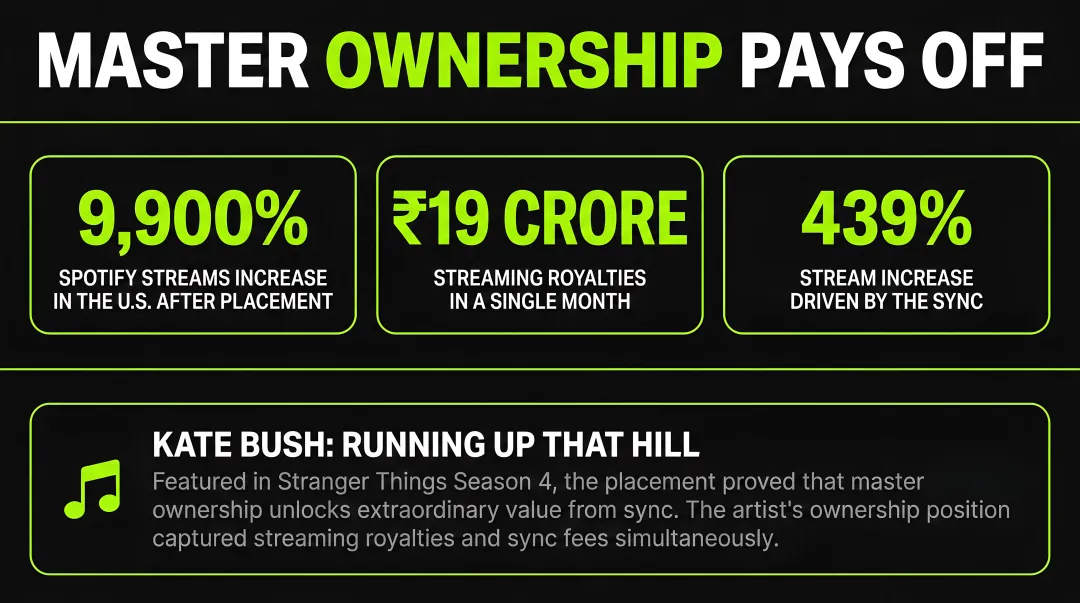
Master ownership isn't just valuable for emerging artists. When "Running Up That Hill" was featured in Stranger Things Season 4, Kate Bush's ownership position allowed her to capture extraordinary value from the placement.
The numbers tell the story:
- Spotify streams increased by 9,900% in the U.S. alone following the placement
- The placement generated over ₹19 crore in streaming royalties in a single month, plus substantial sync licensing fees
- The sync drove a 439% increase in streams across her entire discography, proving that major placements create a halo effect that benefits an artist's full catalogue
- According to Spotify for Artists data, emerging artist Baby Queen saw a 1,134% increase in discoveries the week after her song appeared in Heartstopper, gaining 1.5 million new listeners in 28 days
Key Takeaway
Independent artists with proper distribution and licensing support can compete for major placements while retaining ownership and maximising royalties.
The combination of master ownership, professional distribution, and dedicated sync licensing support creates opportunities that were previously accessible only to major label artists. Platforms like Madverse help independent artists access sync licensing while keeping 95% of royalties and maintaining full ownership of their masters. Contact Madverse to learn how their sync licensing services can help you monetise your catalog.
Conclusion
Understanding sync vs master rights isn't academic—it's about empowering yourself to make informed decisions that protect your work and maximise income. The distinction between these two rights determines who gets paid, how much, and who controls your music's commercial future.
For independent artists, ownership translates directly to control and income. Those who own their masters and publishing control 100% of licensing decisions, negotiate better deals, and capture the full economic value of their work.
When you work with distribution platforms that provide sync licensing services—like Madverse, where you keep 95% of royalties with splits handled at source—you gain access to opportunities while retaining the ownership percentages that major label artists often sacrifice.
The sync licensing market continues to grow, reaching ₹5,200 crore globally in 2023. With proper preparation, ownership structure, and platform support, independent artists can capture their share of this lucrative revenue stream.
Frequently Asked Questions
What is the difference between master rights and sync rights?
Sync rights cover the composition (melody, lyrics, arrangement), while master rights cover the specific recording (the audio performance). Both are needed for placements, controlled by different rights holders, and generate separate fees.
Who gets sync royalties?
Songwriters/publishers receive the sync license fee; recording owners receive the master license fee. PROs pay backend performance royalties to songwriters and publishers when content airs publicly.
How much money can you make from sync licensing?
Income varies by placement type: indie projects typically pay ₹40,000-₹4 lakh; network TV episodes ₹80,000-₹8 lakh; major commercials ₹8 lakh-₹4 crore+. Backend performance royalties can exceed upfront fees over time.
Do I need both a sync and master license if I wrote and recorded the song myself?
Yes, both licenses are still legally required, but owning both rights means you negotiate as one entity and keep all fees. This "one-stop" clearance is an advantage—supervisors prefer it because it simplifies and speeds up approval.
How do music distribution platforms help with sync licensing?
Platforms like Madverse pitch music to supervisors, handle licensing paperwork, and provide sync opportunities with dedicated support. Artists retain ownership and keep 95% of royalties while accessing professional infrastructure and industry connections.
What should I do to prepare my music for sync licensing opportunities?
Prepare your music by:
- Creating instrumental versions of all tracks
- Embedding proper metadata in files
- Registering with a PRO to collect performance royalties
- Delivering high-quality WAV files
- Working with a platform offering sync licensing services and industry connections