On April 11, 2025, YouTube rolled out Music Assistant, an AI-powered tool that generates copyright-free instrumental tracks directly within YouTube Studio. Available to US-based creators in the YouTube Partner Program with Creator Music beta access, this tool lets you describe the music you need in plain text and receive custom-generated tracks in minutes—completely free.
In this article, you'll learn how Music Assistant works, who can access it, how to generate custom soundtracks with text prompts, and what this means for both content creators and musicians competing in the creator economy.
TLDR: Key Takeaways About YouTube's AI Music Assistant
- Generates copyright-free instrumental tracks from text prompts describing mood, genre, and video context
- Limited to US-based YouTube Partner Program members with Creator Music beta access
- Free to use without copyright claims or licensing fees—saves creators ₹8,000-25,000 annually
- Powered by DeepMind's Lyria model with SynthID watermarking for provenance tracking
- Instrumental-only format leaves room for human-made music in vocal-driven and premium content
What is YouTube's AI Music Assistant?
YouTube has launched an AI tool that creates custom background music on demand. Music Assistant lives inside YouTube Studio's Creator Music marketplace, letting eligible creators type descriptions like "upbeat electronic loop" or "melancholic piano" and receive original instrumental tracks within seconds.
Unlike traditional stock music libraries where you browse pre-made tracks, this tool generates entirely new audio tailored to your specific needs.
Evolution from Dream Track to Music Assistant
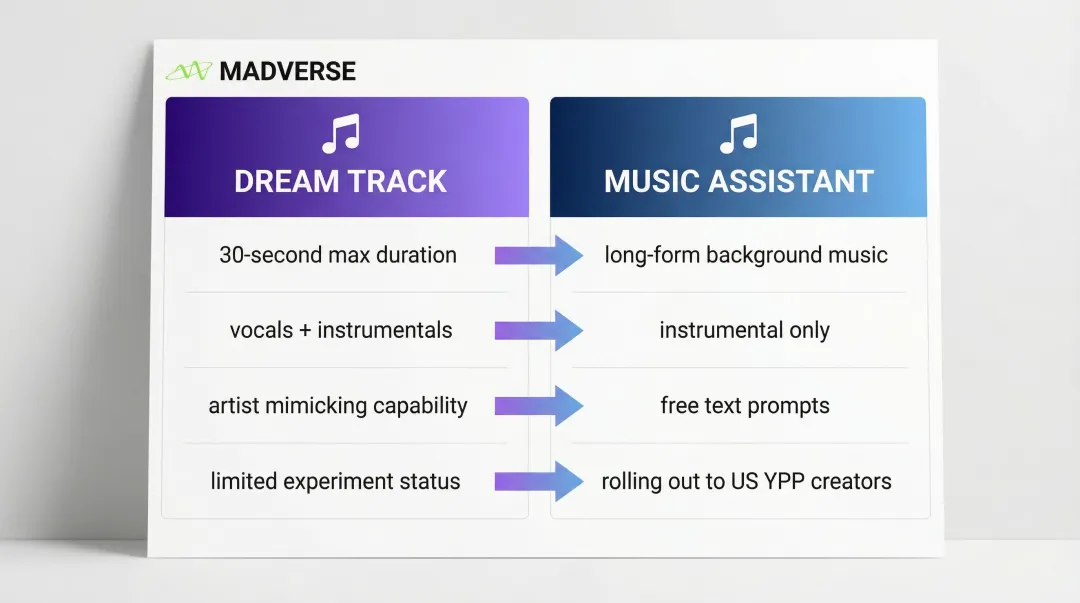
YouTube has deployed DeepMind's Lyria music generation model in two distinct ways:
| Feature | Dream Track | Music Assistant |
|---|---|---|
| Primary Use | YouTube Shorts (30 seconds max) | Long-form video background music |
| Audio Type | Vocals + instrumentals mimicking specific artists | Instrumental only |
| Input Method | Text prompt + artist selection carousel | Free text describing mood/genre |
| Availability | Limited experiment with select artists (Charlie Puth, T-Pain) | Rolling out to US YPP creators |
The instrumental-only approach solves a critical problem for creators: copyright complications. By generating instrumentals without vocals, Music Assistant avoids the complex rights issues surrounding voice likeness and artist representation. This makes the tracks safer for commercial use in monetized videos.
The tool targets practical production needs rather than creative experimentation. Creators can generate unlimited variations until they find the right mood for their content.
The Technology: DeepMind's Lyria and SynthID
Music Assistant runs on Lyria, Google DeepMind's most advanced music generation model, designed to handle complex musical structures. Every generated track includes SynthID, an inaudible digital watermark that converts audio waves into 2D visualizations to embed provenance data (origin information). This watermark remains detectable even after MP3 compression, noise addition, or speed changes.
The SynthID watermark matters for the broader music ecosystem. As AI-generated tracks enter distribution channels, platforms like Spotify and Apple Music will need ways to identify synthetic content. For independent artists using services like Madverse for distribution, this technology signals how AI music may be tracked and categorized separately from human-created work in the future.
Who Can Access Music Assistant?
YouTube currently restricts access to creators who meet three criteria:
- YouTube Partner Program membership — You must be an accepted YPP member
- US location — The tool is only available to creators based in the United States
- Creator Music beta access — You need the Creator Music feature enabled in YouTube Studio
For creators outside the US: The geographic restriction means international creators cannot access this tool yet, even with YPP membership. YouTube has not announced expansion plans for other regions, including major markets like India, UK, or EU.
The limited rollout gives US-based creators early access to royalty-free background music, while international creators must continue using traditional stock music libraries or commissioned tracks.
How to Use Music Assistant: Step-by-Step Guide
Accessing the Tool
Eligible creators access Music Assistant through the Creator Music section of YouTube Studio, where a dedicated "Music Assistant" tab appears for those with beta access.
Creating Effective Text Prompts
Once inside, you'll see a simple text field where you describe the audio you need. Successful prompts typically include:
- Mood descriptors - Uplifting, calm, energetic, mysterious, dramatic
- Instrumentation - Acoustic guitar, electronic synth, piano, strings
- Video context - Tech review, meditation video, workout montage, travel vlog
- Tempo indicators - Fast-paced, slow, moderate
Example prompts that work well:
- "Uplifting electronic music with synth for tech product review"
- "Calm acoustic guitar instrumental for meditation and relaxation video"
- "Energetic drum and bass track for fitness workout montage"
- "Ambient piano music with soft strings for travel vlog background"
The Generation Process
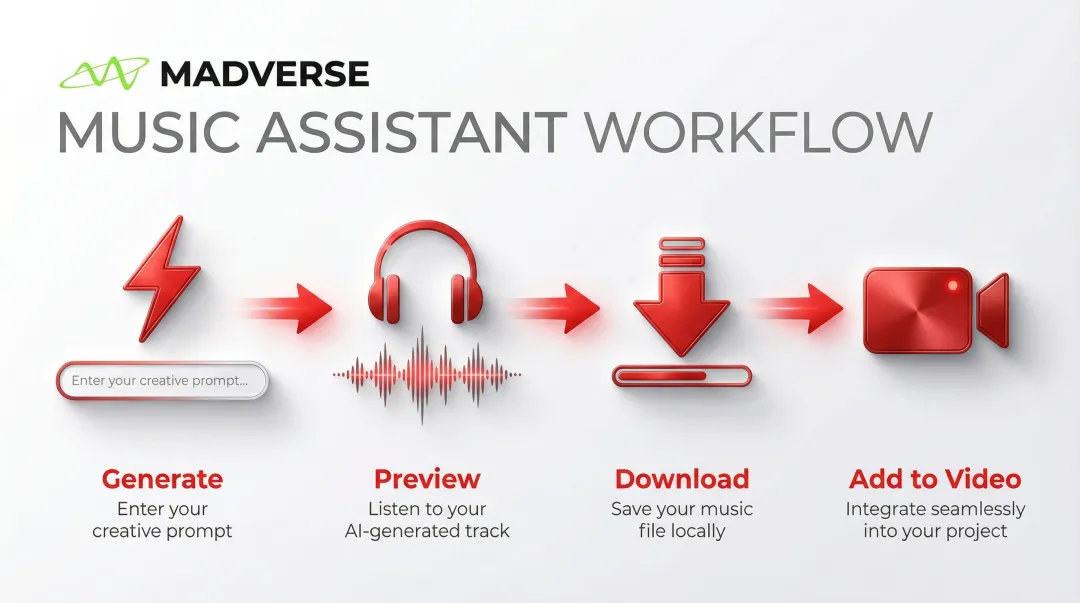
After entering your prompt, the AI generates several track options within seconds. Here's what happens next:
- Generate - The AI creates multiple track variations from your description
- Preview - Listen to each option against your video footage
- Download - Select and download your preferred track
- Add to video - Import directly into YouTube's editor
If you're unsure where to start, the tool provides suggested prompts to guide you.
Tips for Better Results
- Be specific - "Upbeat electronic music for cooking tutorial" works better than just "happy music"
- Try multiple variations - Generate several batches if the first results don't match your vision
- Preview with video - Play tracks alongside your video footage to check timing and mood alignment
- Mix descriptors - Combine mood, genre, and context for more targeted results
Benefits for Content Creators
Complete Copyright Safety
YouTube explicitly states that Music Assistant tracks are "free to use" without copyright concerns. This eliminates:
- Content ID claims that trigger revenue sharing
- Copyright strikes that jeopardize channel standing
- Manual disputes and appeals processes
- Uncertainty about audio clearance
Significant Cost Savings
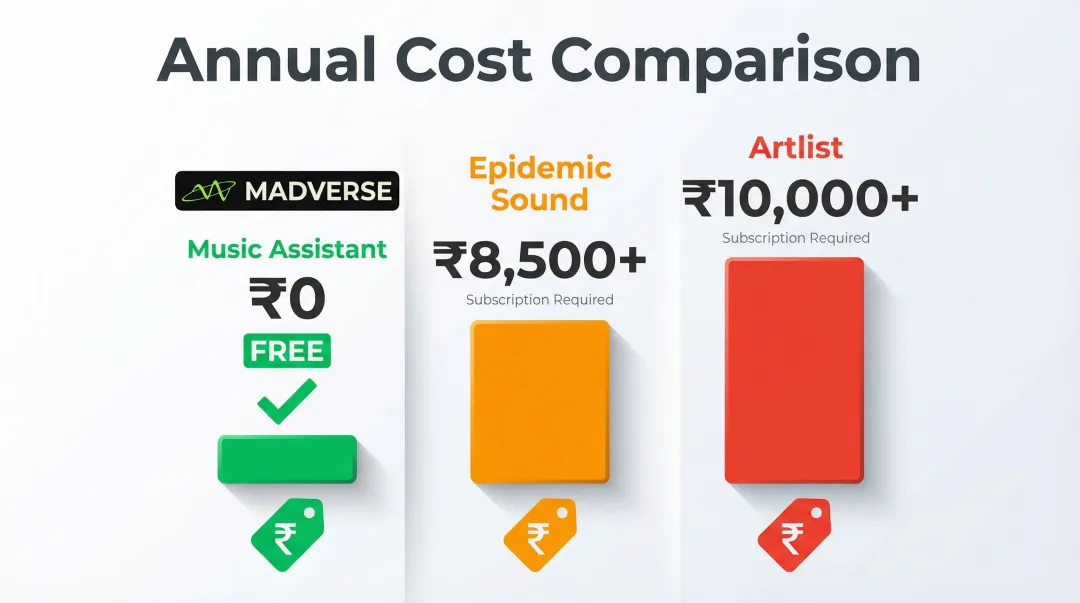
Beyond copyright protection, Music Assistant delivers substantial financial benefits. Traditional production music subscriptions cost ₹8,500-25,000 annually, while Music Assistant offers a free alternative for background instrumentals:
| Service | Annual Cost | Notes |
|---|---|---|
| Music Assistant | ₹0 | Free for eligible creators |
| Epidemic Sound | ₹8,500+ | Varies by plan tier |
| Artlist | ₹10,000+ | Subscription required |
For creators producing high volumes of content, replacing paid subscriptions with Music Assistant could save thousands of rupees annually while maintaining legal safety.
Creative Flexibility
Music Assistant eliminates the tedious search through stock music libraries. Instead of settling for "close enough," you generate exactly what your content needs.
The tool excels at creating:
- 30-second upbeat transitions for quick cuts
- Two-minute ambient backgrounds for voiceovers
- Genre-specific instrumentals matching your brand style
- Custom-length tracks fitting precise editing requirements
Simply describe your vision, generate options, and refine until the track perfectly complements your content.
Implications for Musicians & the Music Industry
The Sync Licensing Market Context
Music Assistant enters a growing market. The global sync licensing market was valued at $6.8 billion in 2024 and is projected to expand at 8.2% annually through 2033, driven by escalating use of licensed audio-visual content on platforms like YouTube.
Human-Made Music Remains Strong
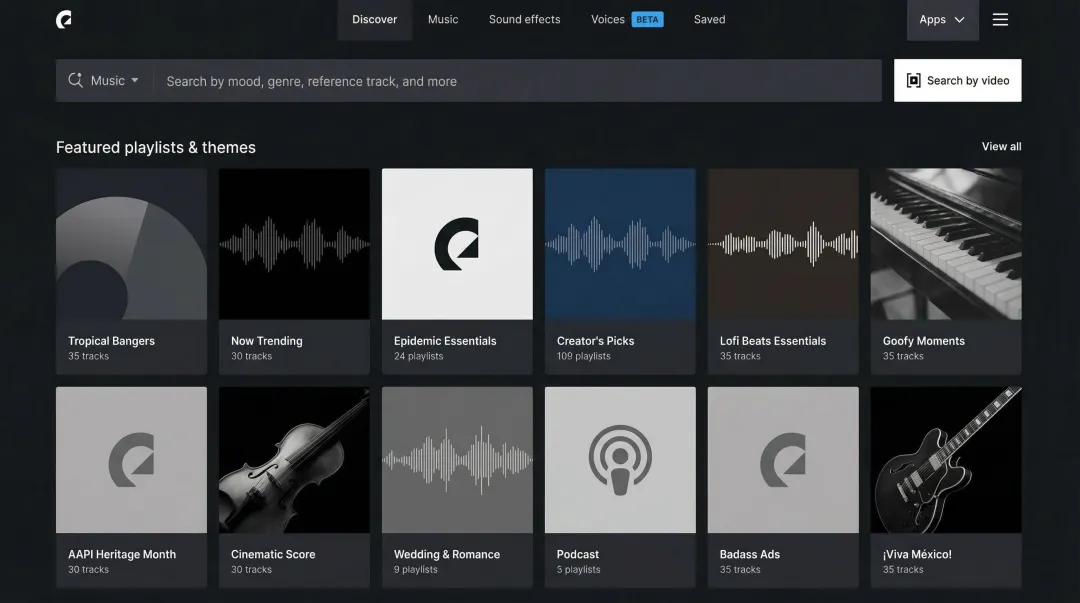
Despite AI tools entering the market, traditional production music companies continue thriving. Epidemic Sound reported 29% year-over-year revenue growth in 2024, reaching $181.6 million, with adjusted EBITDA soaring 150% to $13.9 million.
A split ecosystem is emerging. AI handles functional background audio while human music serves premium, emotional, or artist-centric needs.
This split creates new opportunities for independent artists.
Opportunities for Independent Artists
The creator economy's explosive growth means more content creators need music than ever before. Independent artists can take advantage of this demand by:
- Making original tracks discoverable in YouTube's Creator Music marketplace where creators actively search for licensable music
- Pursuing placements in TV, movies, commercials, and video games where human creativity commands premium rates
- Partnering directly with content creators who need consistent, branded audio
Distribution platforms help independent artists reach global audiences while retaining 95% of royalties. Getting tracks into YouTube Content ID and streaming platforms makes music discoverable to creators searching for alternatives to generic AI instrumentals.
Services like Madverse also offer sync licensing for TV, film, and advertising—providing additional revenue streams beyond streaming royalties.
The Competitive Landscape
Music Assistant creates pressure on the lower end of the stock music market—generic background tracks that serve purely functional purposes. However, creators still need:
- Music Assistant only generates instrumentals, leaving vocal tracks as an artist opportunity
- Brand partnerships and licensed popular music for specific artist sounds
- High-end scores for professional productions
- Custom music that differentiates channels and builds unique sonic identity
Human musicians who focus on distinctive style, emotional depth, and professional quality will continue finding opportunities in the creator economy.
Limitations & Considerations
Current Functional Constraints
Music Assistant has several notable limitations:
- Instrumental only - No vocals or lyrics, limiting use cases
- US-only access - International creators cannot generate tracks yet
- Quality variations - As with all AI generation, output quality varies by prompt
- Genre coverage - Limited by training data, may not cover niche or emerging genres
- Background focus - Positioned for supporting audio, not featured music
When to Use Licensed Human-Made Music
Creators should still invest in licensed music for:
- Brand partnerships - Sponsors often require specific music or production standards
- Vocal requirements - Any video needing lyrics or singing
- Premium productions - High-stakes content where audio quality directly impacts brand perception
- Channel identity - Consistent sonic branding that distinguishes your content
Regulatory Context: The NO FAKES Act
Understanding these practical limitations becomes even more important as regulatory frameworks evolve around AI-generated content.
The NO FAKES Act (Nurture Originals, Foster Art, and Keep Entertainment Safe Act), introduced in the Senate in July 2024, aims to hold individuals and companies liable for producing unauthorized digital replicas of performances.
While Music Assistant currently generates only instrumentals, the underlying Lyria model's capability to mimic vocals (as seen in Dream Track) makes this legislation relevant for future feature expansions. YouTube's use of SynthID watermarking aligns with the industry's move toward provenance and accountability in AI-generated content.
Frequently Asked Questions
How to use YouTube AI music generator?
Access Music Assistant through YouTube Studio's Creator Music section (US YPP members only). Enter a text prompt describing mood and instruments, preview generated tracks, and download your preferred option to add to your video.
Does YouTube Music have an AI?
YouTube Music (the streaming service) is separate from Music Assistant (the creator tool). Music Assistant is an AI generation feature within YouTube Studio's Creator Music section for making videos, not for listening to commercial music releases.
Does Music Assistant work with YouTube Music?
No. Music Assistant is a creation tool inside YouTube Studio for generating background tracks. YouTube Music is a consumer streaming service. They serve completely different purposes and are separate products.
Can I use Music Assistant tracks outside of YouTube?
Official documentation does not explicitly grant off-platform rights. Assume tracks are for YouTube use only unless download licenses state otherwise, or contact YouTube support for clarification.
Is Music Assistant available globally?
No. As of April 2025, the feature is available only to US creators in the YouTube Partner Program. YouTube has not announced a timeline for expansion to creators outside the United States.
Will AI music replace human composers?
AI tools like Music Assistant handle functional background audio, but human creativity remains essential for emotional depth, vocal tracks, and distinctive sonic identity. Both AI tools and human-made music are growing as the creator economy expands.