
Introduction: The Sync Licensing Opportunity for Music Producers
Many independent music producers struggle to monetise their catalogues beyond traditional streaming platforms, where per-stream payouts rarely translate to sustainable income. Sync licensing offers a powerful alternative revenue stream that addresses this challenge head-on.
The numbers tell a compelling story. U.S. synchronisation royalties reached $412.6 million in 2024, marking a 2.5% year-over-year increase. For independent producers, this represents both immediate upfront fees and long-term passive income through performance royalties.
Beyond direct revenue, sync placements create a "multiplier effect" that can transform careers overnight. When Orville Peck's "Dead of Night" appeared in HBO's Euphoria, the track experienced an 812% spike in on-demand streams in a single week.
Similarly, Kate Bush's "Running Up That Hill" saw an 8,700% global streaming increase following its Stranger Things placement.
This guide covers everything you need to navigate sync licensing successfully: understanding the fundamentals, preparing broadcast-ready music, managing rights and contracts, connecting with music supervisors, and negotiating fair deals that protect your long-term value.
TLDR: Key Takeaways
- Sync licensing pairs music with visual media (TV, film, ads, games) and generated $412.6M in U.S. royalties in 2024
- Professional production quality, clean frequency balance, and universal lyrical themes make music "syncable"
- Have instrumentals, clean versions, stems (24-bit/48kHz WAV), metadata, and split sheets ready before pitching
- Music supervisors want organized metadata and responsive rights holders
- Understand fee structures, exclusivity terms, and usage contexts to negotiate fair deals
What is Sync Licensing and Why It Matters for Producers
Sync licensing—short for synchronization licensing—is the process of licensing music to be synchronized with visual media including TV shows, films, commercials, video games, trailers, and online content.
The term describes the legal pairing of audio and visuals into a unified work.
Two Rights, One License
Every sync deal requires clearing two distinct rights:
- Master rights: Permission to use the specific sound recording (owned by the label or independent artist)
- Publishing rights: Permission to use the underlying musical composition—the melody, lyrics, and arrangement (owned by songwriters/publishers)
As a producer, you may own 100% of the master if you created the instrumental, but you'll likely share publishing with vocalists and co-writers. Both rights must be cleared before any placement can proceed.
Revenue Potential Beyond Streaming
Sync fees vary dramatically based on media type, budget, and usage terms:
| Media Type | Typical Fee Range |
|---|---|
| Indie Film | ₹40,000 – ₹1,60,000 |
| TV Episode (Cable) | ₹1,60,000 – ₹8,00,000 |
| Major Studio Film | ₹16,00,000 – ₹80,00,000+ |
| National Ad (India) | ₹8,00,000 – ₹40,00,000 |
| Video Games (AAA) | ₹8,00,000 – ₹40,00,000+ |
| Trailers | ₹8,00,000 – ₹64,00,000 |
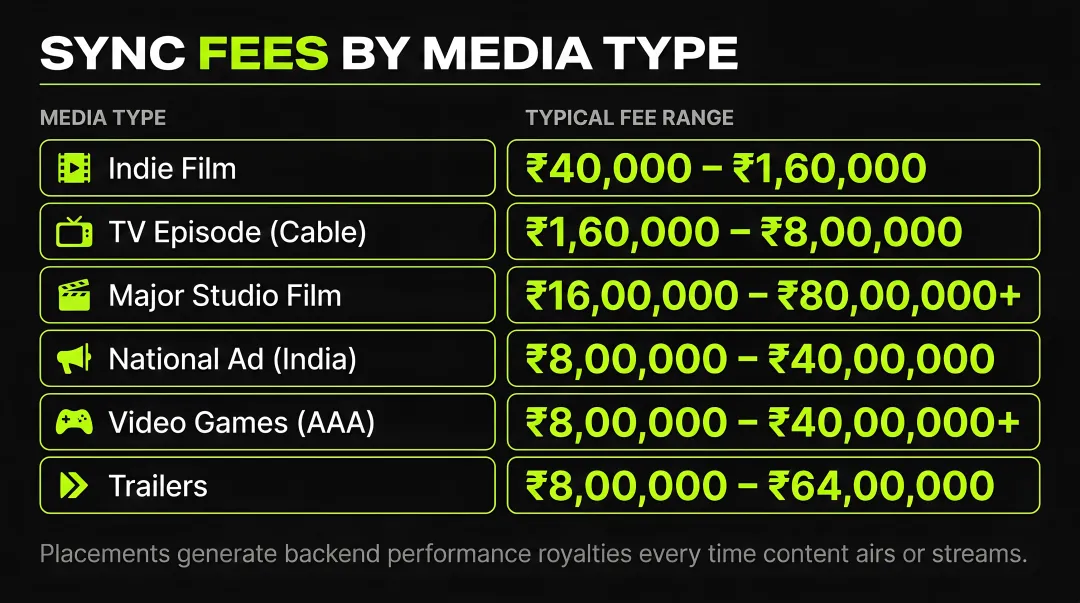
Beyond upfront fees, placements generate backend performance royalties every time the content airs on television or streams on platforms.
PROs (Performing Rights Organizations) collect these royalties and provide passive income long after the initial placement.
The Multiplier Effect on Discovery
Financial compensation is just one part of the equation. Sync placements drive measurable audience growth.
Orville Peck's "Dead of Night" saw Shazam searches jump over 10,000% before the Euphoria episode even aired. A Swedish cover of Adele's "Hello" garnered over 1.4 million Spotify streams after appearing in the same show.
This exposure attracts new fans and grows social followings. It opens doors to touring and collaboration opportunities that would take years to build organically.
Sync Artist vs. Synced Artist
Understanding your positioning helps shape your strategy:
- Sync artist: Builds a catalog specifically for licensing, prioritizing versatility and universal themes over personal expression
- Synced artist: Creates authentic, artistically-driven music that happens to attract placements
Neither path is superior. Sync artists earn more consistent licensing income, while synced artists command higher fees for unique, culturally relevant tracks.
Most producers benefit from a hybrid approach: creating some tracks for targeted sync opportunities while maintaining artistic integrity on passion projects. Platforms like Madverse support both strategies through distribution services that connect your music with sync licensing opportunities while helping you retain ownership rights.
What Makes Music "Syncable"? Production Essentials
Production Quality Standards
Music supervisors work under tight deadlines and zero tolerance for technical issues. A single audio artifact can disqualify your track from a £50,000 placement.
Your tracks must meet broadcast-ready production standards before consideration.
Technical requirements include:
- Loudness standards: -23 LUFS (EBU R128) for European broadcasts, -24 LKFS for U.S. television
- Headroom: -6dB to -3dB for peaks to prevent clipping during broadcast encoding
- Clean frequency balance: Professional mixing that translates across playback systems (TV speakers, phones, laptops)
- No audio artifacts: Zero distortion, clicks, pops, or compression artifacts that become obvious during broadcast
Over-compressed "loudness war" masters often fail broadcast standards because they lack the dynamic range dubbing mixers need during post-production. Prioritise clarity over maximum loudness.
Lyrical Considerations for Sync
Beyond technical quality, your lyrics determine whether supervisors can place your track across multiple projects.
Universal themes work across contexts:
- Love and relationships (without overly specific details)
- Overcoming challenges and resilience
- Ambition and achievement
- Celebration and joy
- Nostalgia and reflection
Lyrics should be "universal, visual, and emotionally clear" according to industry professionals. "We met in New York last July" is too specific; "The sun comes through the rain" offers open-ended emotional context suitable for multiple scenes.
Avoid the "paint-by-numbers" trap:
Generic lyrics like "We can do anything if we believe" sound formulaic and fail to stand out. Express universal themes through specific imagery and authentic emotion rather than clichés.
Explicit content restricts placement opportunities in advertising and daytime television. Prepare clean versions that maintain artistic integrity rather than awkward mutes or obvious edits.
Musical Versatility and Arrangement
Music supervisors prefer tracks with clear structure and dynamic range:
- Defined sections: Intro, verse, chorus, bridge that can be edited to fit various scene lengths
- Musical space: Arrangements that leave room for dialogue and don't compete with on-screen action
- Natural builds: Songs that evolve and mirror emotional arcs work better than static arrangements
Avoid wall-to-wall production where every frequency is filled. Sparse arrangements with intentional space are easier to place and edit.
Genre Awareness and Market Fit
Different media types prefer specific genres:
- Pop/indie pop: CW shows, romantic comedies, lifestyle advertising
- Hip-hop/trap: Sports content, urban dramas, athletic brand campaigns
- Ambient/electronic: Tech commercials, sci-fi productions, corporate videos
- Folk/acoustic: Documentary films, emotional scenes, organic brand messaging
Research shows and brands in your genre lane using Tunefind to understand what's currently getting placed. Study patterns in tempo, energy level, and lyrical themes.
Preparing Your Music for Sync Opportunities
Essential File Versions and Formats
When a supervisor selects your track, you must deliver a complete asset package immediately. Delays cost placements.
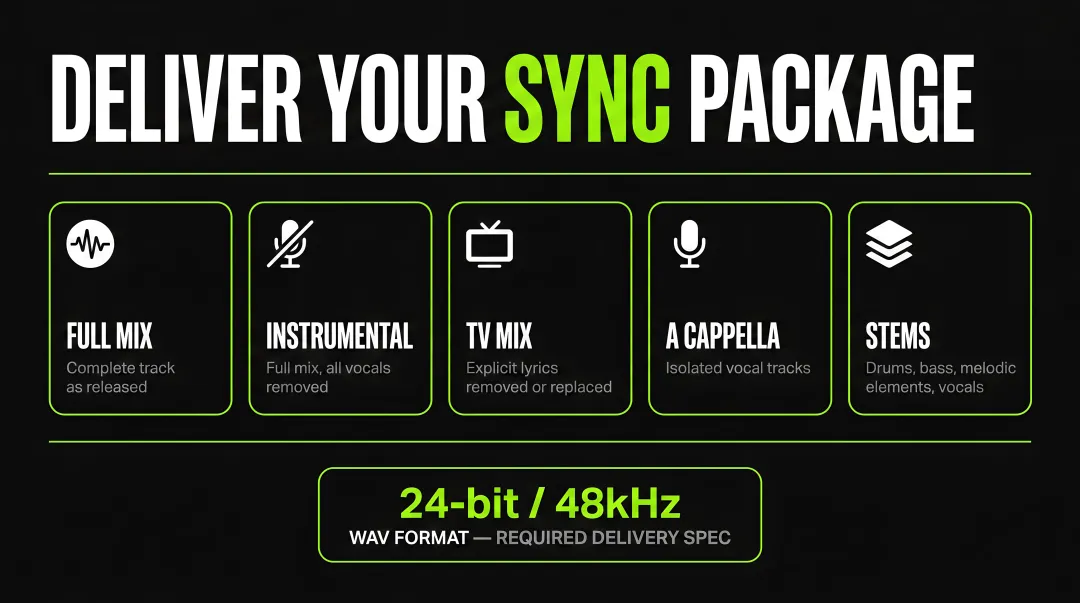
Required deliverables:
- Full mix: The complete track as released
- Instrumental version: Full mix with all vocals removed
- TV mix (clean/radio edit): Explicit lyrics removed or replaced
- A cappella: Isolated vocal tracks (requested less frequently)
- Stems: Separated sub-mixes (drums, bass, melodic elements, vocals)
Technical specifications:
- Format: WAV files at 24-bit/48kHz minimum (24-bit/44.1kHz accepted)
- File naming:
ArtistName_SongTitle_BPM_Key_Version.wav - Organization: Organized folder structure with all versions clearly labeled
MP3s work for initial previewing, but final delivery requires WAV files only.
Metadata and Documentation
Proper metadata is critical for sync consideration. Missing information kills deals.
Essential metadata fields:
- Song title and alternate titles
- Composer/producer names with IPI/CAE numbers
- Publisher information and splits
- ISRC codes (International Standard Recording Code)
- Tempo (BPM) and key signature
- Descriptive tags (moods, themes, instruments)
- Contact information for quick clearance
Split sheets must be finalized before pitching. Music supervisors won't wait while you sort out ownership disputes with collaborators.
Document every contributor's percentage in writing and get signatures before submitting music.
Sample Clearance for Producers
Beyond documentation, sample clearance presents another critical hurdle. Uncleared samples are automatic disqualifiers for sync licensing because the legal liability is too high for production companies to accept.
Your options:
- Use royalty-free samples: Platforms like Splice offer samples cleared for commercial use (verify your license covers sync)
- Clear samples before pitching: Obtain licenses for both the composition and the sound recording (expensive and time-consuming)
- Create original compositions: Recreate melodies or recreate sounds rather than sampling directly
Tracklib offers pre-cleared samples specifically for sync-friendly production, though some tracks are marked "Sync On Request" and require additional approval. When in doubt, create original content or use verified royalty-free sources.
Understanding the Business Side: Rights, Splits, and Licenses
Music Rights Ownership
Master rights refer to the specific sound recording—the actual audio file. As a producer, you typically own master rights to instrumentals you create, unless you've signed them to a label.
Publishing rights refer to the underlying composition—the melody, lyrics, chord progression, and arrangement. Songwriters own these rights and often split them among multiple contributors.
Common ownership scenarios for producers:
- 100% ownership: You created an original instrumental with no samples or collaborators
- Shared publishing: You produced the beat (50% master, 25-50% publishing) and collaborated with a vocalist/lyricist (50-75% publishing)
- Label/publisher involvement: You've assigned some rights to third parties in exchange for advances or services
"One-stop" clearance—where a single entity controls both master and publishing—is highly preferred by supervisors because it simplifies negotiations and speeds up the clearing process.
Split Sheets and Collaboration Agreements
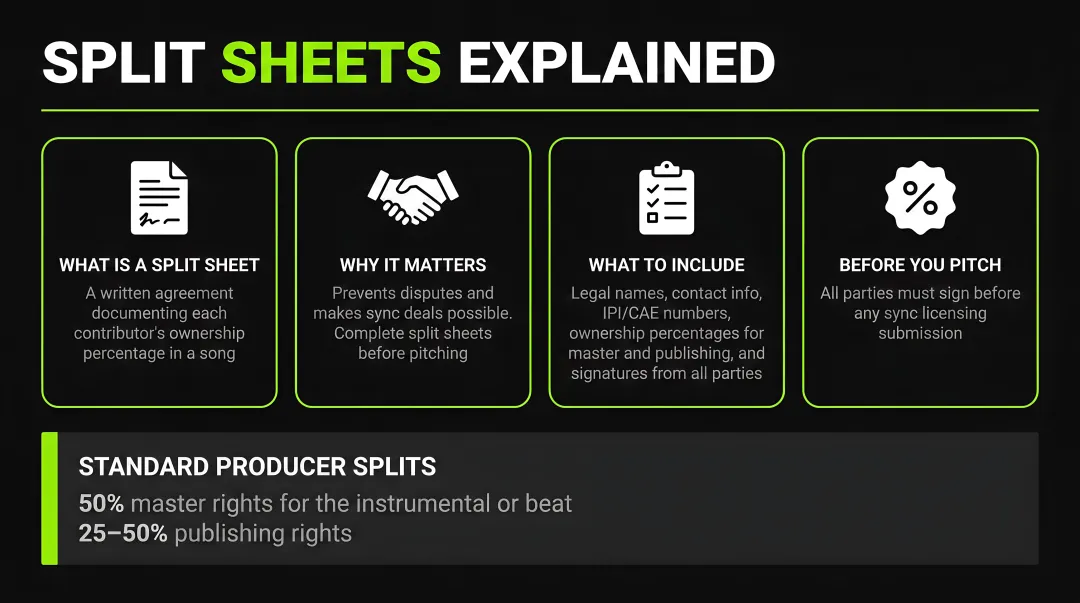
Split sheets are written agreements documenting each contributor's ownership percentage in a song. They prevent disputes and make sync deals possible.
Complete split sheets before pitching. Include:
- Every contributor's legal name and contact information
- IPI/CAE numbers (from your PRO registration)
- Ownership percentages for both master and publishing
- Signatures from all parties
Standard producer splits typically include:
- 50% master rights for the instrumental/beat
- 25-50% publishing rights (negotiated based on your creative contribution to melody/arrangement)
- Remaining publishing split between vocalists, lyricists, and co-writers
These percentages are negotiable—document everything in writing to avoid conflicts when opportunities arise.
Performance Rights Organizations (PROs)
PROs like ASCAP, BMI, and SESAC collect performance royalties when music airs on television, radio, or streams on certain platforms.
How it works:
- Production companies file "cue sheets" documenting every song used in their content
- PROs track broadcasts and streaming using these cue sheets
- PROs distribute royalties to registered writers and publishers quarterly
Sync fees are upfront payments; PRO royalties provide ongoing passive income every time the placement airs. A single TV placement can generate royalties for years. Reruns and streaming keep paying.
Register with a PRO before pitching music to ensure you receive backend royalties:
- U.S.: ASCAP, BMI, or SESAC
- UK: PRS
- India: IPRS
Working with Publishers vs. Sync Reps
Music publishers take a percentage of your publishing rights (often 15-50%) in exchange for actively pitching your catalog, handling administration, and collecting royalties globally.
Sync reps/agents work on commission only when they secure placements. They don't take ownership of your publishing—they earn a percentage of the sync fee they negotiate.
Red flags to watch:
- "Publishing companies masquerading as sync reps" who demand publishing ownership for vague promises of placements
- Contracts requiring you to assign publishing rights before any placements are secured
- Long-term exclusive agreements with no performance guarantees
- Upfront fees to "pitch" your music (legitimate reps earn commission on placements, not submission fees)
Platforms like Madverse offer sync licensing opportunities while allowing producers to retain 95% of royalties—a non-exclusive approach that lets you maintain control of your catalog.
How to Connect with Music Supervisors and Sync Agents
Understanding the Music Supervisor's Workflow
Music supervisors oversee all music-related aspects of a production—from creative selection to rights clearance and budget management.
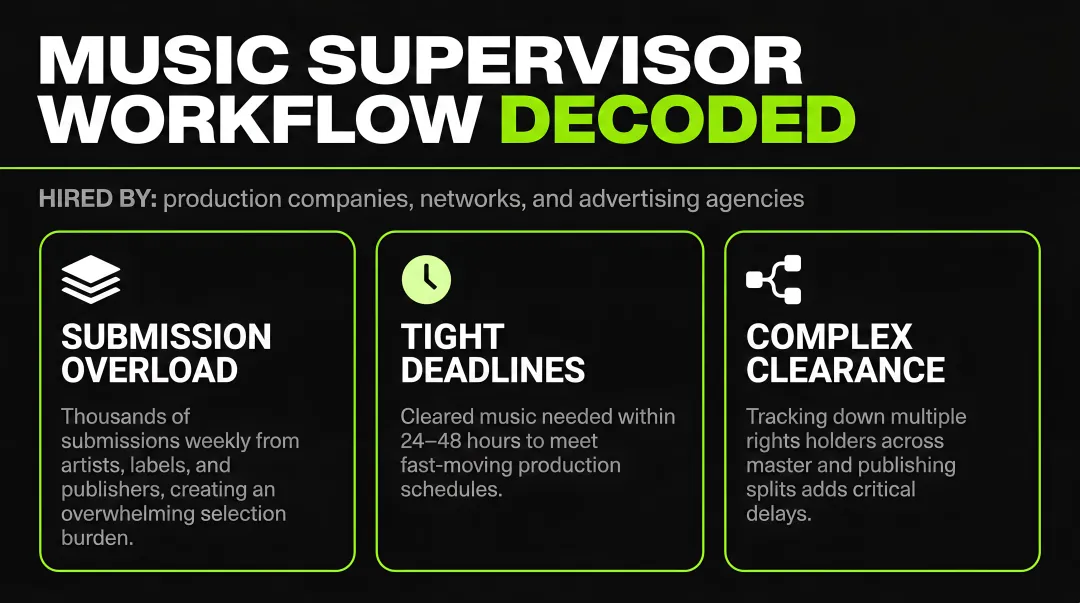
They're hired by production companies, networks, or advertising agencies to find music that enhances storytelling within budget constraints.
Their pain points:
- Overwhelming volume: Thousands of submissions weekly from artists, labels, and publishers
- Tight deadlines: Often need cleared music within 24-48 hours
- Complex clearance: Tracking down rights holders who don't respond quickly
- Budget limitations: Finding quality music that fits financial constraints
This is why supervisors rely heavily on trusted sources—established sync agents, reputable labels, and professional distribution platforms that provide pre-vetted, easily clearable music with responsive rights holders.
Building Your Sync Network
Understanding these pain points shapes your networking strategy. Start with lateral connections:
- Collaborate with other producers, songwriters, and artists who may have sync connections
- Join online communities focused on sync licensing (forums, Discord servers, LinkedIn groups)
- Attend local music industry meetups where you can build genuine relationships
Target industry events strategically:
- Sync-focused panels at SXSW, ASCAP Expo, Sync Summit
- Music conferences where supervisors and licensing executives speak
- Local film festivals where you can meet emerging directors and producers
Think long-term when building these relationships. The assistant music supervisor you meet today may be the head of music for a major network in five years. Early connections often become your most valuable industry relationships.
Pitching Best Practices
Before pitching, research your targets thoroughly:
- Use IMDb to find supervisors for shows in your genre
- Study their past placements on Tunefind to understand their taste
- Only pitch music that genuinely fits their current projects
Effective pitch email structure:
- Personalized subject line: "Indie electronic track for [Specific Show Name]"
- Brief introduction: One sentence about who you are
- Specific reference to their work: "I loved how you used [Artist Name] in episode X"
- Concise song description: Genre, mood, tempo, what it's perfect for
- Easy access link: Use DISCO or Dropbox for one-click access to files and metadata
Distribution platforms like Madverse can help streamline this process by providing sync licensing opportunities alongside standard distribution, giving your music visibility to supervisors actively searching for placements.
Avoid these common mistakes:
- Mass generic emails sent to 50+ supervisors simultaneously
- Pitching inappropriate music for the supervisor's projects
- Following up aggressively after no response (supervisors remember pushy pitchers)
- Attaching large files to emails or using expiring links
- Failing to include essential information (BPM, key, clear contact details)
Respect supervisors' time. Make it easy for them to preview your music, understand the vibe, and clear it quickly if interested.
Navigating Sync Deals: Fees, Contracts, and Negotiations
Understanding Sync Fee Structures
Sync fees vary based on media type, usage, territory, and production budget. Understanding typical ranges helps you negotiate fair compensation.
Factors affecting fees:
- Media type: Commercials and trailers command premium fees; reality TV typically pays less
- Territory: Global rights cost more than regional or local rights
- Exclusivity: Exclusive licenses demand significantly higher fees
- Term length: Perpetuity costs more than 1-3 year terms
- Production budget: Major studio films pay more than indie productions
MFN (Most Favored Nations) deals are common in reality TV where all songs receive equal compensation regardless of usage length.
If one rights holder negotiates a higher fee, the MFN clause ensures all other parties receive that same rate.
Exclusive vs. Non-Exclusive Licenses
Beyond fee structures, the type of license you grant significantly impacts your music's earning potential.
Non-exclusive licenses (recommended for most producers) allow the same music to be licensed for multiple projects simultaneously. You maintain full control and can continue licensing the track elsewhere.
Exclusive licenses grant the licensee sole rights for a specific period, territory, or category.
These make sense when:
- The fee justifies restricting future opportunities (typically 3-5x non-exclusive rates)
- Exclusivity is limited by term (12-24 months) and category (e.g., automotive advertising only)
- The placement offers significant exposure that outweighs lost licensing opportunities
Negotiate term-limited exclusivity whenever possible. A Coca-Cola commercial might require exclusivity for soft drink advertising for 12 months, but you can still license to film, TV, and non-competing brands.
Avoid total exclusivity in perpetuity unless the fee is substantial enough to replace years of potential licensing income.
In-Context vs. Out-of-Context Usage
In-context use means the music appears within the film, show, or game itself—synchronized with the scene for which it was licensed.
Out-of-context use includes promotional materials separate from the original content:
- Trailers and TV spots
- Social media promotional clips
- Behind-the-scenes content
- Marketing campaigns
Out-of-context uses command premium fees and shouldn't be bundled into the base sync fee. Trailers especially generate significant exposure and require separate compensation.
When negotiating, be explicit: "The sync fee covers in-context use in the film. Trailer rights require an additional fee."
Contract Red Flags and Negotiation Tips
Warning signs in contracts:
- Requests for total buyouts of all rights in perpetuity
- Unlimited term lengths with no renewal negotiations
- All-media rights without fee differentiation
- Publishing rights transfer (you should only license, not assign)
- Vague usage descriptions that could expand without additional compensation
Effective negotiation strategies:
- Ask about project budget and other artists' fees to gauge fair compensation
- Request limited terms (1-3 years) with renewal options
- Specify territories clearly (North America vs. global)
- Separate in-context and out-of-context usage rights
- Include reversion clauses if the project isn't released within a specified timeframe
Always have contracts reviewed by a trusted advisor—entertainment lawyer, manager, or experienced producer friend—before signing.
Turning down unfair deals protects long-term value, but being overly rigid can cost opportunities. Finding the right balance is essential to building a sustainable sync licensing career.
Frequently Asked Questions
What is sync licensing and how does it work for music producers?
Sync licensing allows your music to be paired with visual media like TV, film, ads, and games. It requires clearing both master rights (recording) and publishing rights (composition), with compensation through upfront sync fees plus backend PRO royalties when content airs.
How much money can you make from sync licensing?
Fees range from ₹40,000-₹1,60,000 for indie TV placements to ₹8,00,000-₹80,00,000+ for major commercials. Backend PRO royalties provide additional passive income over time, sometimes exceeding the initial sync fee through years of reruns and streaming.
Do I need to clear samples before pitching my beats for sync?
Yes. Uncleared samples are automatic disqualifiers due to legal liability. Use royalty-free samples, clear samples in advance through proper licensing, or create original compositions to ensure your music is sync-ready.
What's the difference between exclusive and non-exclusive sync licenses?
Non-exclusive allows your music to be licensed for multiple projects simultaneously while you retain full control. Exclusive restricts usage to one licensee, usually for higher fees and limited terms or categories. Most producers should prioritize non-exclusive deals unless exclusivity compensation justifies restricting future opportunities.
How do I find and contact music supervisors?
Use IMDb to identify supervisors for shows in your genre, then research their placement history on Tunefind. Craft personalized pitches with easily accessible music via platforms like DISCO. Focus on building genuine relationships rather than mass submissions, and only pitch music that genuinely fits their current projects.
What file formats and versions do I need for sync licensing?
Provide full mix, instrumental, clean version, and stems as 24-bit/48kHz WAV files with metadata (BPM, key, ISRC, splits). Use clear file naming and include complete contact info for quick clearance.