Introduction
The difference between successful music careers and guesswork? Data. With over 100 million songs now available on streaming platforms and 100,000+ new tracks uploaded daily, the music industry has become an ocean of information.
Industry professionals—artists, managers, and labels—can no longer rely on gut instinct alone. Analytics help you track performance across platforms, understand audience behavior, and identify growth opportunities in an increasingly competitive landscape.
This guide covers seven essential analytics tools across different categories:
- Native platform dashboards
- All-in-one solutions
- Radio monitoring tools
- Specialized platforms
Each includes selection criteria to help you build the right analytics stack for your career stage and budget.
Key Takeaways
- Music analytics tools track streaming, radio, social, and playlist performance
- Seven tools covered: native platforms (Spotify/Apple), comprehensive solutions (Soundcharts, Chartmetric), radio tracking (Luminate), and specialized platforms (Viberate, Madverse)
- Key selection criteria: data coverage, market reach, real-time updates, competitor benchmarking
- Most professionals combine free native tools with 1-2 premium platforms
- Build your stack to identify opportunities, optimize releases, and make data-backed decisions
Overview of Music Analytics in the Modern Music Industry
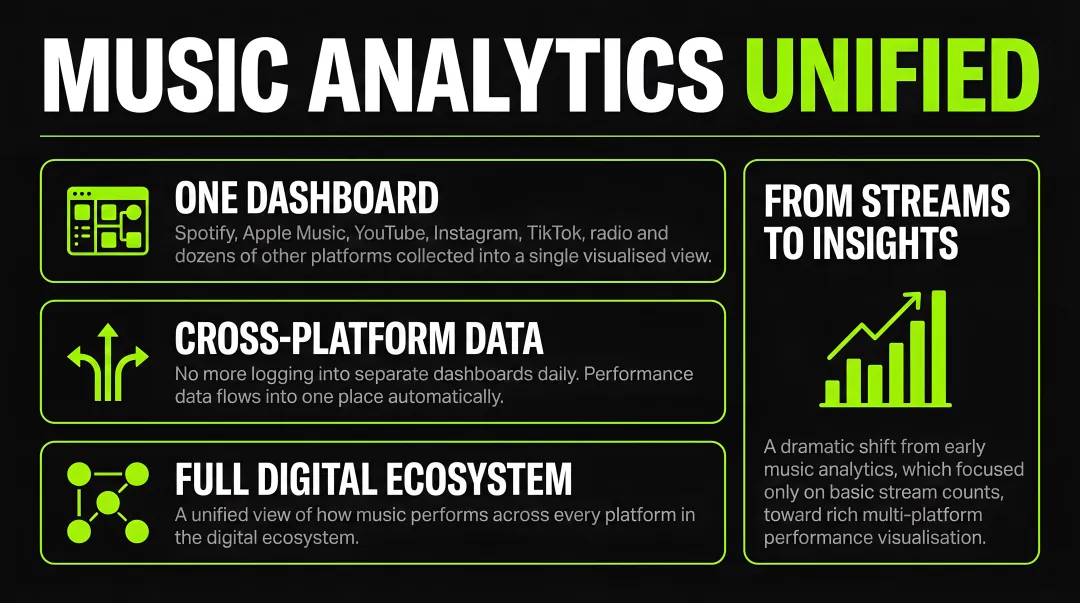
Tracking music performance across Spotify, Apple Music, YouTube, Instagram, TikTok, radio stations, and dozens of other platforms means logging into separate dashboards daily. Music analytics tools solve this by collecting and visualizing all this data in one place, giving professionals a unified view of how their music performs across the entire digital ecosystem.
This unified approach represents a dramatic shift from early music analytics. A decade ago, tools focused on basic stream counts from a single platform.
Today's platforms track performance across 100+ digital service providers, countless playlists, and global radio markets. They correlate streaming data with social media trends, radio airplay, and live performance metrics. Manual tracking across this fragmented landscape is impossible—which is why analytics tools have become essential infrastructure for modern music careers.
The tools below represent different categories and price points, allowing you to build a custom analytics stack based on your specific needs and budget.
Whether you're an emerging artist tracking your first thousand streams or a label managing dozens of artists across global markets, there's a combination designed for your situation.
7 Essential Music Analytics Tools for Industry Professionals
These seven tools deliver actionable insights for artists, managers, and labels—selected for data coverage, reliability, and industry adoption.
Spotify for Artists
Spotify's native analytics platform is available free to all verified artists, covering audience demographics, playlist placements, and listener behavior. As the world's largest streaming platform with 752 million paid subscribers globally, Spotify data is essential for understanding your streaming audience.
Why it matters: Direct access to first-party Spotify data means the most accurate, real-time information available—no middleman.
Key features include:
- Demographic breakdowns by city and country
- Playlist discovery tracking showing exactly how listeners find your music
- Canvas analytics monitoring engagement with visual content
- Discovery Mode insights revealing algorithmic recommendation performance
| Key Features | Real-time streams, listener demographics, playlist tracking, Canvas analytics, Discovery Mode insights |
|---|---|
| Best For | All artists on Spotify (free), understanding your Spotify audience deeply, identifying growth markets |
| Pricing | Free for verified artists |
Apple Music for Artists
Apple's native analytics dashboard launched in 2019 provides insights into Apple Music and iTunes performance, including unique Shazam integration data that shows discovery moments before listeners even know your name.
The standout feature: Shazam integration tracks exactly when and where people discover your music through audio recognition—in clubs, on radio, in retail environments. City-level insights help identify micro-markets for touring.
The platform tracks performance across Apple's entire ecosystem including iTunes purchases, radio spins across 40,000+ stations globally, and Apple Music streaming.
| Key Features | Stream counts, Shazam tags, playlist adds, radio spins, purchase data, listener demographics |
|---|---|
| Best For | Artists focused on Apple's ecosystem, tracking Shazam discovery, understanding radio impact |
| Pricing | Free for artists with music on Apple Music |
Soundcharts
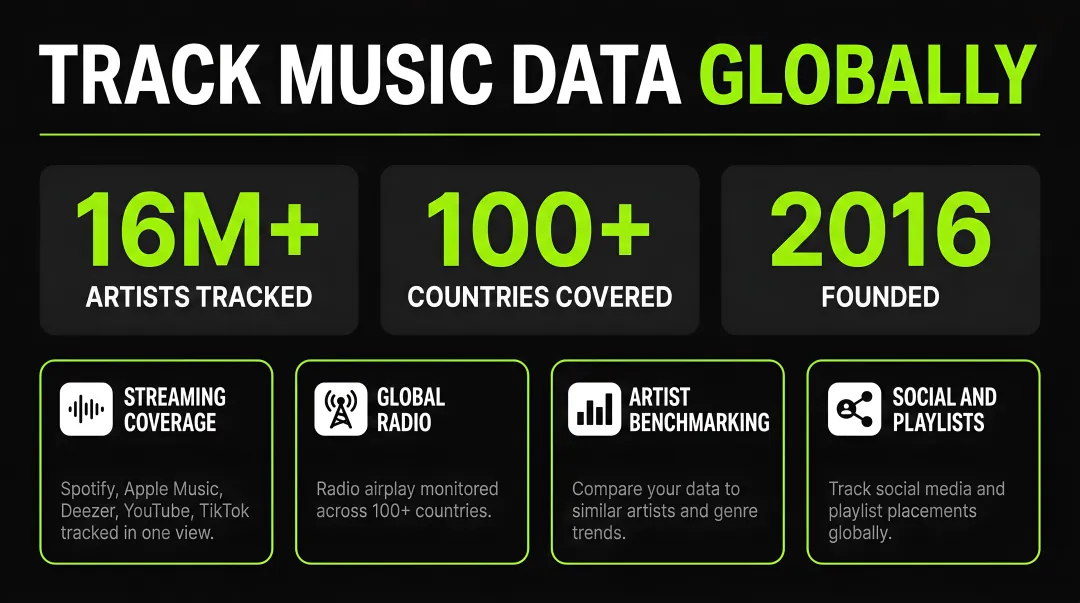
Founded in 2016, Soundcharts is a comprehensive music data platform tracking 16 million+ artists across streaming, radio, social media, and playlists in 100+ countries. It's designed for professionals who need global market intelligence beyond what native platforms provide.
What sets it apart: This all-in-one solution tracks your data and shows how you compare to similar artists, genre trends, and market movements.
Coverage includes:
- Spotify, Apple Music, Deezer, YouTube, TikTok
- Global radio airplay across 2,465+ stations in 87 countries
- Playlist tracking across all major platforms
- Competitor benchmarking with customizable dashboards
- API access for custom integrations
| Key Features | Multi-platform tracking, global radio monitoring, playlist intelligence, TikTok analytics, competitor analysis, API access |
|---|---|
| Best For | Labels, managers, established artists needing comprehensive global data and competitive intelligence |
| Pricing | ₹830/month (Artist Plan for 1 artist), ₹10,700/month (Pro Plan for unlimited artists) |
Chartmetric
Since 2015, Chartmetric has become the industry-standard analytics platform trusted by major labels and independent professionals alike, tracking 8 million+ artists across streaming, social media, playlists, and charts. With over 50,000 paying users including labels, managers, and publishers, it's the go-to platform for playlist strategy.
The game-changer: Playlist tracking includes curator contact information for direct pitching.
Core capabilities:
- Deep TikTok trending insights and influencer identification
- Spotify algorithm insights and cross-platform growth tracking
- Career trajectory modeling
- Interface designed for A&R scouting, manager strategy, and playlist pitching
| Key Features | Playlist curator contacts, TikTok trend tracking, Spotify algorithm insights, cross-platform analytics, career trajectory modeling |
|---|---|
| Best For | A&R teams, artist managers, playlist pitchers, anyone focused on playlist strategy and social media growth |
| Pricing | ₹830/month (Artist Plan), ₹4,980/month (Manager Plan), ₹12,450/month (Premium Plan) |
Radiomonitor (now Luminate Radio)
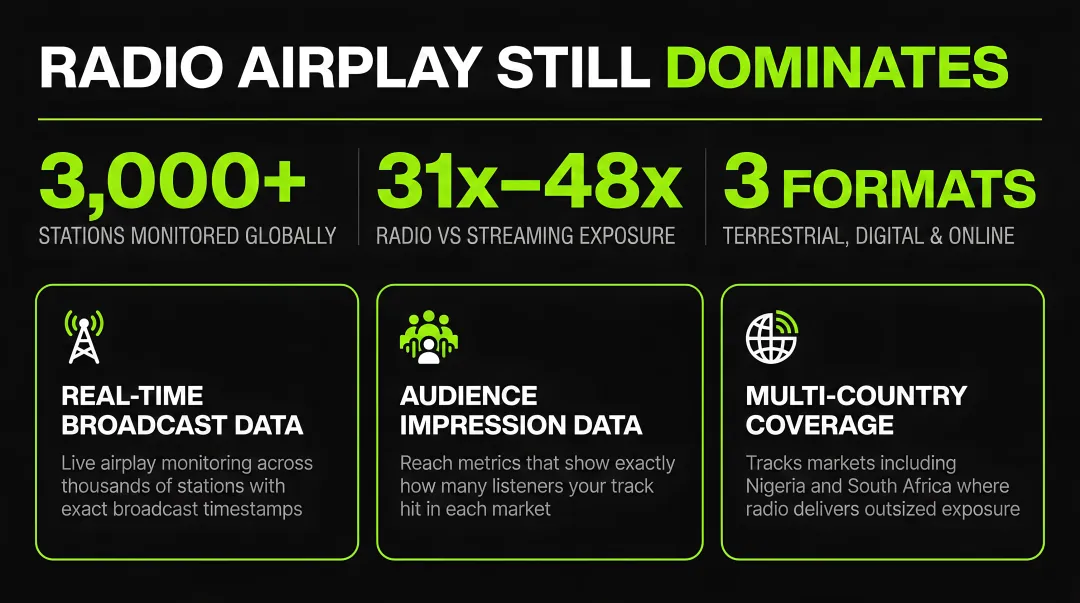
Luminate Radio (formerly Radiomonitor) is the leading radio airplay monitoring service tracking 3,000+ stations across multiple countries, providing real-time broadcast data and audience reach metrics. Despite the streaming revolution, radio remains dominant in many markets—generating 31x to 48x the exposure of streaming platforms in countries like Nigeria and South Africa.
Why it's essential: Comprehensive coverage includes terrestrial, digital, and online stations with audience impression data—not just spin counts.
This distinction matters. A single spin on a major market station during drive time can reach hundreds of thousands of listeners. The platform provides competitive airplay analysis, historical data, and integration with charts data.
| Key Features | Real-time radio airplay tracking, audience reach/impressions, station formats, geographic coverage, historical airplay data |
|---|---|
| Best For | Artists with radio campaigns, radio promoters, labels tracking airplay ROI, markets where radio drives discovery |
| Pricing | Enterprise pricing (contact for quote; typically included in Chartmetric Premium tier) |
Madverse Analytics Dashboard
Built into Madverse's music distribution and label services suite, the Madverse Analytics Dashboard is designed specifically for independent artists and labels managing rosters. The platform combines distribution with analytics in a single interface.
The unified approach: Track distribution analytics, roster management, royalty tracking, and team collaboration from one dashboard—no toggling between tools.
For independent labels, roster analytics features include:
- Tracking multiple artists simultaneously
- Detailed streaming reports and audience demographics
- Royalty splits tracking
- Catalog performance comparison
- Team access controls
| Key Features | Multi-artist roster analytics, detailed streaming reports, audience demographics, royalty splits tracking, catalog performance comparison, team access controls |
|---|---|
| Best For | Independent labels, artist managers, collectives managing multiple artists, artists who want distribution + analytics in one platform |
| Pricing | ₹8,300/year (Label Plan with unlimited roster artists); analytics included with all distribution tiers |
Viberate
Viberate is a music data platform with a unique focus on live performance analytics and booking intelligence, tracking 11 million+ artists across streaming, social media, and live venue data. If touring is central to your strategy, Viberate provides insights no other platform offers.
The touring advantage: While other tools focus on digital metrics, Viberate tracks venue capacities, ticket sales estimates, booking contacts, and geographic fan concentration to optimize tour routing.
Fan location heatmaps show exactly where your audience clusters geographically. Standard streaming and social metrics are included, but live performance intelligence sets Viberate apart.
| Key Features | Live performance tracking, venue database, booking contact info, fan location heatmaps, streaming + social analytics, festival lineup data |
|---|---|
| Best For | Touring artists, booking agents, managers planning tours, artists looking to optimize live performance strategy |
| Pricing | ₹1,650/month (Premium); free tier available with limited features |
How We Chose the Best Music Analytics Tools
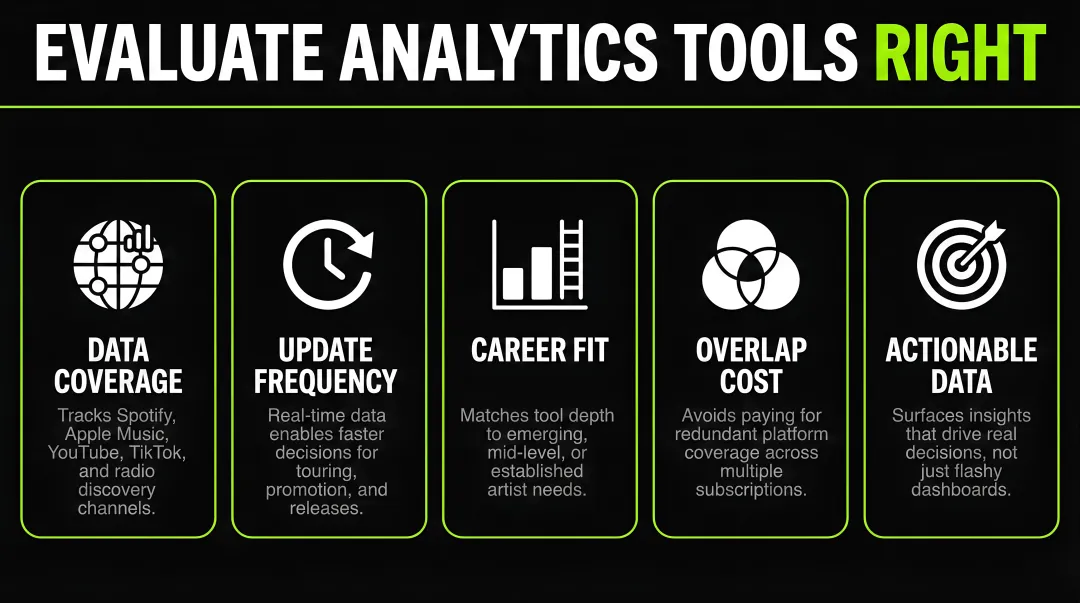
Artists often choose analytics tools based on flashy dashboards rather than actionable data. Others pay for overlapping coverage across multiple platforms, or pick tools that don't match their actual career stage and needs.
We evaluated tools based on five key factors:
- Data coverage — Which platforms and markets does the tool track? A tool monitoring only Spotify and Apple Music misses YouTube, TikTok, and radio—increasingly important discovery channels
- Update frequency — Real-time data enables quick responses to viral moments, while delayed reporting means missed opportunities
- User interface — The best tools surface insights quickly without requiring data science expertise
- Accuracy and reliability — Data quality matters more than volume. Tools pulling directly from platform APIs offer the most accurate information
- Integration capabilities — API access, export options, and compatibility with other platforms determine practical usability
Matching Tools to Your Goals
Different goals require different tools:
- Playlist pitching — Chartmetric provides curator contacts
- Radio campaigns — Luminate Radio tracks airplay monitoring
- Touring strategy — Viberate maps fan geography
- Roster management — Madverse offers multi-artist dashboards with advanced analytics
Most professionals adopt a "stack approach"—combining free native tools (Spotify for Artists and Apple Music for Artists) with one or two premium platforms based on priority needs, rather than trying to use every available tool. This strategy maximizes value while controlling costs.
Conclusion
The right analytics stack depends entirely on your career stage, primary platforms, geographic markets, and specific goals—whether that's playlist growth, radio penetration, touring optimization, or roster management.
There's no one-size-fits-all solution, and the most expensive tool isn't automatically the best choice for your situation.
Start with free native tools from Spotify and Apple to master your own audience data. When you've identified your biggest data gaps or strategic priorities—whether that's understanding competitors, accessing playlist curators, tracking radio, or managing multiple artists—invest in premium tools that address those specific needs. Avoid paying for comprehensive platforms with features you won't fully utilize.
For independent artists and labels looking for distribution with built-in analytics, explore how Madverse combines music distribution with roster performance analysis and advanced analytics tools—eliminating the need to juggle separate platforms for distribution and data insights.
Frequently Asked Questions
Do I need paid analytics tools if I already use Spotify for Artists and Apple Music for Artists?
Native tools only cover their own platforms and lack competitor benchmarking, cross-platform insights, and advanced features like playlist curator contacts. Paid tools fill these gaps if you're releasing across multiple platforms or need competitor comparisons.
What's the difference between music analytics tools and distribution platforms?
Distributors get your music onto platforms and collect royalties, while analytics tools track cross-platform performance. Some distributors like Madverse combine both with advanced analytics and roster management features.
How much should I budget for music analytics tools?
Start with free native tools (₹0) until reaching 50,000+ monthly streams. Growing artists invest ₹4,150-8,300/month for one platform, while established artists and labels budget ₹16,600-41,500/month for specialized tools.
Can analytics tools help me get more streams or playlist placements?
Analytics tools don't directly increase streams—they provide data for smarter decisions about release timing, target markets, and playlist pitching. Acting on these insights helps you focus resources where they'll drive the greatest growth.
What metrics should I focus on besides stream counts?
Focus on listener retention (saves, repeats), geographic concentration (touring/ad targeting), playlist conversion rates, audience demographics, and growth trends. These reveal engagement depth—more valuable than raw stream counts.
Are music analytics tools worth it for new/emerging artists?
Start with free native tools until hitting 10,000-50,000 monthly streams. Premium tools become worthwhile when data-driven decisions can meaningfully impact growth and budget allows for marketing optimization.