
Introduction
Independent music production has exploded in 2026. Non-major labels and self-releasing artists now control 46.7% of the global recorded music market, generating ₹1.18 lakh crore in revenue.
This shift represents a fundamental transformation in how music reaches audiences—producers no longer need traditional labels to build sustainable careers.
This independence comes with a critical challenge: producers need platforms that do far more than just stream music. Today's successful independent artists require distribution infrastructure, transparent royalty management, advanced analytics, payment splitting capabilities, and promotional tools—all integrated into a single platform.
The difference between a platform built for listeners and one designed for producers can mean thousands of rupees in lost revenue and missed opportunities.
We evaluate the best music streaming and distribution platforms for producers' needs in 2026. We compare royalty structures, distribution reach (including emerging markets like China and India), payment splitting features, and career-building tools that separate hobbyists from professionals.
Key Takeaways
- Top platforms: DistroKid, TuneCore, Madverse, CD Baby, Beatport—combining global reach with transparent royalties
- Royalty retention: 85-100% with annual fees of ₹1,650-4,150 for unlimited distribution
- 2026 essentials: TikTok/Instagram monetization, automated splits, fraud protection, AI marketing
- Madverse retains 95% royalties plus sync licensing and editorial playlist pitching on every plan
- Electronic music? Beatport delivers DJ-focused discovery and stronger per-track revenue
What Producers Need From Streaming Platforms in 2026
Distribution vs. Consumption: Understanding the Difference
Streaming platforms serve two fundamentally different audiences. Consumer platforms like Spotify and Apple Music focus on playback experience—audio quality, playlists, and discovery features.
Producer platforms work differently. They provide distribution infrastructure that gets your music onto those consumer platforms while offering royalty collection, analytics, and promotional tools.
When evaluating platforms as a producer, you're not choosing where listeners will hear your music—you're choosing the service that delivers your tracks to Spotify, Apple Music, Amazon, and 150+ other platforms worldwide.
Global Distribution Reach Matters More Than Ever
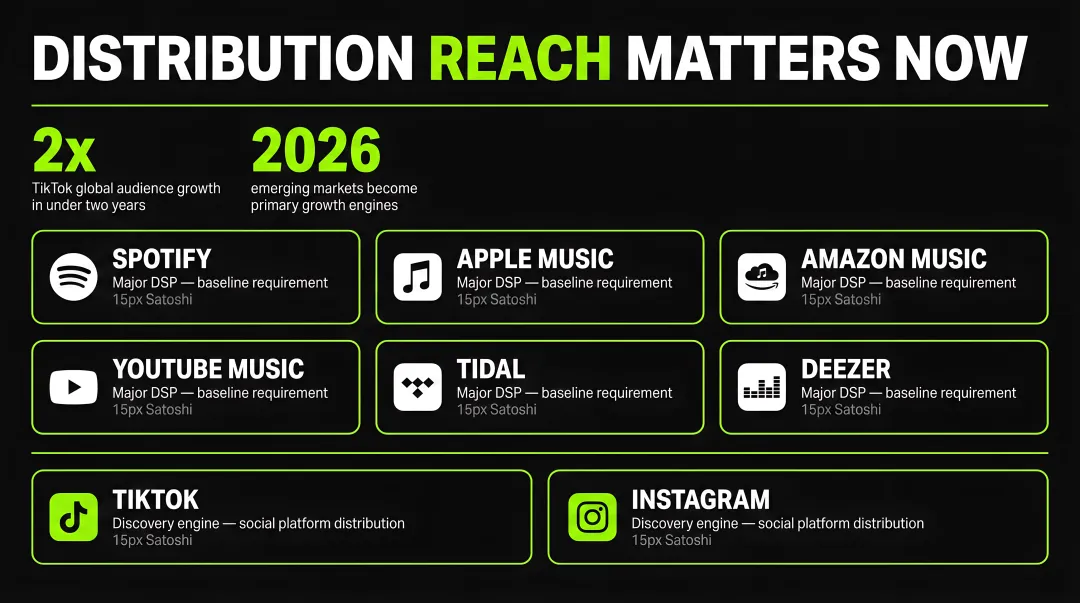
Understanding distribution models helps you evaluate reach. In 2026, emerging markets represent massive growth opportunities. TikTok doubled its global audience in under two years, becoming a primary growth engine for the US music market.
Distribution to social platforms isn't optional—it's where discovery happens.
Critical distribution checkpoints include:
- Major DSPs: Spotify, Apple Music, Amazon Music, YouTube Music, Tidal, Deezer (baseline requirement)
- Social platforms: TikTok, Instagram, Facebook for UGC monetisation and viral discovery
- Emerging markets: China (Tencent, NetEase), India (JioSaavn, Gaana), Africa (Boomplay)
- Specialised platforms: Beatport for electronic music, Anghami for Middle East/North Africa
Verify your distributor explicitly lists these platforms. Generic claims of "worldwide distribution" often exclude lucrative regional services and social monetisation opportunities.
Transparent Royalty Management
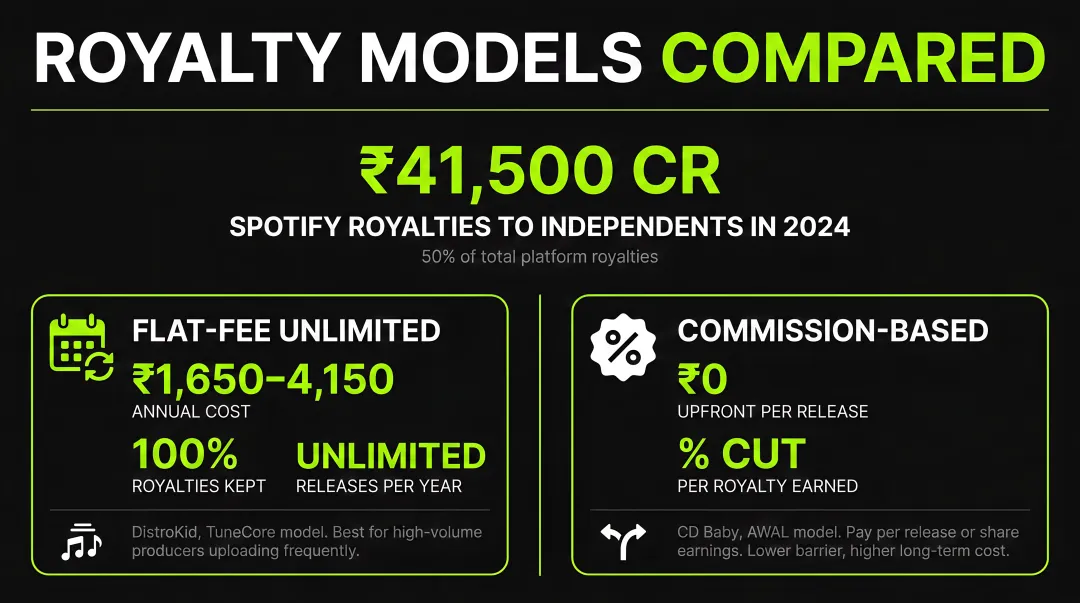
Independent artists generated over ₹41,500 crore (approximately $5 billion USD) from Spotify alone in 2024, representing 50% of the platform's total royalties. To capture your share, you need transparent reporting and favourable commission structures.
Two primary models dominate in 2026:
- Flat-fee unlimited (DistroKid, TuneCore): Pay ₹1,650-4,150 annually, keep 100% of royalties, upload unlimited releases. Best for high-volume producers.
- Commission-based (CD Baby, AWAL): Pay per release or nothing upfront, but the platform takes 9-15% of all revenue. Better for occasional releases or artists with very low stream counts.
- Hybrid high-retention (Madverse): Keep 95% of royalties with comprehensive distribution, analytics, and promotional tools included.
Payment splitting at source is now essential for collaborative work. Platforms like DistroKid, TuneCore, and Madverse automatically route percentages to collaborators, eliminating manual calculations and payment disputes. Without this feature, you'll spend hours managing spreadsheets and PayPal transfers.
Analytics That Drive Strategy
Basic stream counts don't cut it anymore. Producers need detailed data to inform release strategy, tour routing, and promotional spending.
Look for these analytics capabilities:
- Stream source breakdown (algorithmic playlists vs. user libraries vs. search)
- Geographic and demographic breakdowns
- Playlist placement tracking
- Skip rates and completion metrics
- Real-time performance monitoring
Platforms like TuneCore and Madverse offer best-in-class analytics dashboards that translate raw data into actionable insights, helping you understand not just how many people listened, but who they are and how they found you.
Promotional Tools That Amplify Reach
Distribution gets your music on platforms—promotion gets it heard. In 2026, integrated promotional tools separate platforms that simply deliver files from those that actively build your career.
Promotional features that matter:
- Pre-save campaigns: Build momentum before release day, boosting algorithmic visibility
- Playlist pitching: Direct submission to editorial curators at Spotify, Apple Music, and other DSPs
- Sync licensing access: Opportunities for TV, film, commercial, and video game placements
- Social media integration: Automated ad targeting and fan link builders
- YouTube Content ID: Monetise user-generated content featuring your music
Top Music Streaming/Distribution Platforms for Producers in 2026
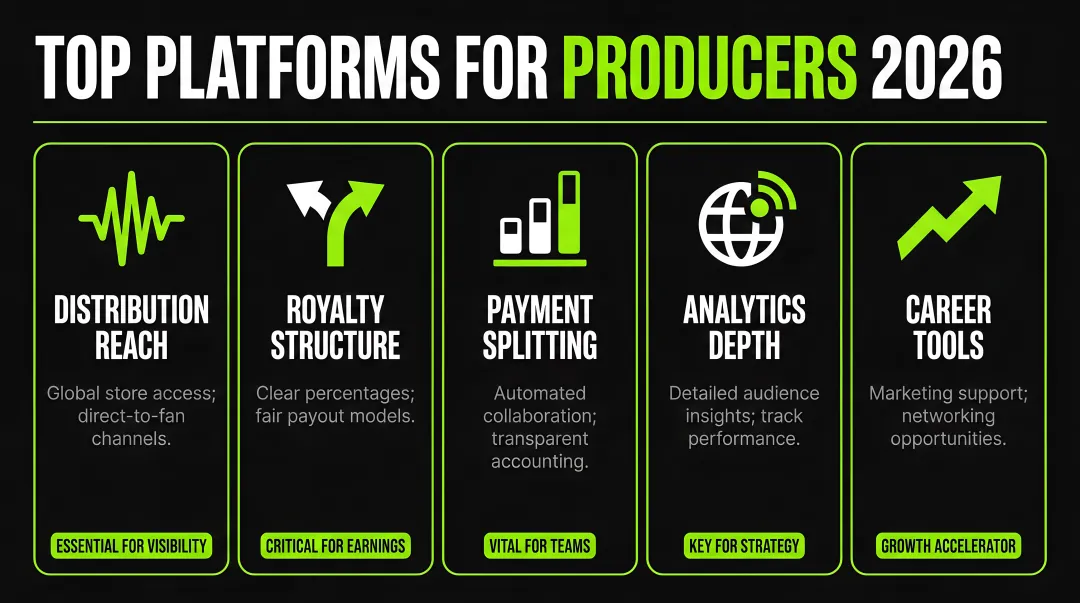
These platforms were evaluated based on producer-specific needs: distribution capabilities, royalty structures, payment splitting, analytics depth, and career-building tools—not consumer listening features.
DistroKid
DistroKid launched the unlimited upload model and remains the most popular distributor for high-volume producers. The platform distributes to 150+ platforms including TikTok and China, with industry-leading turnaround times of 2-7 days from upload to live.
What sets DistroKid apart:
- Delivers music 10-20x faster than traditional distributors
- Customizable pre-save and streaming links through HyperFollow pages
- Route royalty percentages to collaborators with options to recoup advances first
- AI-powered mastering service (Mixea) for instant professional sound
- Automatically submits releases to new platforms as they launch
Customer support relies on email-only communication, with response times extending during peak periods.
| Feature | Details |
|---|---|
| Pricing | ₹1,900-4,100/year depending on plan, unlimited releases, 100% royalties, extra fees for some features (payment splitting ₹820/collaborator/year) |
| Best For | High-volume producers who release frequently and need fast turnaround, those who want payment splitting with recoupment capabilities |
| Key Features | Unlimited distribution, YouTube Content ID, payment splitting, Mixea mastering, HyperFollow pages, store maximizer |
TuneCore
For producers who prioritize data-driven decisions, TuneCore offers detailed analytics alongside distribution.
TuneCore evolved from a pay-per-release model to unlimited plans. The platform includes publishing administration through its Sentric partnership, collecting both master and publishing royalties.
TuneCore's competitive advantages:
- Revenue reports break down earnings by platform, territory, and time period
- Eligible artists can access instant advances based on streaming history
- Collects mechanical and performance royalties globally (15% commission)
- Human customer support with faster response times than many competitors
The platform charges 20% commission on social platform revenue (TikTok, Instagram, Facebook), though standard streaming keeps 100% with the artist.
| Feature | Details |
|---|---|
| Pricing | ₹1,240-4,130/year for unlimited releases, 100% royalties on music (20% commission on social platforms), payment splitting included |
| Best For | Producers who prioritize detailed analytics and reporting, those who want integrated publishing administration alongside distribution |
| Key Features | Detailed analytics, revenue advances, territory carving, publishing admin, payment splitting, social monetization, lyrics distribution |
CD Baby
If you release music infrequently, CD Baby's one-time payment model might suit your workflow better than annual subscriptions.
CD Baby launched independent distribution in 1998. The platform is owned by Downtown Music and includes optional Boost packages for mechanical royalty collection.
CD Baby's unique advantages:
- Pay ₹825 per single or ₹1,240 per album once, no recurring fees
- Adds MLC registration and SoundExchange collection for ₹3,300
- Access to CD Baby's sync licensing team for placement opportunities
- Still offers CD manufacturing for physical releases
The platform's 9% commission means you'll earn less per stream than flat-fee competitors. Customer support now operates primarily through automated systems.
| Feature | Details |
|---|---|
| Pricing | ₹825 per single or album (one-time), or ₹3,300 to add Boost package, takes 9% commission, no annual fees |
| Best For | Producers with infrequent releases who prefer one-time payments over subscriptions, those who want mechanical royalty collection included |
| Key Features | One-time payment option, Boost package (MLC registration, SoundExchange), sync licensing opportunities, limited payment splitting |
Madverse
Madverse offers comprehensive label services with higher royalty retention than most competitors. The platform combines distribution with sync licensing and team collaboration tools.
Madverse's key features:
- Artists keep up to 95% of royalties on premium plans
- Sync licensing opportunities (achieved first South Asian track placement on The Kardashians)
- Editorial playlist pitching to major DSP curators
- Team collaboration tools for labels and collectives
- Dolby Atmos distribution for high-fidelity audio
Operating from India with global reach, Madverse serves independent artists and labels worldwide.
| Feature | Details |
|---|---|
| Pricing | Free to ₹8,250/year, keep 85-95% of royalties depending on plan, no per-release fees on paid tiers |
| Best For | Independent artists and labels who want maximum royalties, producers seeking sync licensing opportunities (TV, movies, video games), teams needing collaboration and roster management tools |
| Key Features | 95% royalty retention, royalty splits at source, Dolby Atmos distribution, sync licensing, editorial playlist pitching, YouTube Content ID, advanced analytics, team collaboration, catalog migration support |
Beatport (for Electronic/Dance Producers)
Electronic music producers benefit from Beatport's specialized focus on DJ culture and direct sales revenue.
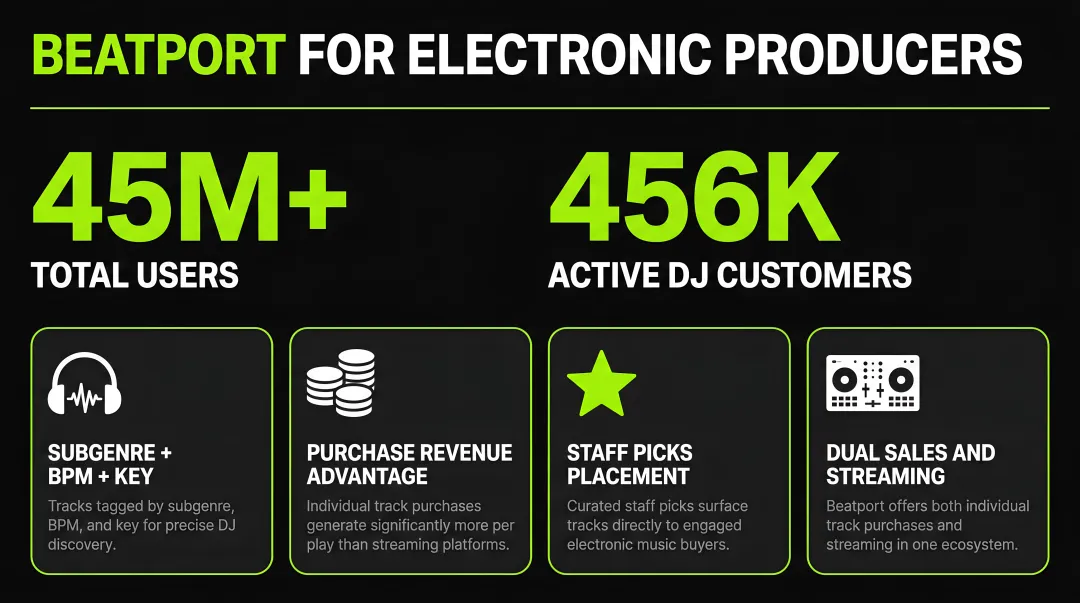
Beatport dominates electronic music distribution with 45M+ users and 456K active DJ customers. Unlike pure streaming platforms, Beatport offers both individual track purchases and streaming.
Why electronic producers choose Beatport:
- Tracks organized by subgenre with BPM and key information for DJ discovery
- Individual track purchases generate significantly more than streaming
- Staff Picks, Best New Tracks, and genre-specific charts drive discovery
- High-quality WAV and AIFF downloads for professional DJ use
- Chart placement carries weight with booking agents and labels
Distribution to Beatport typically requires working through aggregators or paying label-tier fees. The platform reported a 25% increase in download revenue in Mexico in 2024, demonstrating that direct sales remain viable for electronic music.
| Feature | Details |
|---|---|
| Pricing | ₹825/track (label) or via aggregator, ~15% commission on sales, 2-5 day distribution |
| Best For | Electronic, techno, house, and dance music producers who want to reach DJs and club culture, producers who want higher per-track revenue from sales |
| Key Features | Individual track purchases plus streaming, DJ-focused discovery tools, weekly editorial curation (Staff Picks, Best New Tracks), genre-specific charts, premium digital formats |
Honorable Mentions
Spotify for Artists doesn't distribute music but is essential for managing your presence once tracks are live. The platform offers playlist pitching, audience analytics, and profile customization—use it alongside your distributor.
Amuse provides a solid free option with 100% royalty retention, but customer support issues plague the platform. Their automated advance system has delivered over 50,000 advances to artists, making it worth considering despite support challenges.
SoundCloud excels at community building and direct fan engagement through comments and reposts. While distribution reach is limited, it's unmatched for building early fanbases and testing new material.
RouteNote offers both free (15% commission) and premium (0% commission) tiers, letting you choose per release. Good for producers with mixed release strategies.
Symphonic targets established artists and labels with advanced features, but the platform requires application approval and isn't ideal for beginners.
How We Evaluated These Platforms
Our evaluation methodology prioritized producer-specific needs over consumer listening features. We tested platforms based on five key criteria:
- Upload process complexity and ease of use
- Distribution speed (time from upload to live on DSPs)
- Royalty reporting accuracy and transparency
- Customer support responsiveness across multiple channels
- Feature completeness for professional music careers
Producer-specific criteria received priority weighting:
- Payment splitting capabilities and flexibility
- Analytics depth and actionability
- Distribution reach to emerging markets and social platforms
- Sync licensing access and success rate
- Pricing transparency with no hidden fees
Beyond hands-on testing, we incorporated multiple research sources:
- Comprehensive comparisons from Ari's Take (a respected independent source)
- Real releases tracked across multiple platforms to verify distribution speed and royalty reporting
- Producer community feedback on Reddit, Discord, and industry forums regarding support quality and hidden costs
Platforms were evaluated on their ability to serve producers at different career stages. This includes first-time releasers through established artists managing catalogs, ensuring recommendations fit various budgets and needs.
Emerging Trends for Music Producers in 2026
Fraud Prevention Becomes Mandatory
Streaming fraud penalties have escalated dramatically. Spotify now charges labels and distributors $10 monthly per track for flagrant artificial streaming.
Apple Music doubled its fraud penalties in February 2026, now deducting 10-50% of royalties on manipulated content.
Distributors are passing these fines directly to artists. Platforms like Symphonic and Too Lost have implemented ID verification during signup to combat fraud at the source. Spotify's "music spam filter" identifies mass uploads, duplicates, and AI-generated "slop," penalizing accounts that trigger detection.
For producers, this means: Use legitimate promotion only. Bot streams and click farms will cost you far more than they generate, resulting in permanent platform bans.
AI Tools Proliferate Across Distribution
AI has moved beyond novelty to become standard infrastructure across platforms. Major distributors now offer AI-powered tools:
- DistroKid's Mixea delivers instant mastering
- Ditto provides AI-powered mastering services
- Amazon Music uses AI-generated playlists
- Spotify's AI DJ personalizes listening experiences
Deezer launched AI detection tools to identify synthetically generated music. This creates potential barriers for producers using AI in their creative process. The line between AI-assisted production and AI-generated content remains debated and continues evolving.
Key applications:
- AI mastering reduces costs for demo and catalog tracks
- Automated ad targeting (like Madverse's Express Ads) optimizes marketing spend with precision
- AI-powered analytics translate streaming data into actionable recommendations
Direct-to-Fan Monetization Expands
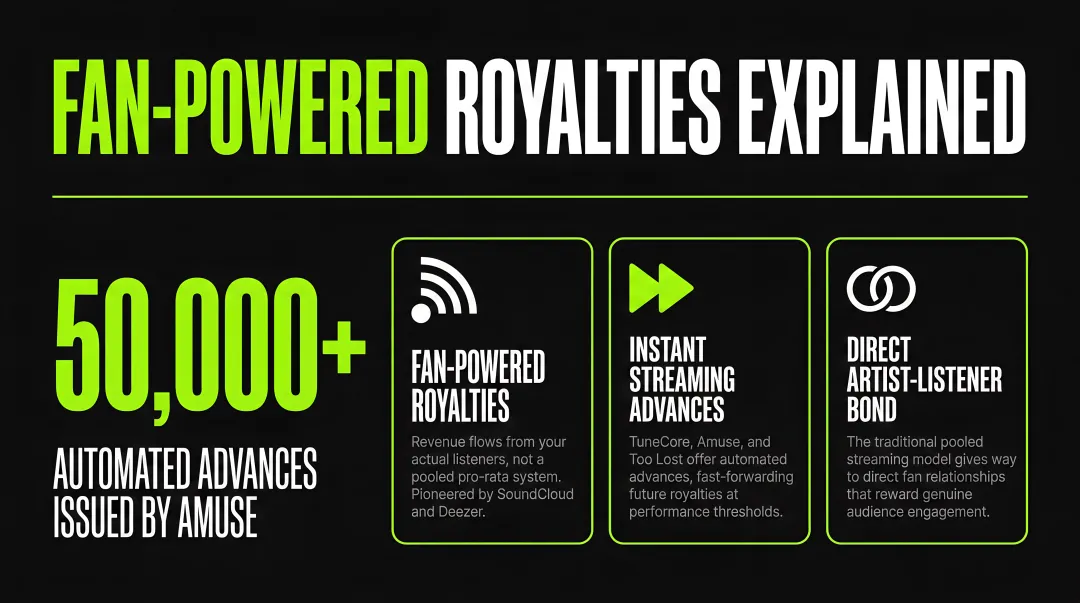
The traditional streaming model is being supplemented by direct relationships between artists and listeners. SoundCloud and Deezer pioneered "fan-powered royalties," where your revenue comes directly from your actual listeners rather than a pooled pro-rata system.
Instant advances based on streaming data have become standard. TuneCore, Amuse, and Too Lost offer automated advances, fast-forwarding future royalties to artists who meet performance thresholds. Amuse surpassed 50,000 automated advances by late 2025, demonstrating the scale of this shift.
Fan messaging capabilities, exclusive content tiers, and direct merchandise integration are becoming standard features, allowing producers to build sustainable careers with smaller, more engaged audiences rather than chasing viral hits.
Conclusion
The best music streaming platform for producers in 2026 depends entirely on your specific needs and release strategy. High-volume producers benefit most from unlimited plans like DistroKid (₹2,000/year) or TuneCore (₹1,200/year), both offering 100% royalty retention with fast turnaround times.
Electronic and dance producers should prioritize Beatport for DJ-focused discovery and higher per-track revenue from direct sales. If maximum royalties and professional services matter most, Madverse retains 95% of earnings while including sync licensing, playlist pitching, and team collaboration tools.
Before committing to any platform, read the fine print carefully. Payment splitting fees, customer support quality, and hidden costs can add up significantly over time.
A platform that looks cheap upfront may cost more annually when you factor in per-collaborator fees, additional charges for features like YouTube Content ID, and commission percentages on social platform revenue.
Once you've weighed these factors, the right choice becomes clearer. For producers serious about keeping maximum royalties while accessing professional distribution, sync licensing opportunities for TV and film placements, and comprehensive label services, Madverse's platform offers 95% royalty retention with integrated promotional tools designed to support independent artists and labels at every stage.
Frequently Asked Questions
What are the top streaming services for music producers?
DistroKid, TuneCore, Madverse, CD Baby, and Beatport lead for 2026. Each excels in different areas—from unlimited uploads and advanced analytics to high royalty retention and electronic music specialization.
How many Spotify streams do you need to make ₹8,00,000?
An artist who accounts for 1 in every 1 million streams generates over ₹8,00,000 annually. This typically requires 2-3 million streams, varying by distributor commission and listener geography.
What's the difference between music distribution platforms and streaming services?
Distribution platforms (DistroKid, TuneCore, Madverse) get your music onto streaming services (Spotify, Apple Music, Amazon), while streaming services are where listeners consume music. You need a distributor to access streaming platforms unless you're signed to a label.
Should I use a free or paid distribution platform?
Free platforms take 15% commission with limited features, while paid platforms (₹1,500-4,000/year) let you keep 100% of royalties. If you earn over ₹15,000-25,000 annually, paid platforms deliver better ROI.
What features should producers prioritize when choosing a platform?
Prioritize transparent royalty reporting, payment splitting at source, global distribution reach (including TikTok), responsive customer support, and comprehensive analytics with demographic breakdowns.
How do I switch distributors without losing my streams and playlist placements?
Upload to your new distributor using the exact same ISRC codes and metadata before requesting takedown from your old distributor. Once the new version appears on streaming platforms, request takedown from the old one to preserve stream counts and playlist placements.