

Introduction
Independent musicians today navigate 10+ distinct revenue streams simultaneously—from streaming royalties and sync placements to social video monetization and Content ID claims. Yet most independent artists leave significant money on the table by not understanding which platforms offer the best royalty rates, features, and revenue diversification.
The challenge isn't lack of opportunity. It's choosing the right platforms to maximize every revenue stream.
Consider the numbers: streaming now accounts for 69% of all recorded music revenue globally, totaling $22.2 billion in 2024 according to IFPI's 2025 Global Music Report. Meanwhile, self-releasing independent artists have grown to 8.2 million creators generating $2 billion annually, according to MIDiA Research.
The gap between potential and actual earnings? Platform choice.
This guide compares the top music monetization platforms across distribution, streaming, social video, and sync licensing to help you maximize every revenue opportunity available.
Key Takeaways
- Distribution platforms retain 70-95% royalties—some charge annual fees, others take commission
- Streaming payouts vary: Amazon Music pays ₹730 per 1,000 streams vs. Spotify's ₹250
- YouTube Content ID generates passive income from user-created videos featuring your tracks
- Sync licensing: ₹1.2-6.5 lakh upfront per track plus ongoing royalties
- Strategic multi-platform presence diversifies income without conflicts
Overview of Music Monetization in the Modern Music Industry
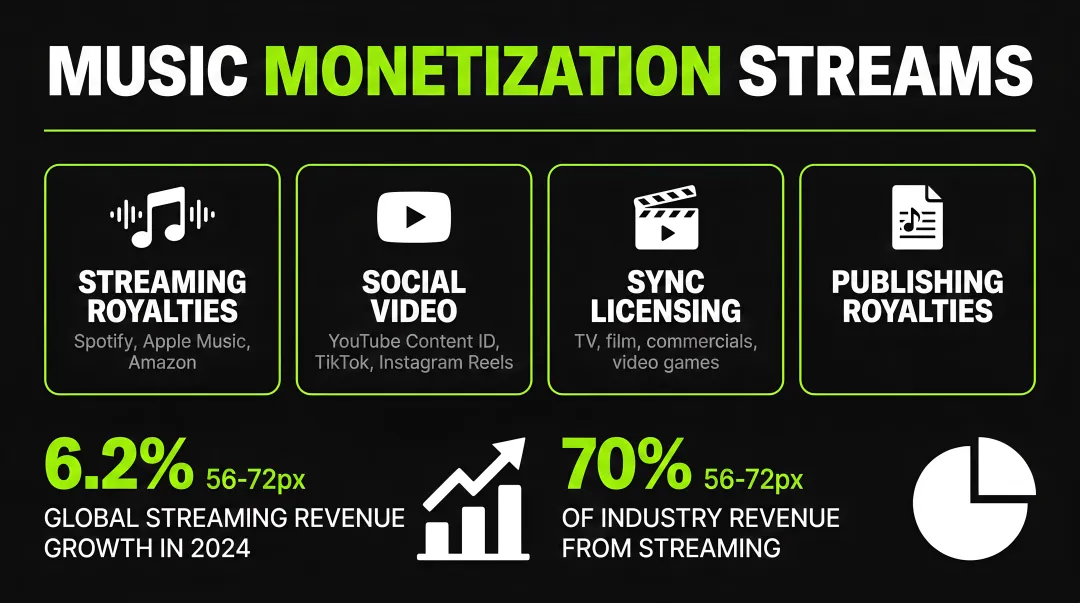
Independent artists today earn from more revenue streams than ever before. Music monetization extends far beyond traditional sales, tapping into:
- Streaming royalties (Spotify, Apple Music, Amazon)
- Social video platforms (YouTube Content ID, TikTok Creator Fund, Instagram Reels)
- Sync licensing (TV, film, commercials, video games)
- Publishing royalties
The market has grown substantially. Global streaming revenue increased 6.2% in 2024, reaching ₹1,85,000 crore and representing nearly 70% of total music industry revenue. For independent artists, this shift has been transformative: non-major labels and independent artists now control 46.7% of the global recorded music market, generating ₹1,19,000 crore annually.
This growth has created unprecedented opportunities for independent artists willing to navigate the platform landscape strategically. The platforms below represent the most effective ways to access these revenue streams, based on royalty rates, feature sets, and earning potential.
Top Music Monetization Platforms
We evaluated platforms based on royalty percentages, revenue stream diversity, ease of use, and verified artist feedback.
Spotify for Artists (Direct Upload via Distribution Partner)
Spotify is the world's largest streaming platform with 713 million monthly active users, including 281 million paying subscribers. Artists access Spotify through distribution partners rather than uploading directly.
Essential revenue features include:
- Streaming royalties and editorial playlist opportunities
- Real-time analytics through Spotify for Artists
- Enhanced features like Canvas video loops
Playlist placement remains the single biggest driver of streams. Algorithmic playlists (Discover Weekly, Release Radar) account for a substantial portion of discovery.
| Feature | Details |
|---|---|
| Revenue Type | Streaming royalties (paid per stream), playlist placements, Spotify Premium revenue share |
| Key Features | Real-time analytics, playlist pitching tools, artist profile customization, Canvas video loops |
| Best For | Artists prioritizing streaming discoverability and playlist placements for passive income |
YouTube Content ID & YouTube Music
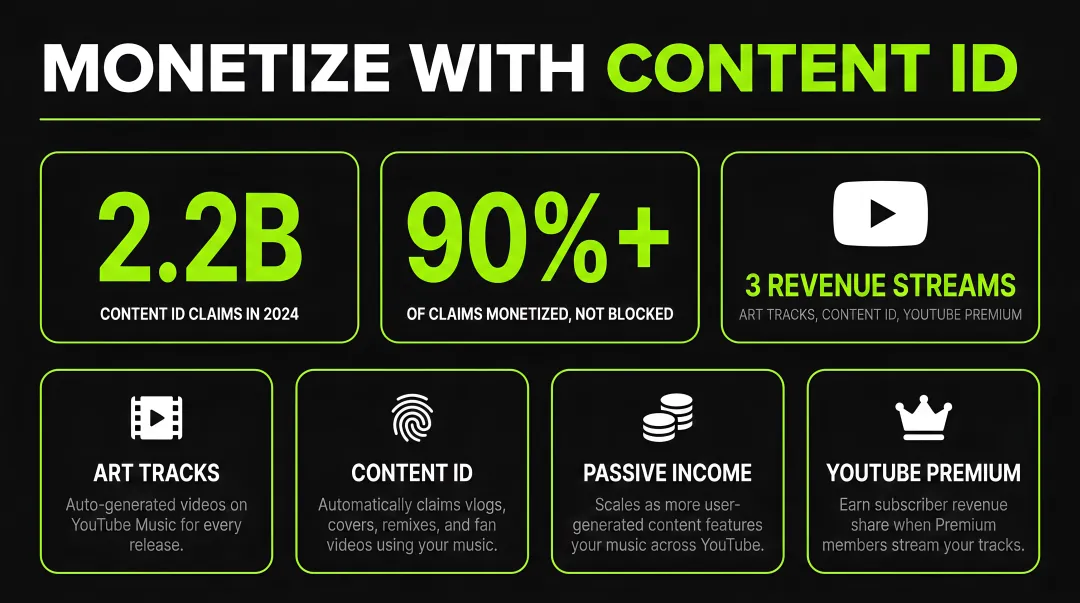
YouTube is the world's second-largest search engine and the largest video platform, offering multiple monetization methods: Art Tracks (auto-generated videos), Content ID, and YouTube Premium subscriber revenue.
Content ID automatically monetizes user-generated videos using your music—vlogs, covers, remixes, and fan videos. YouTube processed 2.2 billion Content ID claims in 2024, with rights holders monetizing over 90% of claims rather than blocking content.
This creates passive income that scales with virality. YouTube has paid over $12 billion to rights holders from Content ID revenue.
| Feature | Details |
|---|---|
| Revenue Type | Ad revenue from Content ID claims on user videos, YouTube Music streaming, Premium subscriber views, official video ads |
| Key Features | Automatic Content ID matching, YouTube Analytics, Official Artist Channel, Shorts monetization |
| Best For | Artists with visual content and those wanting to monetize fan-created videos featuring their music |
Madverse
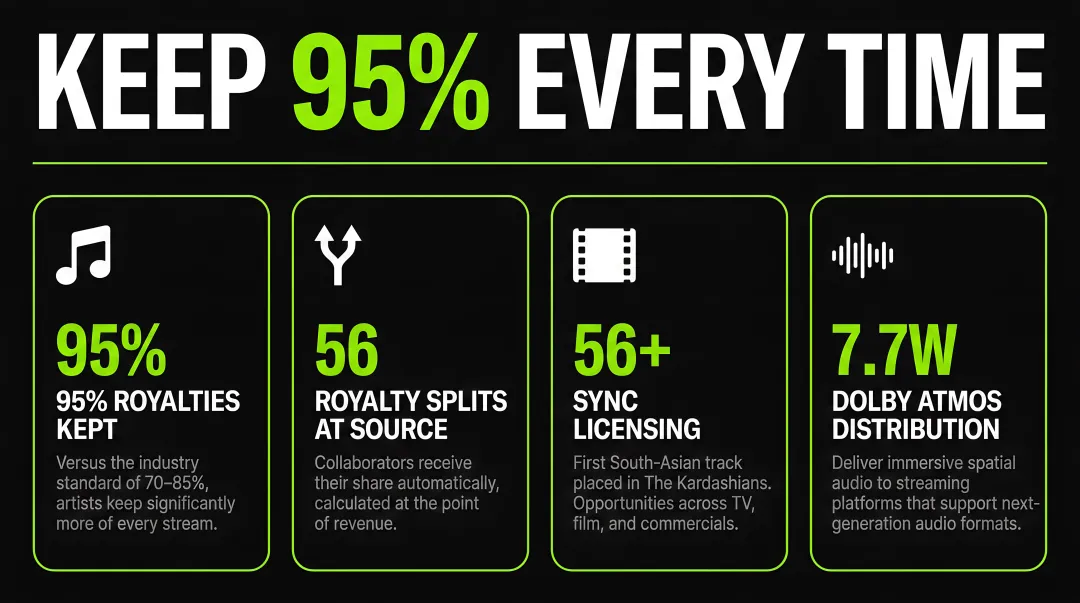
Madverse is a comprehensive music distribution and label services platform serving independent artists and labels globally. The company made headlines by syncing the first South-Asian track in The Kardashians, demonstrating their sync licensing capabilities.
Madverse stands out with several key advantages:
- Artists keep 95% of royalties (versus industry standard of 70-85%)
- Royalty splits at source for collaborators
- Sync licensing opportunities for TV/film/commercials
- Dolby Atmos distribution and YouTube Content ID
- Dedicated account manager support
The platform combines maximum royalty retention with professional collaboration tools designed for both solo artists and labels managing multiple roster members.
| Feature | Details |
|---|---|
| Revenue Type | Streaming royalties (95% kept by artist), sync licensing for TV/film/commercials, YouTube Content ID, social video monetization |
| Key Features | Royalty splits at source, advanced analytics, roster management for labels, editorial playlist pitching, Dolby Atmos support |
| Best For | Artists and labels wanting maximum royalty retention, sync opportunities, professional team collaboration tools, and comprehensive support |
DistroKid
DistroKid is a popular unlimited upload distribution service founded in 2013, known for its simple pricing model and fast delivery to streaming platforms.
Key advantages include:
- Unlimited uploads for a flat annual fee (₹2,100/year)
- Fastest distribution speed (typically 1-2 days versus 3-7 days for competitors)
- Automatic royalty splits for collaborators
- HyperFollow smart links for pre-save campaigns
Artists keep 100% of royalties with no commission, though the service requires an annual subscription.
| Feature | Details |
|---|---|
| Revenue Type | Streaming royalties (100% kept, requires annual subscription), YouTube Content ID (additional fee), social video monetization |
| Key Features | Unlimited uploads, automatic splits, HyperFollow landing pages, Spotify pre-save campaigns |
| Best For | Prolific artists releasing music frequently who want unlimited uploads and fast distribution |
TuneCore
TuneCore is one of the oldest distribution platforms, founded in 2005, with a reputation for detailed royalty reporting and transparent analytics.
TuneCore offers 100% royalty retention on DSPs (digital service providers), detailed sales analytics broken down by territory, and publishing administration services as an add-on. Social video monetization is included.
However, TuneCore takes a 20% commission on social platform revenue (YouTube, TikTok, Instagram), which can significantly impact earnings for artists with viral social content.
| Feature | Details |
|---|---|
| Revenue Type | Streaming royalties (100% kept, pay per release/year), YouTube Content ID, publishing royalties (via TuneCore Publishing) |
| Key Features | Territory-by-territory reporting, daily trending reports, publishing administration option |
| Best For | Artists who release infrequently and want granular sales data and optional publishing administration |
Epidemic Sound / Artlist (Production Music & Sync Licensing)
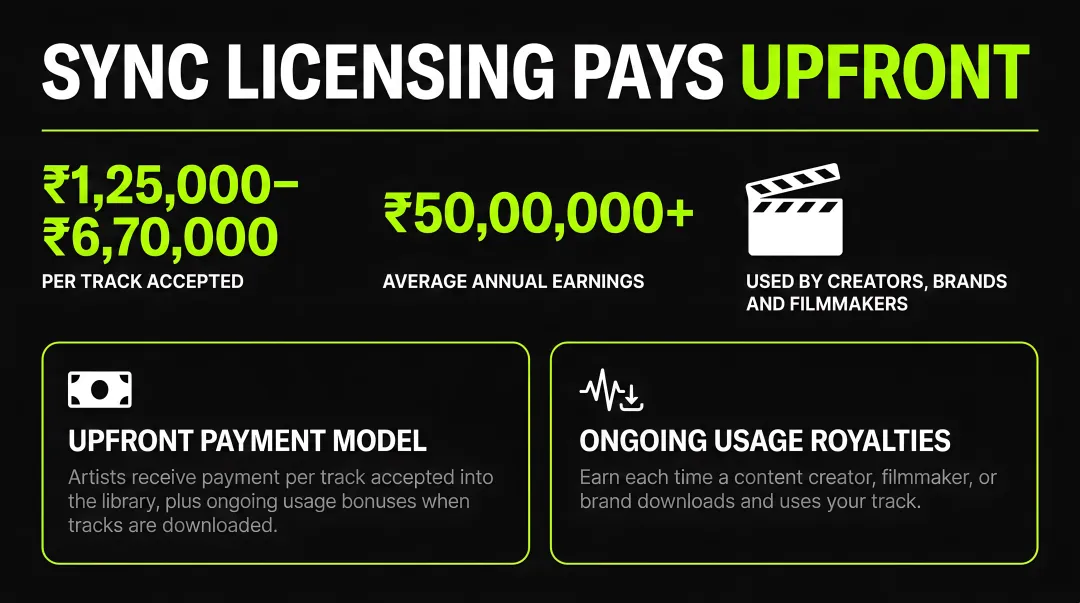
These are production music libraries where artists license their music upfront for use in content creation, receiving payment per track accepted plus usage bonuses.
The model differs from traditional distribution:
- Artists receive upfront payment of ₹1,25,000-₹6,70,000 per track
- Ongoing royalties when tracks are downloaded or used by content creators, filmmakers, and brands
- Epidemic Sound reports that active artists earn over ₹50,00,000 annually on average
The trade-off: most agreements are exclusive, meaning you transfer rights to the library in exchange for guaranteed upfront income.
| Feature | Details |
|---|---|
| Revenue Type | Upfront licensing fees per accepted track, usage-based bonuses, performance royalties from PRO when used in broadcasts |
| Key Features | Curated catalog acceptance, exposure to content creators and filmmakers, simplified licensing, ongoing passive income |
| Best For | Producers and composers creating instrumental/background music willing to license tracks for guaranteed upfront income |
How We Chose the Best Music Monetization Platforms
Artists often make critical mistakes when choosing platforms: selecting based solely on brand recognition or upfront cost without considering long-term royalty percentages, revenue stream diversity, and hidden fees.
We evaluated platforms across six critical factors:
- Royalty percentage retained (70-100%): The difference between keeping 70% versus 95% of royalties can mean lakhs of rupees over time
- Payment terms and thresholds: Some platforms pay monthly, others quarterly; minimum thresholds range from ₹800-₹8,000
- Revenue stream diversity: Does the platform only handle streaming, or does it include Content ID, sync licensing, and social video?
- Feature sets: Analytics quality, automatic royalty splits, playlist pitching, pre-save campaigns
- Rights retention: You should keep 100% ownership of your masters and copyrights
- Artist support quality: Dedicated account managers versus ticket-based support
Your choice should match your specific needs and career stage.
Platforms like Madverse provide complete distribution packages with sync licensing opportunities and 95% royalty retention, while specialized services like DistroKid prioritize unlimited uploads and fast delivery. Choose based on your release frequency, collaboration needs, and income diversification goals.
Maximizing Revenue Across Multiple Platforms
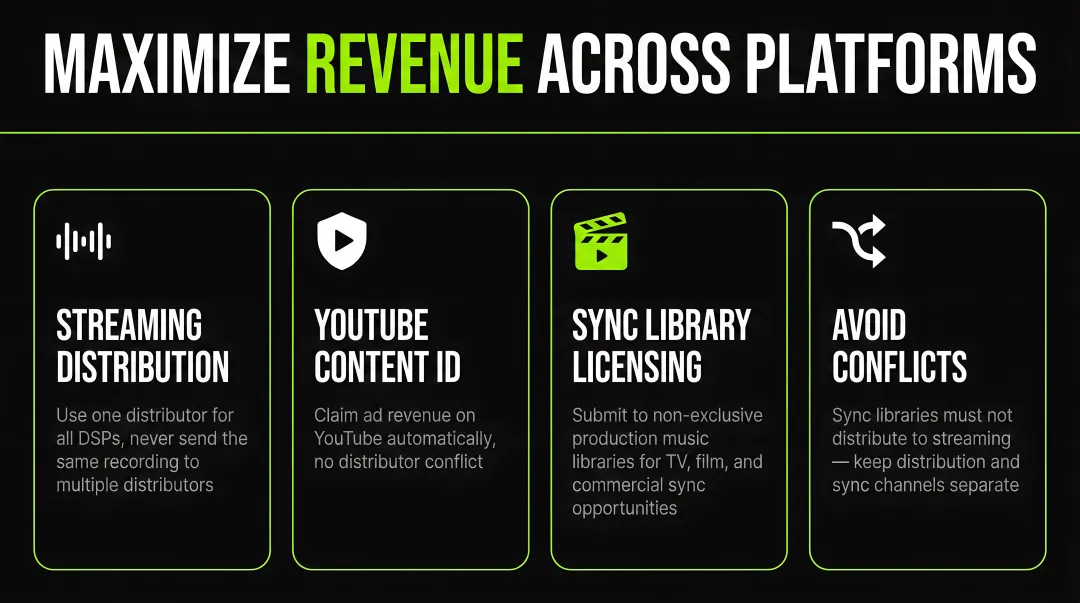
Successful monetization strategies involve using multiple platforms simultaneously. Combine one distribution service for streaming, Content ID for YouTube, and production music libraries for sync opportunities.
Strategic guidance to avoid conflicts:
- Never send the same recordings to multiple distributors — this creates metadata conflicts, duplicate releases, and potential takedowns
- Use one distributor for streaming + separate sync libraries non-exclusively — as long as sync libraries don't require streaming exclusivity
- Timing matters for playlist placements — submit tracks for editorial consideration 4-6 weeks before release date
- Leverage exclusive vs. non-exclusive sync strategically — exclusive deals pay more upfront but limit flexibility; non-exclusive allows multiple placements
Once you've established your multi-platform presence, tracking becomes essential.
Track all revenue streams in one place:
- Use spreadsheets or financial tools to monitor which platforms generate the most income
- Calculate your effective per-stream rates across platforms to understand which deliver the best returns
- Adjust strategy quarterly based on performance data
- Identify which revenue streams (streaming, sync, Content ID) contribute most to your income
Conclusion
Choosing the right monetization platform isn't about following the biggest brand name—it's about aligning royalty percentages, feature sets, and revenue stream access with your specific goals as an artist or label.
Before committing to a platform, evaluate:
- Release frequency – Prolific artists releasing weekly singles need different tools than occasional album creators
- Collaboration needs – Labels and collectives require roster management and split payment features
- Income goals – Producers creating sync-ready instrumentals prioritize licensing opportunities over streaming
- Performance tracking – Review actual earnings quarterly to ensure your platform delivers results
A producer creating sync-ready instrumentals has different needs than an artist focused purely on streaming revenue.
For artists and labels seeking maximum royalty retention, Madverse keeps 95% of royalties in your pocket while providing sync licensing access for TV, film, and commercial placements. The platform includes team collaboration tools and roster management—designed specifically for independent artists and emerging labels building sustainable careers.
Frequently Asked Questions
Where can I monetize my music?
You can monetize through distribution platforms (Spotify, Apple Music, Amazon Music), social video platforms (YouTube Content ID, TikTok, Instagram Reels, Facebook), sync licensing libraries (TV/film/ads), and live streaming. Most successful artists use 2-4 platforms simultaneously for diversified income.
How much money do 1,000 streams on Spotify pay?
Spotify pays approximately $3.00 (₹250) per 1,000 streams on average for independent artists in 2024. This varies based on listener location, subscription type (Premium vs. Free), and your royalty split—artists keeping 95% earn more per stream than those keeping 70%.
What percentage of royalties do music distributors take?
Most distributors take 15-30% of streaming royalties, meaning artists keep 70-85%. Premium services like Madverse let artists keep up to 95% with no upfront fees, while subscription-based services may charge annual fees but pass through 100% of royalties.
What is the difference between music distribution and monetization?
Distribution is the process of delivering your music to streaming platforms and digital stores. Monetization encompasses all ways you earn revenue from that music—streaming royalties, Content ID claims, sync licensing, social video ads, and publishing royalties. Distribution is one component of a broader monetization strategy.
How do I monetize my music on YouTube?
Distribute through a service offering Content ID (like Madverse, DistroKid, or TuneCore) to automatically place ads on videos using your music. Create your own YouTube channel with official videos and enable YouTube Shorts monetization for additional revenue streams.
Can I use multiple music monetization platforms at once?
Yes, but never send the same recordings to multiple distributors—this causes conflicts and takedowns. You can use one distributor for streaming plus separate sync libraries non-exclusively, and monetize multiple social platforms through one distributor's social video feature.