
Introduction
YouTube remains the heavyweight for video monetization, but TikTok, Patreon, and Spotify are reshaping how musicians earn. For music creators, choosing the right platform—or combination of platforms—directly affects revenue potential and long-term sustainability.
The stakes are real: pick wrong, and you leave money on the table while competitors thrive.
The creator economy reached $234.65 billion in 2026, up from $191.55 billion in 2025. Yet 58.3% of creators face recent monetization challenges, underscoring why strategic platform selection matters more than ever.
Key Takeaways
- Multiple revenue streams on YouTube (ads, memberships, Super Chat, Content ID) require 1,000 subscribers and 4,000 watch hours
- Faster growth on TikTok comes with lower earnings: $0.40-$1.00 per 1,000 views vs YouTube's $1-$10+
- Highest per-fan revenue comes from Patreon's monthly subscriptions—but you need an existing audience
- Diversification maximizes income: ads (YouTube), discovery (TikTok), superfans (Patreon), streaming (distribution)
YouTube vs Other Platforms: Quick Comparison Table
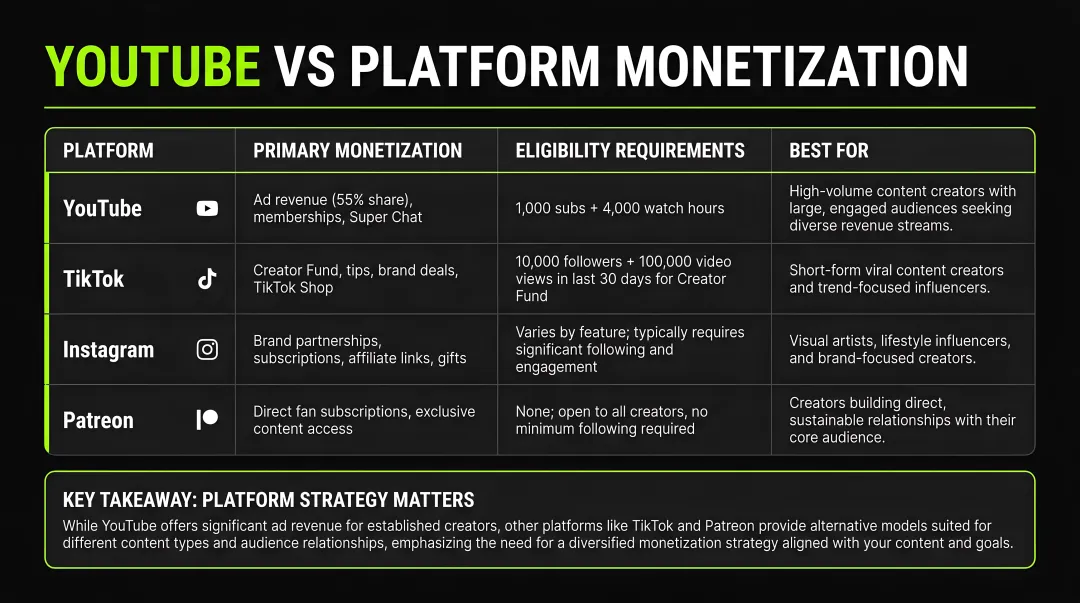
Each platform offers distinct monetization models tailored to different content types and audience engagement styles. This comparison breaks down eligibility requirements, revenue models, and ideal use cases to help you identify which platforms align with your content strategy.
| Platform | Primary Monetization | Eligibility Requirements | Best For |
|---|---|---|---|
| YouTube | Ad revenue (55% share), memberships, Super Chat | 1,000 subs + 4,000 watch hours OR 10M Shorts views | Video creators, musicians with visual content, long-form educational content |
| Patreon | Monthly subscriptions | None | Creators with dedicated fanbases, exclusive content offerings |
| Twitch | Subscriptions, Bits, ads | 50 followers + 8 hours streamed + 3 avg viewers | Live streamers, gaming content, interactive performances |
| TikTok | Creator Rewards Program | 10,000 followers + 100,000 views/30 days | Viral short-form content, music promotion, younger demographics |
| Spotify | Streaming royalties | Distribution partner required | Musicians, audio-first content, passive catalog income |
| Reels bonuses, brand deals, subscriptions | Varies by program | Visual storytelling, influencer marketing, lifestyle creators | |
| Content monetization program | Varies by region and program | Community-focused creators, video content |
Note: Revenue shares and eligibility thresholds typically quoted in USD. Requirements and programs vary by region and are subject to platform policy changes.
What is YouTube Monetization?
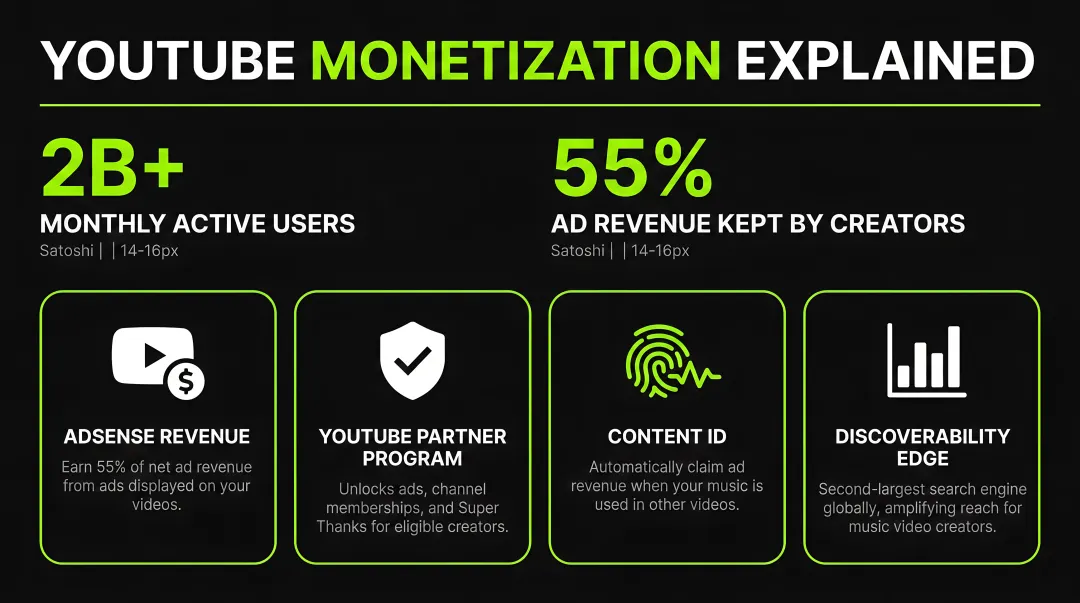
YouTube monetization represents the most comprehensive revenue ecosystem for video creators, particularly musicians who combine audio with visual storytelling.
As the second-largest search engine globally with over 2 billion monthly active users, YouTube offers exceptional discoverability alongside multiple income streams.
Core monetization methods include:
- AdSense Revenue - Creators earn 55% of net ad revenue from ads displayed on their videos
- YouTube Partner Program (YPP) - Unlocks ads, channel memberships, Super Chat/Stickers, and merchandise shelf
- YouTube Premium Revenue - Share of subscription fees based on watch time from Premium members
- Channel Memberships - Monthly subscriptions offering exclusive perks to supporters
- Super Chat & Super Stickers - Live stream monetization through viewer donations
- Merchandise Shelf - Direct product sales integration
For music creators specifically, YouTube Content ID represents a powerful additional revenue stream. This automated rights management system scans uploaded videos against a database of registered content.
When your music appears in someone else's video, you can monetize it by running ads, turning fan uploads and user-generated content into passive income.
Distribution platforms like Madverse provide independent artists with Content ID protection and Official Artist Channel setup, maximizing monetization across original uploads and third-party uses.
Revenue Benchmarks:
Music content on YouTube typically generates CPM (cost per thousand impressions) rates of ₹80-₹800+, with actual earnings varying based on audience demographics, advertiser demand, and content category.
A video with 100,000 views might generate ₹8,000-₹80,000 in ad revenue, though these figures fluctuate significantly.
YouTube Monetization Requirements
Before you can earn from YouTube, you need to meet specific Partner Program requirements:
Standard Path:
- 1,000 subscribers
- 4,000 valid public watch hours in the past 12 months
Shorts Alternative Path:
- 1,000 subscribers
- 10 million valid public Shorts views in the past 90 days
Additional Requirements:
- Adherence to YouTube Community Guidelines and monetization policies
- Active AdSense account linked to your channel
- Two-step verification enabled on your Google account
- Residence in a country where the Partner Program is available
Timeline Expectations:
Most creators take 6-12 months to reach monetization thresholds. This varies based on:
- Content quality and upload consistency
- Niche competition and audience demand
- Promotional efforts and SEO optimization
- Video format (long-form vs. Shorts)
YouTube Monetization Advantages
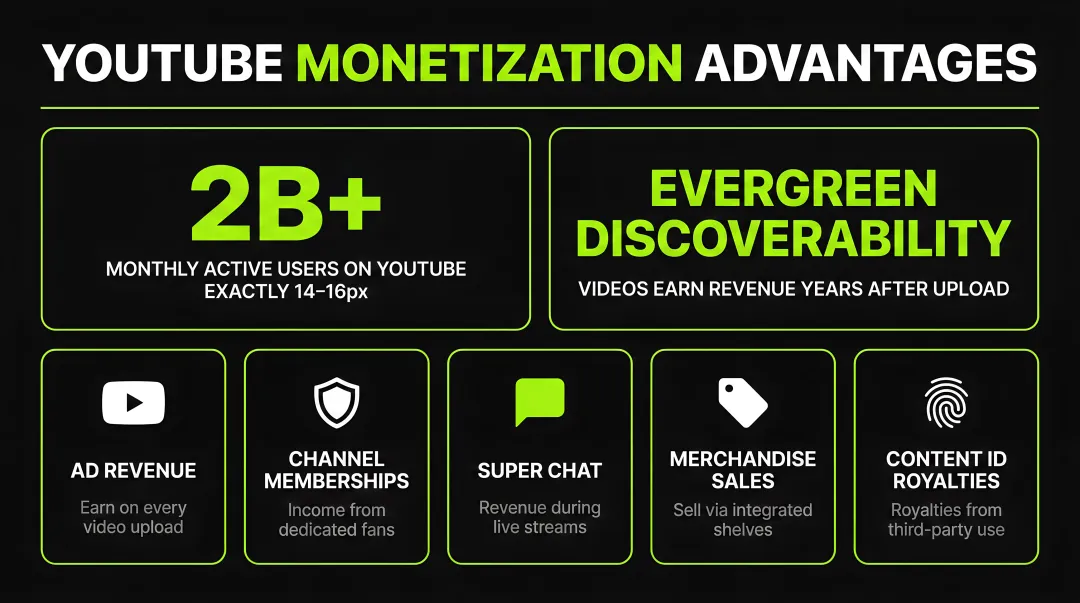
Massive Audience Reach: YouTube's 2+ billion monthly users provide unparalleled exposure potential.
The platform's search functionality gives content evergreen discoverability—videos can continue generating views and revenue years after upload.
Multiple Revenue Streams: YouTube creators can simultaneously earn from:
- Ad revenue on every video
- Channel memberships from dedicated fans
- Super Chat during live streams
- Merchandise sales through integrated shelves
- Content ID royalties from third-party uses
Algorithm That Rewards Engagement: YouTube's recommendation algorithm prioritizes watch time and engagement, meaning quality content gets promoted regardless of subscriber count.
Small channels can achieve viral reach if content resonates.
Format Flexibility: Creators can publish long-form videos (10+ minutes for maximum ad placements), YouTube Shorts (under 60 seconds), live streams, and Premieres—all monetizable through different mechanisms.
YouTube Monetization Challenges
High Entry Barriers: New creators face a significant gap between starting and earning. Reaching 1,000 subscribers and 4,000 watch hours requires substantial time investment with zero guaranteed income.
Revenue Volatility: Ad revenue fluctuates based on CPM rates, which vary by season (higher during Q4 holidays), advertiser demand, and viewer demographics.
Content discussing sensitive topics may face limited ads or demonetization.
Algorithm Dependency: Changes to YouTube's recommendation algorithm can significantly impact visibility and earnings overnight.
Creators who relied on specific content formats or topics may see sudden traffic drops.
Intense Competition: Popular niches like music, gaming, and lifestyle content face saturation, making it harder for new creators to stand out and build audiences.
Other Platform Monetization Options
While YouTube dominates video monetization, alternative platforms offer unique advantages for specific content types and audience engagement models. The most successful modern creators adopt a multi-platform approach, leveraging each platform's strengths.
Patreon and Membership Platforms
Patreon created the subscription-based creator economy, allowing fans to support creators directly through tiered monthly memberships.
The platform works through tiered memberships where creators offer exclusive content, behind-the-scenes access, early releases, or personalized perks. Subscription tiers typically range from ₹250-₹4,250/month.
Key Benefits:
- Predictable income - Monthly recurring revenue provides financial stability
- Deeper fan relationships - Direct connection with your most dedicated supporters
- Creative freedom - No advertiser restrictions or demonetization concerns
- Immediate monetization - No follower thresholds or eligibility requirements
Performance Data: In 2024, Patreon creators surpassed 60 million free memberships, with over 400,000 converting to paid tiers monthly. More than 60% of new sign-ups now come from within Patreon's network, improving internal discoverability.
Best For: Musicians offering exclusive tracks, tutorial creators providing premium lessons, podcasters with bonus episodes, and any creator with a dedicated fanbase willing to pay for premium access.
Twitch
Twitch dominates live streaming monetization, particularly for gaming content but increasingly popular for music performances and interactive shows.
Monetization Streams:
- Subscriptions - Tiered monthly subs (₹425, ₹850, ₹2,125) with revenue split between creator and platform
- Bits - Virtual currency viewers purchase to "cheer" during streams (creators earn ₹0.85 per Bit)
- Ad Revenue - Share of ads displayed during streams
Eligibility Requirements: Twitch Affiliate status requires 50 followers, 8 hours streamed over 7 days, and 3 average concurrent viewers. Partner status (higher revenue share) requires approximately 75 average viewers.
Best For: Live music performances, Q&A sessions with fans, gaming content, interactive tutorials, and creators who thrive on real-time audience engagement.
TikTok Creator Fund and Brand Partnerships
TikTok revolutionized content discovery with its algorithm-driven feed, offering massive viral potential but lower direct platform payouts.
Creator Rewards Program: TikTok transitioned from its original Creator Fund to the Creator Rewards Program, which pays ₹34-₹85 per 1,000 views for qualifying videos over 1 minute long—significantly higher than the legacy fund but still lower than YouTube's ₹85-₹850+ RPM.
Eligibility:
- 18+ years old
- 10,000+ followers
- 100,000+ video views in the past 30 days
Alternative Revenue: Most successful TikTok creators earn primarily through brand partnerships and sponsored content rather than platform payouts, leveraging viral reach to command sponsorship fees.
Best For: Short-form viral content, music promotion (songs going viral on TikTok often chart on streaming platforms), reaching Gen Z demographics, and driving traffic to higher-earning platforms.
Spotify and Music Streaming Platforms
Spotify leads music streaming with direct royalty payments to rights holders, though per-stream rates remain controversial.
Payment Model: Spotify paid out over $11 billion in 2025, with independent artists and labels accounting for nearly 50% of total payouts. The platform pays approximately 70% of revenue to rights holders (labels, publishers, distributors), who then pay artists based on individual contracts.
Earnings Benchmarks:
- An artist accounting for 1 in every 1 million streams generates roughly ₹8.5 lakhs
- Approximately 1,500 artists generated over ₹8.5 crores from Spotify alone in 2024
- Reaching ₹8.5 crores requires approximately 20-25 million streams
Ideal for: Musicians focusing purely on audio content, building passive catalog income, and artists using distribution platforms to maximize multi-platform streaming presence.
Instagram and Facebook
Meta's platforms offer monetization primarily through branded content, Reels bonuses, and fan subscriptions.
Monetization Options:
- Instagram Subscriptions - Exclusive content for monthly subscribers (Meta currently takes 0% revenue share, though app store fees apply)
- Reels Bonuses - Performance-based payouts for qualifying creators
- Branded Content - Sponsored posts and partnerships with brands
- Facebook Content Monetization - Unified program rewarding performance across Reels, photos, and text
Payout Thresholds: Minimum balance of ₹425 in India or ₹2,125 internationally (₹8,500 for wire transfers).
Best For: Visual storytelling, influencer marketing, lifestyle content, e-commerce integration, and creators with strong visual aesthetics.
Sync Licensing and Content Distribution Platforms
Sync licensing involves placing music in TV shows, films, commercials, and video games—offering potentially massive one-time payments.
Market Overview: The global sync market reached approximately $650 million in 2024, with fees varying dramatically based on usage:
- Film festival rights: ~₹85,000
- Indie film: ₹8.5-68 lakhs
- National ad campaign: ₹8.5-42.5 lakhs
- Global campaign: ₹85 lakhs-₹2.1 crores+
How Distribution Platforms Help: Individual artists rarely have direct access to sync opportunities, which is where distribution platforms become essential. These services represent artists to music supervisors, handle rights clearances, and negotiate placements.
Madverse, for example, provides sync licensing access as part of its distribution services—opening doors that independent artists couldn't access alone. The platform's sync team secured placements like the first-ever South Asian track in The Kardashians, demonstrating how the right distribution partner can transform sync opportunities from aspirational to achievable.
Platform Comparison: Which is Best for Music Creators?
No single platform universally dominates for all music creators.
The optimal choice depends on your content type, audience demographics, monetization goals, and available resources.
Revenue Potential Comparison
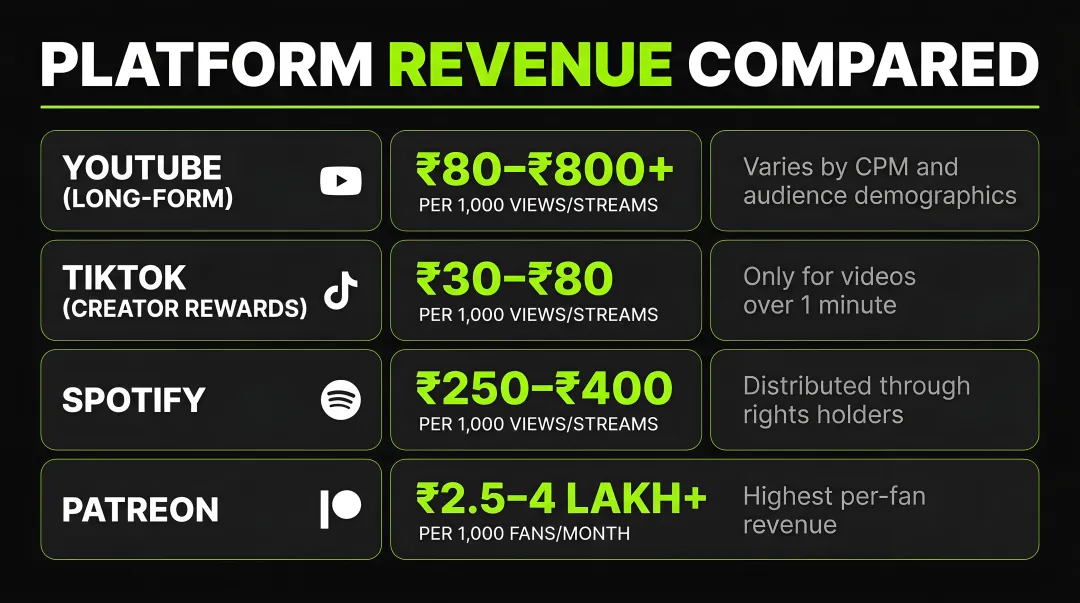
Per-View/Stream Earnings:
| Platform | Earnings Per 1,000 Views/Streams | Notes |
|---|---|---|
| YouTube (Long-form) | ₹80-₹800+ | Varies by CPM and audience demographics |
| TikTok (Creator Rewards) | ₹30-₹80 | Only for videos over 1 minute |
| Spotify | ₹250-₹400 (per 1,000 streams) | Distributed through rights holders |
| Patreon | ₹2.5-4 lakh+ (per 1,000 fans at ₹250-₹400/month) | Highest per-fan revenue |
Multi-Stream Revenue Power
YouTube's true power lies in combining multiple revenue sources.
A creator with 100,000 subscribers might earn:
- ₹40,000-₹1.6 lakh/month from ad revenue
- ₹40,000-₹1.2 lakh/month from channel memberships (100 members at ₹400-₹1,200/month)
- ₹16,000-₹40,000/month from Super Chat during live streams
- Additional income from Content ID on third-party videos
Streaming platforms offer passive royalty income. An artist with 1 million monthly Spotify streams generates approximately ₹2.5-4 lakh monthly in royalties.
Audience Reach and Discoverability
YouTube: Search-Driven Longevity
YouTube's search functionality provides evergreen discoverability. Well-optimized videos continue attracting views years after publication, creating compound growth. The recommendation algorithm also promotes engaging content regardless of channel size.
TikTok: Viral Discovery Engine
TikTok's "For You Page" algorithm can deliver millions of views to completely new creators overnight. Converting viral views into sustainable income or loyal followers remains challenging, though. TikTok excels at discovery but requires funneling audiences to higher-earning platforms.
Patreon: Audience Required
Patreon offers no built-in discovery—creators must bring their own audience. Once established, Patreon provides the highest per-fan revenue and most stable income.
Platform User Statistics
- YouTube: 2+ billion monthly active users
- TikTok: 1+ billion monthly active users
- Spotify: 600+ million monthly active users
- Patreon: 60+ million free memberships, growing monthly
Content Format Flexibility
YouTube: Supports long-form videos (ideal for tutorials, vlogs, music videos), Shorts (under 60 seconds), live streams, and Premieres. Maximum flexibility for diverse content strategies.
Spotify/Streaming: Audio-only focus limits format options but provides passive income from catalog streams without requiring ongoing video production.
Instagram/TikTok: Prioritize short, visually engaging content (15-60 seconds). Best for quick consumption and viral potential but require constant content production.
Best Format Matches:
- Music educators: YouTube long-form for detailed tutorials
- Recording artists: Streaming platforms for catalog income + YouTube for music videos
- Live performers: Twitch for interactive concerts + YouTube for recorded performances
- Viral musicians: TikTok for discovery + YouTube/Spotify for monetization
Time to Monetization
Immediate Earning Potential:
- Patreon: Can generate income from day one if you have existing fans
- Streaming platforms: Earn royalties immediately once distributed (though payouts have minimum thresholds)
Short-Term (1-3 months):
- TikTok: Reaching 10,000 followers and 100,000 views happens frequently with viral content
- Twitch: Affiliate status (50 followers, basic requirements) within reach relatively quickly
Medium-Term (6-12 months):
- YouTube: Most creators reach Partner Program requirements (1,000 subs, 4,000 watch hours) within this timeframe with consistent quality content
Long-Term Investment:
- Sync Licensing: Building relationships and catalog takes time, but individual placements can generate substantial one-time payments
Multi-Platform Strategy Recommendation
Understanding each platform's timeline helps you plan strategically. The real power emerges when you combine multiple platforms.
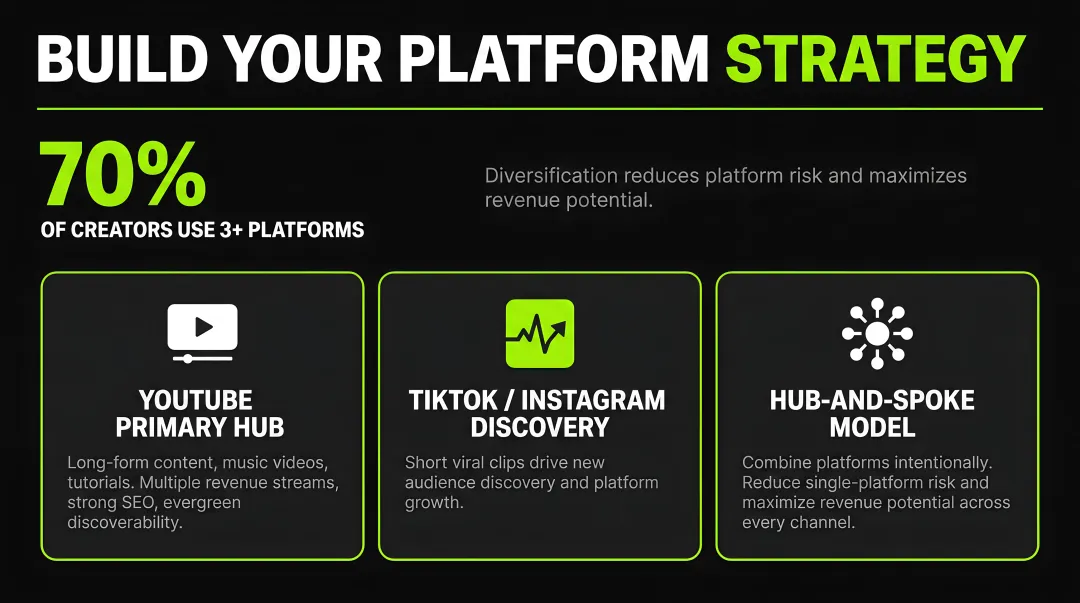
The 70% of creators now using three or more platforms aren't doing so randomly. Diversification reduces platform risk and maximizes revenue potential.
Recommended Hub-and-Spoke Model:
YouTube as Primary Hub - Long-form content, music videos, tutorials. Multiple revenue streams, strong SEO, evergreen discoverability.
TikTok/Instagram for Discovery - Short viral clips, behind-the-scenes snippets, music previews. Drive traffic to YouTube and streaming platforms.
Patreon for Superfans - Exclusive content, early releases, personalized perks. Highest per-fan revenue and predictable monthly income.
Distribution Platform for Streaming - Distribute your music to Spotify, Apple Music, Amazon Music, and all major platforms simultaneously. Services like Madverse handle technical requirements while providing Content ID protection and sync licensing opportunities, letting you focus on creating music.
Cross-Platform Content Strategy:
- Create long-form content for YouTube
- Extract short clips for TikTok/Instagram Reels
- Offer extended versions or bonus content on Patreon
- Distribute audio tracks to all streaming platforms
- Leverage Content ID to monetize fan-made content
This approach maximizes reach (TikTok), ad revenue (YouTube), fan support (Patreon), and passive income (streaming platforms) while distribution platforms handle technical requirements and revenue collection across channels.
Real-World Success Story: Multi-Platform Monetization in Action
Successful musicians using distribution platforms demonstrate the power of diversified monetization strategies. While specific revenue breakdowns remain confidential, the multi-platform approach shows consistent results.
Typical Multi-Platform Approach:
Independent artists typically use:
YouTube as the Primary Revenue Driver:
- Build an Official Artist Channel featuring music videos, behind-the-scenes footage, and lyric videos
- Monetize user-generated content through Content ID protection
- Earn from ads, channel memberships, and Super Chat during live premieres
Streaming Platforms for Passive Income:
- Distribute simultaneously to Spotify, Apple Music, Amazon Music, YouTube Music, and 100+ platforms
- Secure playlist placements that generate consistent monthly streams
- Your catalog grows compound value as older tracks keep earning
Social Media for Discovery:
- Share song snippets and studio sessions on TikTok and Instagram Reels
- Viral moments drive traffic to your streaming profiles and YouTube channel
- Build direct relationships with your fanbase
Sync Licensing for High-Value Opportunities:
- Connect with sync opportunities in TV, film, and advertising through distribution platforms
- Placements like the first South Asian track in The Kardashians show the global reach possible for independent artists
Why Distribution Platforms Maximize Revenue
This multi-platform strategy works because distribution services handle the technical complexity while you keep control.
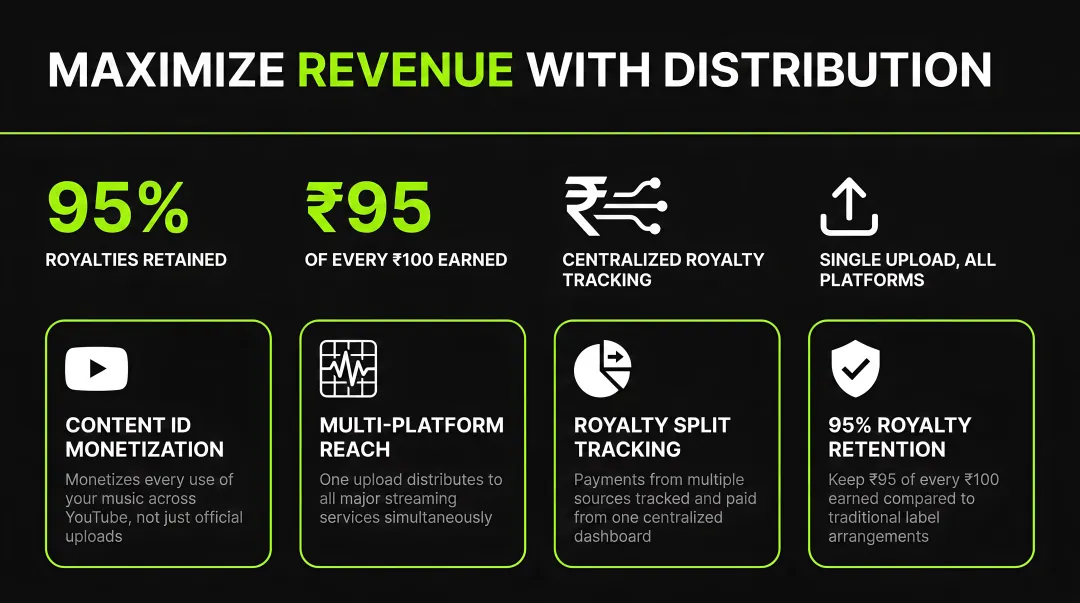
Artists using platforms like Madverse benefit from:
- Content ID access that monetizes every use of your music across YouTube, not just official uploads
- Single upload distribution reaching all major streaming services simultaneously
- Centralized royalty tracking and payment from multiple sources
- 95% royalty retention (keeping ₹95 of every ₹100 earned, compared to traditional label deals taking 50-85%)
- Automatic royalty splits at source for collaborative projects
Implementation Strategy:
- Set up your Official Artist Channel on YouTube and upload your first music video
- Choose a distribution platform offering Content ID protection to maximize YouTube revenue
- Post short-form content on TikTok and Instagram Reels to drive discovery
- Launch memberships on Patreon or YouTube to create direct fan revenue
- Track your analytics weekly to identify which platforms deliver the best return on your time investment
Successful monetization in 2026 requires treating each platform as serving a specific purpose within your overall strategy.
Distribution platforms streamline this approach by handling technical requirements, maximizing revenue collection, and providing access to sync licensing and Content ID opportunities that individual artists couldn't access alone.
Conclusion
Successful monetisation in 2026 requires understanding each platform's unique strengths and building a diversified strategy that uses multiple revenue streams. The creator economy's growth to ₹1,95,000 crore reflects increasing opportunities, but also intensifying competition and platform volatility.
YouTube remains the strongest platform for video content creators and musicians with visual content, especially when combined with Content ID protection and distribution platform support. Its multiple revenue streams, massive audience reach, and evergreen discoverability create sustainable long-term income.
However, supplementing YouTube with Patreon for superfan support, streaming platforms for passive royalties, and TikTok for viral discovery creates more stable, resilient income.
Final Strategic Guidance:
Start where your audience already exists. If you have existing fans, launch Patreon immediately for predictable income. If you're building from scratch, focus on one platform—typically YouTube for its monetisation depth or TikTok for its discovery potential—until you build momentum. Then expand strategically to complementary platforms serving different monetisation purposes.
Managing multiple platforms becomes simpler with the right infrastructure. Distribution platforms like Madverse simplify multi-platform presence by handling technical requirements, providing Content ID access, collecting royalties from all sources, and opening doors to sync licensing opportunities. For independent artists, these services level the playing field, providing access to monetisation tools that major labels previously monopolised.
The most successful creators in 2026 won't ask "which platform is best?" but rather "how do I strategically combine platforms to maximise reach, revenue, and resilience?"
Frequently Asked Questions
What are the minimum requirements to monetize on YouTube vs other platforms?
YouTube requires 1,000 subscribers + 4,000 watch hours (or 10M Shorts views in 90 days). TikTok needs 10K followers + 100K views in 30 days, while Twitch requires 50 followers + 8 hours streamed. Patreon has no minimums—start earning immediately.
Which platform pays the highest revenue per view/stream for music content?
YouTube offers the highest per-view earnings at $1-$10 CPM, versus TikTok's $0.40-$1.00 and Spotify's $0.003-$0.005 per stream. However, Patreon delivers the best per-fan revenue—1,000 fans at $5/month generates ₹4 lakh monthly, matching YouTube earnings that require millions of views.
Can I monetize my music on multiple platforms simultaneously?
Yes, and it's highly recommended. Multi-platform strategies maximise revenue and reduce risk. Distribution platforms like Madverse ensure your music reaches all streaming services with Content ID protection, letting you collect YouTube ad revenue, streaming royalties, Patreon support, and sync fees simultaneously.
How does YouTube Content ID work for music monetization?
Content ID automatically scans YouTube for your registered music in other creators' videos. You can then monetise those videos, block them, or track statistics—turning covers and remixes into passive income. Madverse provides Content ID access to independent artists who wouldn't qualify individually.
What's the best platform for independent musicians to start monetizing?
Start with YouTube for video content—it offers multiple revenue streams and strong discoverability. Simultaneously distribute audio to all streaming platforms for passive royalties. If you have dedicated fans, launch Patreon immediately for predictable monthly income.
How long does it take to start earning money on different platforms?
Patreon and streaming platforms pay immediately (with minimum thresholds). TikTok typically takes 1-3 months if content goes viral, while YouTube requires 6-12 months for most creators. Realistic timeline: treat the first 6-12 months as audience-building, then monetisation accelerates as your catalogue and following grow.