Introduction
YouTube commands 2.70 billion monthly active users as of January 2026, making it the world's largest music discovery platform.
The platform has launched the careers of global superstars like Justin Bieber (discovered through covers in 2007), Billie Eilish (whose viral "Ocean Eyes" upload led to her record deal), and Shawn Mendes—proving that independent artists can bypass traditional industry gatekeepers entirely.
Yet with over 360 hours of content uploaded every minute, visibility has become the critical challenge. Simply uploading music isn't enough.
Independent musicians need strategic, data-driven approaches to stand out and trigger YouTube's powerful recommendation algorithm, which drives discovery for billions of viewers daily.
That's where smart strategy makes the difference. This guide delivers 10 actionable strategies specifically designed for indie artists to maximize YouTube discovery—from content creation and algorithmic optimization to monetization and community building.
Key Takeaways
- Success on YouTube requires three pillars: compelling video content, strategic SEO, and active community engagement
- YouTube Shorts drive 200 billion daily views—combine them with long-form videos for maximum reach
- Set up an Official Artist Channel to unlock verification, analytics, and editorial consideration
- Metadata optimization (titles, descriptions, thumbnails) increases click-through rates by 30-50%
- Content ID monetization turns fan covers and user-generated content into royalty streams
Create Compelling Video Content That Stands Out
Video quality and concept creativity form the foundation of YouTube discovery. Viewers make stay-or-leave decisions within the first 30 seconds of any video.
This initial retention window directly determines whether YouTube's algorithm promotes your content.
High-Performing Content Formats for Musicians:
- Music videos - Official releases with strong visual storytelling
- Acoustic/stripped sessions - Intimate performances that showcase raw talent
- Behind-the-scenes vlogs - Studio sessions, tour diaries, songwriting process
- Lyric videos - Cost-effective visual content for new releases
- Performance videos - Live shows, rehearsals, or one-take recordings
- Storytelling content - Personal narratives that connect emotionally with viewers
Balancing Production Quality with Authenticity
Modern smartphone cameras produce broadcast-quality video, making expensive equipment unnecessary. Audio quality cannot be compromised, though—invest in a decent microphone and proper sound mixing.
Viewers forgive average visuals but abandon videos with poor audio within seconds.
Build a Recognizable Visual Identity
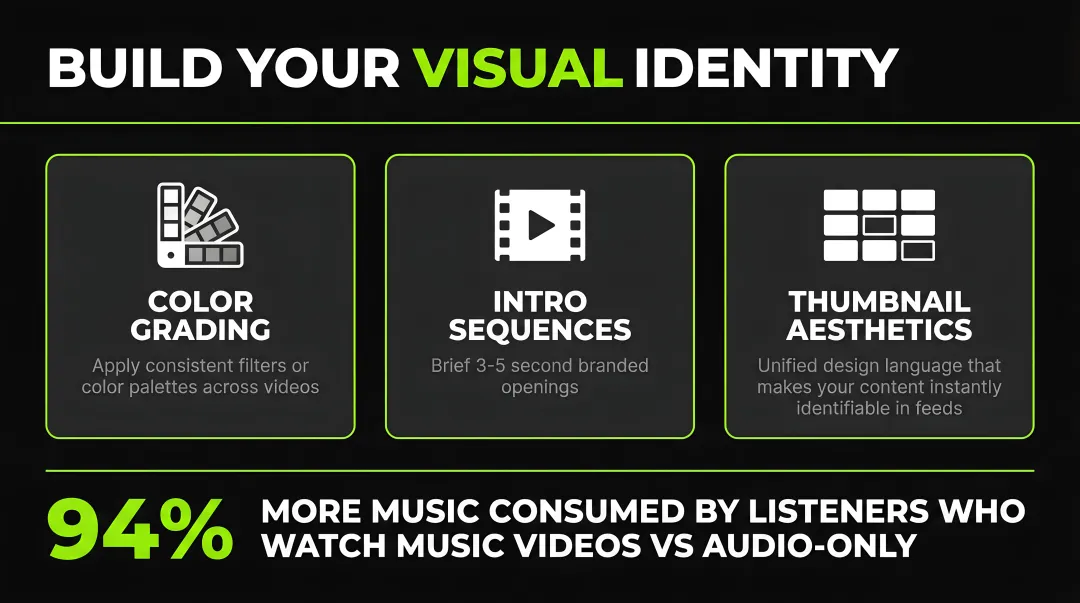
Develop a signature visual style that makes your content instantly recognizable:
- Color grading - Apply consistent filters or color palettes across videos
- Intro sequences - Brief (3-5 second) branded openings
- Thumbnail aesthetics - Unified design language that makes your content instantly identifiable in feeds
This visual consistency pays off beyond recognition alone. Listeners who watch music videos consume 94% more of that artist's music in the following month compared to audio-only listeners, making visual content your most powerful conversion tool.
Optimize Your Channel and Videos for Discovery
YouTube's recommendation algorithm processes over 80 billion signals to match viewers with content. Proper optimization dramatically increases your visibility in search results and suggested video feeds.
Keyword Research and Title Optimization
Effective titles balance searchability with intrigue. Include your primary keyword in the first 40 characters (the visible portion in most feeds), followed by compelling context.
Good Example: "Indie Folk Love Song | 'Wildfire' Official Music Video"
Bad Example: "New Song (Official Video)"
Write Strategic Video Descriptions
Place your most important keywords in the first 2-3 sentences—YouTube's algorithm weighs this section heavily. Include:
- Primary and secondary keywords naturally woven into context
- Timestamps for different sections (increases watch time)
- Links to streaming platforms (Spotify, Apple Music, etc.)
- Relevant hashtags (maximum 3-5, placed at the end)
Custom Thumbnails Drive Clicks
Beyond titles and descriptions, your visual presentation determines whether viewers actually click. Custom thumbnails increase click-through rates by 30-50%, with 90% of top-performing videos using them.
Design thumbnails with:
- High-contrast colors that pop in crowded feeds
- Close-up face shots (human faces attract attention)
- Minimal text (3-5 words maximum, large font)
- Consistent branding elements across all videos
Target a click-through rate (CTR) of 4-6% as a baseline, with 7%+ considered strong performance.
Organise Content into Playlists
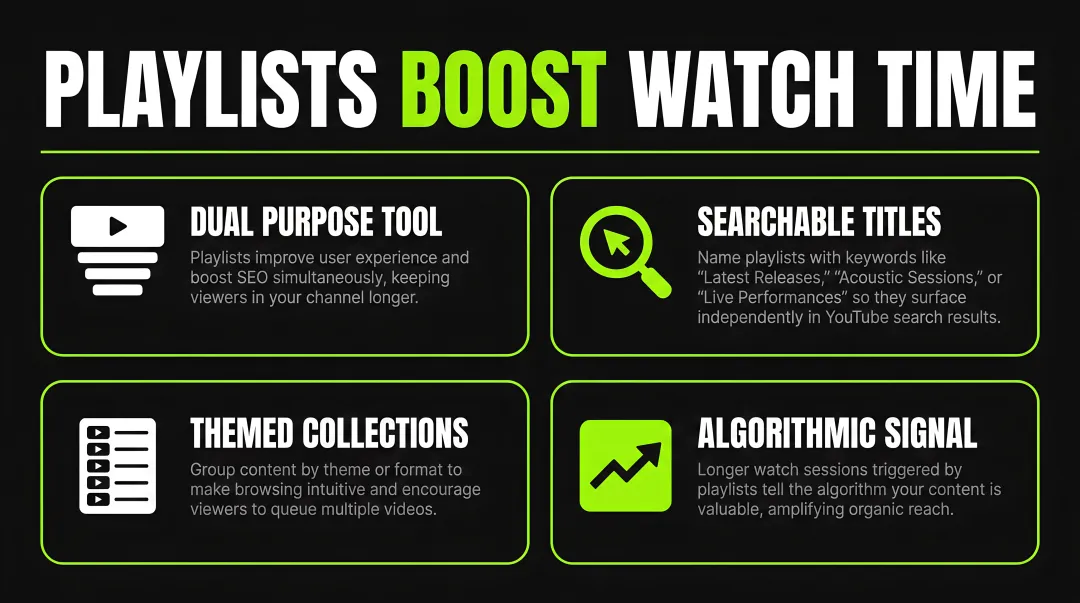
Once viewers click through, playlists help keep them watching. Playlists serve dual purposes: improving user experience and boosting SEO.
Create themed playlists like "Latest Releases," "Acoustic Sessions," or "Live Performances." Playlist titles should include searchable keywords and appear in YouTube search results independently.
Playlists encourage longer watch sessions—a powerful algorithmic signal that indicates valuable content.
Leverage YouTube Shorts for Viral Growth
YouTube Shorts now generate over 200 billion daily views, making them the platform's fastest-growing discovery engine.
Unlike traditional videos, 74% of Shorts views come from non-subscribers. This makes Shorts your primary tool for reaching new audiences.
How the Shorts Algorithm Differs
Shorts prioritize:
- Watch time percentage - Completing the full video matters more than absolute duration
- Re-watches - Viewers watching multiple times signal compelling content
- Shares - Distribution beyond YouTube indicates high value
Subscriber count carries minimal weight in Shorts discovery. Equal opportunity for channels of all sizes.
Top Shorts Content Ideas
- 15-30 second song clips - Hook-focused snippets from new releases
- Quick behind-the-scenes moments - Studio bloopers, gear demos, creative process
- "Day in the life" snippets - Authentic glimpses into artist life
- Trending sound participation - Put your spin on viral audio trends
- Performance teasers - Brief live performance clips that drive to full videos
Use Shorts as a Funnel
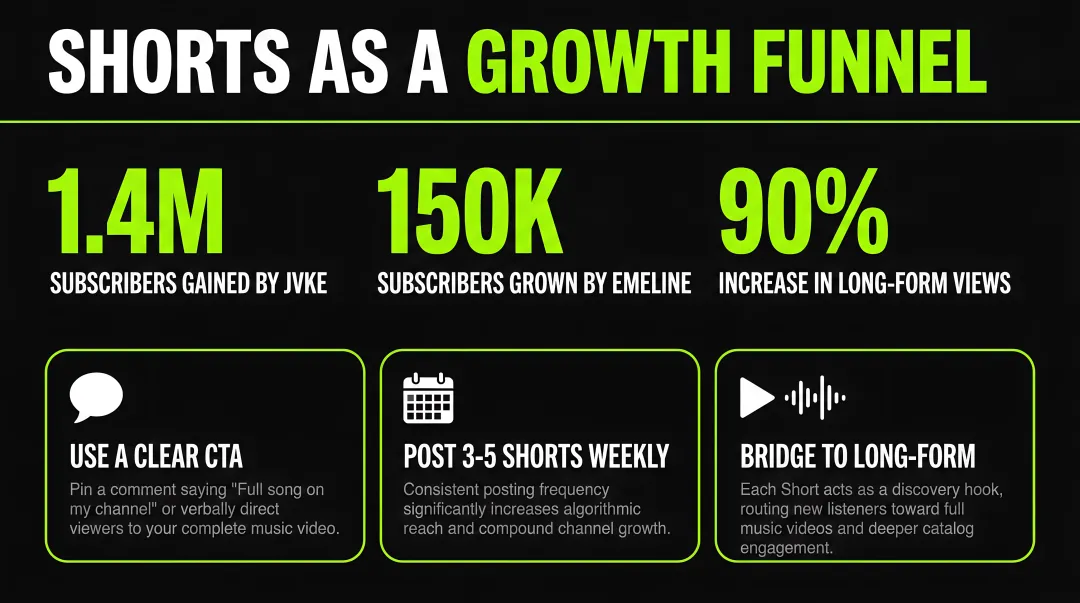
Each Short should include a clear call-to-action directing viewers to your long-form content. Pin a comment saying "Full song on my channel" or verbally direct viewers to watch the complete music video.
Artists like JVKE gained 1.4 million subscribers by strategically combining Shorts with long-form videos. EMELINE grew her subscriber base by 150,000 and increased long-form views by 90% through consistent Shorts posting.
Optimal posting frequency:
3-5 Shorts per week significantly increases algorithmic pickup compared to sporadic posting.
Set Up Your Official Artist Channel
Getting discovered on YouTube starts with establishing legitimacy. An Official Artist Channel (OAC) merges your personal channel, Topic channel, and any distributor channels into one verified hub marked with a Music Note Icon beside your name.
Key Benefits
- Verification signals legitimacy to viewers and YouTube's algorithm
- All channels merge into one unified subscriber count
- Access to YouTube for Artists dashboard with advanced analytics, ticketing integration, and merchandise features
- Increased visibility for YouTube Music playlist curation
- Organised discography section displayed in a dedicated Music tab
Eligibility Requirements
To qualify for an OAC:
- Own and operate a single artist or band channel
- Have at least 1 official music release on YouTube through a distributor
- Comply with all YouTube policies and Community Guidelines
Streamlined Setup Through Distribution
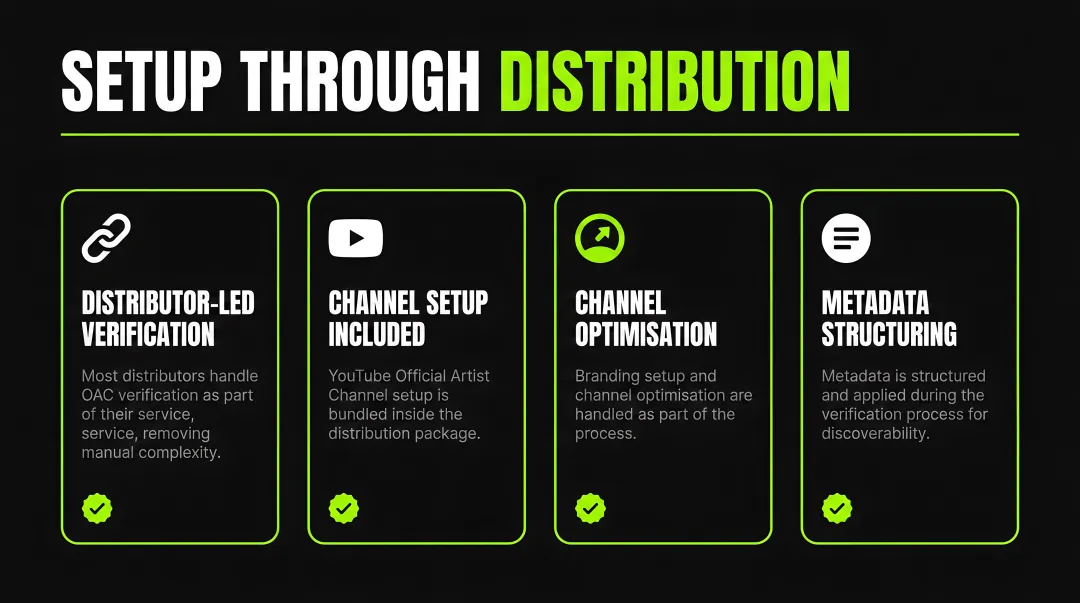
Most music distributors handle OAC verification as part of their distribution service. This removes the technical complexity of manual application.
Madverse Music includes YouTube Official Artist Channel setup in their distribution package, handling the verification process along with channel optimisation, branding setup, and metadata structuring.
Engage with YouTube's Music Community
YouTube's algorithm rewards engagement—comments, likes, shares, and community interaction signal valuable content worth promoting to wider audiences.
Active Response Strategy
Respond to every comment within the first 48 hours of publishing. This early engagement spike signals active community building to the algorithm. Beyond algorithmic benefits, genuine responses build loyalty and encourage viewers to return for future releases.
Encourage Comments Strategically
End videos with specific questions rather than generic "leave a comment" requests:
- "Which lyric hit you hardest?"
- "Should I release an acoustic version of this?"
- "Where should I tour next?"
Specific prompts generate 3-5x more comments than vague calls-to-action.
Use Weekly Community Posts
Beyond videos, community posts keep your channel active between uploads and appear directly in subscribers' feeds:
- Polls about upcoming content
- Behind-the-scenes photos
- Quick updates on new releases
- Teasers for upcoming videos
Thoughtful Engagement on Related Channels
Find artists with similar styles and engaged communities. Leave genuine, thoughtful comments on their videos (never promotional spam). When you do this authentically, this introduces you to relevant audiences who may check out your channel.
Collaborate with Other YouTube Musicians
Collaborations introduce your music to an established audience, making them one of the fastest growth strategies available. When you partner with another creator, you tap into their subscriber base while offering your audience fresh content.
Finding the Right Collaboration Partners
The right collaboration partner can make or break your growth. Target artists with:
- Similar subscriber counts - Aim for 1,000-10,000 or 10,000-50,000 ranges depending on your size
- Complementary musical styles - Shared audience interests without direct competition
- Engaged audiences - Check comment sections and view-to-subscriber ratios
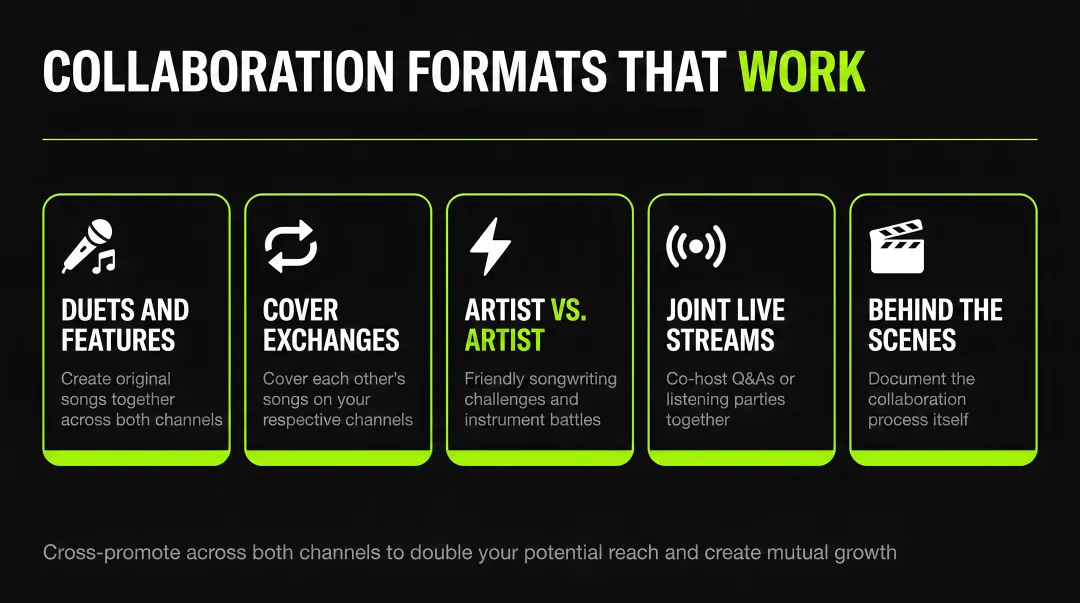
Collaboration Formats That Work
- Duets and features - Create original songs together
- Cover exchanges - Cover each other's songs on your respective channels
- "Artist vs. Artist" challenges - Friendly competitions (songwriting challenges, instrument battles)
- Joint live streams - Co-host Q&As or listening parties
- Behind-the-scenes features - Document the collaboration process itself
Once you've created your collaboration, cross-promote it across both channels to double your potential reach and create mutual growth.
Use YouTube Premiere for Release Events
YouTube Premiere transforms a standard video upload into a live event, combining pre-recorded content with real-time community interaction through live chat.
Why Premieres Boost Discovery
Premieres create focused engagement spikes—live viewers, simultaneous comments, and real-time reactions—that send powerful algorithmic signals. This initial momentum often determines whether YouTube promotes your video beyond your existing subscribers.
Best Practices for Successful Premieres
- Schedule 1-2 weeks in advance - Give your audience time to set reminders. YouTube sends notifications 30 minutes before and when the Premiere starts.
- Promote across all platforms - Announce the Premiere on Instagram, Twitter, email lists, and other social channels. Treat it like a live concert event.
- Engage actively in live chat - Your presence makes it feel like a genuine event. Answer questions, thank viewers, and react to comments in real-time.
- Turn on chat replay - This allows late viewers to experience the community interaction, extending the Premiere's value beyond the live moment.
Beyond community engagement, Premieres enable monetization features like Super Chat and Super Stickers, creating additional revenue opportunities during the event.
Submit to YouTube Music Editorial Playlists
YouTube Music features editorial playlists like "Indie Undercurrents," "New Alternative Indie," and "Fresh New Indie" that drive significant discovery.
Algorithmic playlists account for over 60% of music discovery on YouTube. But editorial placement provides something algorithms can't: credibility and concentrated exposure.
The Submission Process
Unlike Spotify, YouTube Music doesn't offer a public submission form. Instead:
- **Distribute music to YouTube Music** through a service like Madverse Music
- Claim your YouTube for Artists profile to access artist tools
- Submit unreleased tracks for editorial consideration through your distributor
- Ensure metadata accuracy - Genre tags, mood descriptors, and proper categorization significantly impact editorial and algorithmic consideration
Why Metadata Matters for Discovery
Getting the submission right is just the first step. Your metadata determines whether YouTube's system can actually find and categorise your music correctly.
YouTube's "multimodal understanding" system analyses three inputs simultaneously:
- Audio fingerprinting - The actual sound of your track
- Visual elements - Thumbnail, video content, channel design
- Text metadata - Genre tags, artist names, ISRCs, descriptions
Errors in any of these can render your music algorithmically invisible. A mistagged genre or incorrect ISRC means YouTube can't connect your music to the right audiences.
The Explore Tab
Beyond editorial playlists, the Explore tab offers another discovery opportunity.
YouTube Music's Explore tab surfaces new and trending music based on genres and moods. The key difference? It's visual-first. The tab highlights music videos and live performances rather than static album art.
To increase your chances of appearing here:
- Upload compelling music videos (not just lyric videos)
- Ensure precise genre and mood categorisation
- Keep your Official Artist Channel active with fresh content
Monetize Early with Content ID
YouTube Content ID allows independent artists to monetize their music across all YouTube videos—not just their own uploads.
This includes user-generated content like covers, dance videos, vlogs, and any other video featuring your music.
How Content ID Works
When you distribute music with Content ID enabled, YouTube's system scans all uploaded videos for audio matches. When your music is detected, you can:
- Monetize - Run ads and collect revenue
- Track - See where and how your music is being used
- Block - Prevent use in specific regions or entirely (rarely recommended for discovery)
Benefits Beyond Revenue
User-generated content creates organic promotion. A popular TikToker using your song in their YouTube video exposes your music to their entire audience—for free.
Content ID ensures you earn from this exposure while it happens.
Getting Access to Content ID
Most independent artists access Content ID through digital distributors. Madverse Music, for example, includes YouTube Content ID in its distribution service, alongside music video distribution to VEVO, Apple Music, and Tidal.
Key advantages of distributor-enabled Content ID:
- Automated claim management across all YouTube uploads
- Multi-platform distribution from a single dashboard
- Revenue tracking consolidated with your other streaming royalties
Analyze Your Data and Double Down on What Works
YouTube Analytics gives you detailed data that guides your content strategy. Success comes from identifying patterns and amplifying what resonates.
Key Metrics to Track
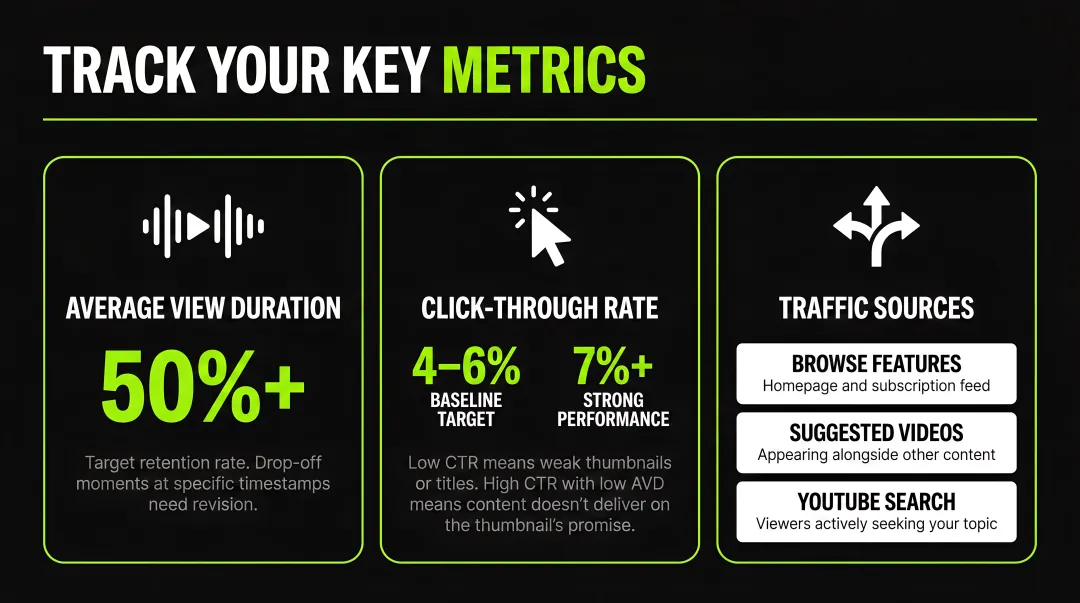
Average View Duration (AVD) - Target 50%+ retention. If viewers consistently drop off at specific points, those moments need revision.
Click-Through Rate (CTR) - Target 4-6% as baseline, with 7%+ indicating strong performance. Low CTR suggests weak thumbnails or titles; high CTR with low AVD means your content doesn't deliver on the thumbnail's promise.
Traffic Sources - Identify where views originate:
- Browse Features - Homepage and subscription feed (indicates YouTube is actively promoting you)
- Suggested Videos - Appearing alongside other content (algorithmic recommendation)
- YouTube Search - Direct searches for your content or keywords
- External - Links from other websites and social platforms
Focus your energy on the sources already bringing views. Don't waste time forcing growth from channels that aren't working.
Audience Retention Graphs - Pinpoint exactly when viewers leave. These moments show you what to fix in your next videos.
Once you understand what's working, test variations to improve even further.
A/B Testing for Continuous Improvement
Test variables systematically:
- Thumbnail styles - Face shots vs. text-heavy vs. abstract imagery
- Video formats - Vlogs vs. performance videos vs. lyric videos
- Posting times - Different days and times to find when your audience is most active
- Video lengths - Experiment with duration to find your audience's sweet spot
Analyze performance data after each test, then implement winning patterns consistently.
Performance Benchmarks by Traffic Source
CTR varies significantly by source:
- Search traffic: 12%+ is typical (viewers actively seeking content)
- Browse/Home traffic: <4% is common (passive scrolling environment)
Context matters—don't panic over low CTR if it's driven by browse traffic.
Conclusion
Getting discovered on YouTube requires combining compelling video content, SEO optimization, community engagement, and data-driven iteration. Consistent execution of these 10 strategies over 6-12 months typically yields measurable growth in subscribers, views, and streaming conversions.
Once your YouTube presence gains traction, platforms like Madverse help you capitalize on that momentum by distributing your music to major streaming services while retaining ownership—turning YouTube views into streams and royalties.
YouTube's algorithm rewards content that keeps audiences engaged and coming back. Build genuine connections through consistent value creation, strategic optimization, and authentic engagement.
The platform's discovery engine is powerful—give it quality content to work with, and it will amplify your reach.
Frequently Asked Questions
Does YouTube Music have a Discover feature?
Yes, YouTube Music features an Explore tab with genre-based discovery, algorithmically generated mixes like "My Supermix" and "Discover Mix," and editorial playlists. The platform's visual-first approach highlights music videos and live performances.
What artists were discovered on YouTube?
Justin Bieber, Shawn Mendes, Billie Eilish, Charlie Puth, and Troye Sivan all launched their careers through YouTube. Bieber was discovered through covers in 2007, while Eilish's viral "Ocean Eyes" upload led directly to her record deal.
How can an indie artist get discovered on YouTube Music?
Distribute music through a service like Madverse Music, optimize metadata for accurate genre categorization, and claim your YouTube for Artists profile. Submit unreleased tracks for editorial playlist consideration through your distributor.
How long does it take to get discovered on YouTube as a musician?
Timelines vary widely, but most artists see meaningful traction (1,000+ subscribers, consistent views) within 6-12 months of strategic, consistent content posting. Artists like JVKE gained 1.4 million subscribers in under a year by combining YouTube Shorts with long-form content, demonstrating that strategic execution can accelerate growth significantly.
What type of content should indie musicians post on YouTube?
High-performing content includes official music videos, acoustic versions, behind-the-scenes vlogs, performance videos, YouTube Shorts (15-60 seconds), and lyric videos. Diversifying formats keeps your channel active and appeals to different viewer preferences.
Do I need a certain number of subscribers to get discovered on YouTube?
No. Discovery is driven by content quality and algorithmic signals (watch time, engagement, retention) rather than subscriber count. Even channels with under 1,000 subscribers can have videos go viral through Shorts or recommended feeds, as 74% of Shorts views come from non-subscribers, creating equal discovery opportunity regardless of channel size.