Introduction
Picture this: You've just checked your streaming analytics and discovered that three months of royalties from your latest collaboration never made it to your producer's account. The split agreement you thought was automated? It was sitting in a spreadsheet you forgot to update. Your producer is frustrated, your relationship is strained, and you've spent the last week trying to manually calculate what's owed across Spotify, Apple Music, YouTube, and fifteen other platforms.
This scenario plays out daily for independent musicians. As music careers expand across multiple platforms and collaborators, tracking royalties manually becomes impossible and leads to lost revenue and damaged relationships.
The digital music landscape now spans 50+ streaming platforms, each with different reporting formats and payment schedules. This creates an administrative nightmare that pulls musicians away from their creative work.
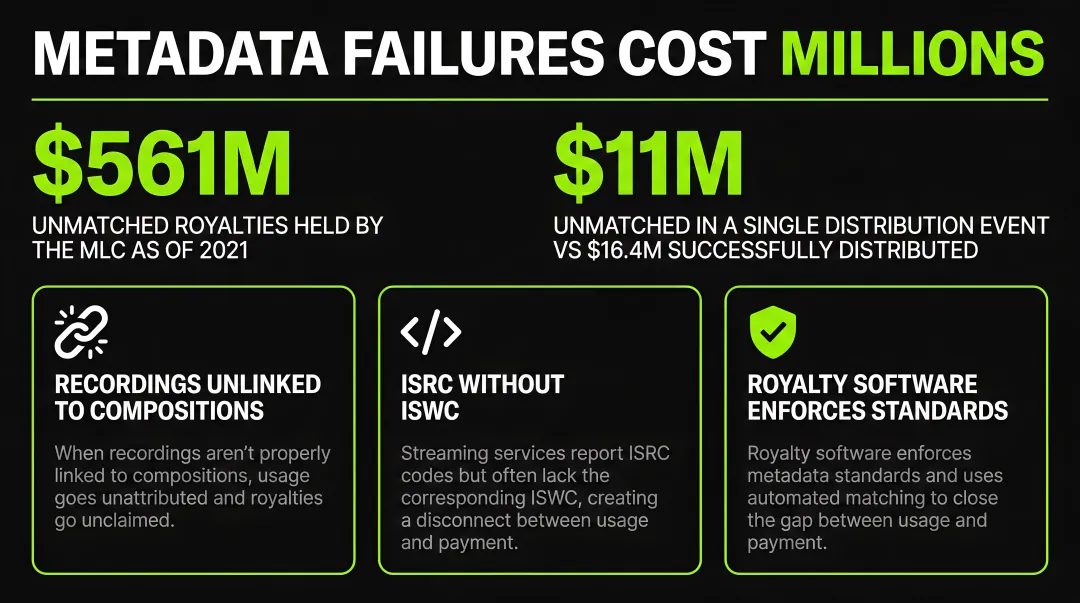
The stakes are high: In 2021 alone, the Mechanical Licensing Collective reported accumulating at least $561 million in unmatched "black box" royalties—money that belongs to creators but can't be distributed due to metadata errors and tracking failures.
For independent artists managing collaborations, multiple revenue streams, and complex split agreements, royalty management software has shifted from luxury to necessity.
TLDR: Key Takeaways
- Automates tracking and distributing earnings across streaming, sync licensing, and performance royalties
- Essential for artists managing collaborations, multiple revenue streams, or operating as independent labels
- Core features include automated split management, multi-platform integration, real-time analytics, and transparent audit trails
- Choose standalone tools for advanced accounting or integrated platforms like Madverse (offering royalty splits at source and 95% royalty retention)
- Pricing ranges from free (under ₹8,000/month revenue) to ₹1,500-₹4,000/month for growing artists, with ROI through time savings and recovered revenue
What is Royalty Management Software for Musicians?
Royalty management software consists of digital tools that automate the tracking, calculation, and distribution of music royalties from various revenue sources. These platforms go far beyond basic spreadsheets. They handle music-specific complexities including split agreements, metadata matching across platforms, and multi-source reconciliation.
To automate royalty tracking accurately, the software relies on industry-standard identifiers. ISRC (International Standard Recording Code) uniquely identifies each sound recording, while ISWC (International Standard Musical Work Code) identifies the underlying musical composition.
The challenge? There's no central publicly accessible database linking ISRCs and ISWCs, which is why specialized software is essential for accurate tracking.
Types of Royalties Tracked
Comprehensive royalty software monitors multiple revenue streams:
- Mechanical royalties - Earnings from streaming services and digital downloads
- Performance royalties - Revenue from radio play, live venues, and public performances
- Sync licensing royalties - Payments from TV shows, films, commercials, and video games
- Print royalties - Income from sheet music sales
Who Needs This Software?
Royalty management tools serve several key user groups:
- Independent artists managing earnings from multiple platforms
- Bands with split agreements across multiple collaborators
- Record labels overseeing artist rosters
- Artist managers tracking earnings for multiple clients
- Publishers administering catalogs across territories
The Ecosystem
Understanding how royalty software fits into the larger music business helps clarify its value. The software sits between distribution platforms, collection societies (PROs), and payment systems.
Distributors send release metadata to streaming platforms using ERN (Electronic Release Notification) messages. Platforms return DSR (Digital Sales Report) files detailing usage. The royalty software processes these reports, matches them to your catalog, and calculates payments based on your specific agreements.
Why Musicians Need Royalty Management Software
Fragmented Revenue Streams Create Tracking Chaos
Managing royalties manually across 50+ digital service providers (DSPs) is nearly impossible. Each platform—Spotify, Apple Music, YouTube, Tidal, Amazon Music—uses different reporting formats and payment schedules.
What takes hundreds of staff hours each quarter to track manually becomes automated workflows that run continuously in the background.
Complex Collaborations Demand Precise Split Management
Modern music production involves multiple collaborators: co-writers, producers, featured artists, and session musicians. Each collaboration requires precise tracking and transparent distribution.
Without automation, calculating splits manually leads to errors, payment delays, and damaged professional relationships. The administrative burden of managing these agreements across dozens of releases becomes unsustainable as your catalog grows.
Metadata Failures Cost Musicians Millions
The MLC held at least $561 million in unmatched royalties as of 2021, with streaming services unable to identify the rightful owners. In one distribution event, $11 million remained unmatched compared to $16.4 million successfully distributed.
These failures occur when recordings aren't properly linked to compositions. Streaming services report ISRC codes but often lack the corresponding ISWC, creating a disconnect between usage and payment.
Royalty software enforces metadata standards and uses advanced matching algorithms to ensure your earnings don't fall into this "black box."
Manual Processes Steal Time from Creative Work
Industry experts describe monitoring and collecting publishing royalties globally as "a full-time job". Time spent reconciling spreadsheets, chasing down payments, and calculating splits is time not spent writing, recording, or performing.
The opportunity cost of manual royalty management extends beyond immediate revenue—it limits your ability to scale your career and make data-driven decisions about which platforms and territories generate the best returns.
The True Cost of Going Without
Operating without royalty management software creates multiple risks:
- Unclaimed royalties and metadata errors drain revenue you've already earned
- Payment disputes from calculation errors damage professional relationships
- Tax complications emerge without accurate records of income sources
- You can't identify which songs, platforms, or territories drive revenue
- Manual processes that work for 10 releases break down at 50
How Royalty Management Software Works
Step 1: Automated Data Ingestion
Modern platforms support multiple methods to import royalty statements from distributors, PROs, sync agencies, and streaming platforms. Systems connect to providers using specific protocols—SFTP for Spotify, APIs for Apple Music, and direct integrations with distribution platforms.
The automation handles multiple file formats:
- CSV exports and Excel spreadsheets
- Industry-standard DDEX messages
- Platform-specific API responses
- Direct database integrations
The software continuously monitors these sources, pulling in new data as it becomes available. This eliminates the bottleneck of manually downloading and processing statements from dozens of sources.
Step 2: Metadata Matching and Reconciliation
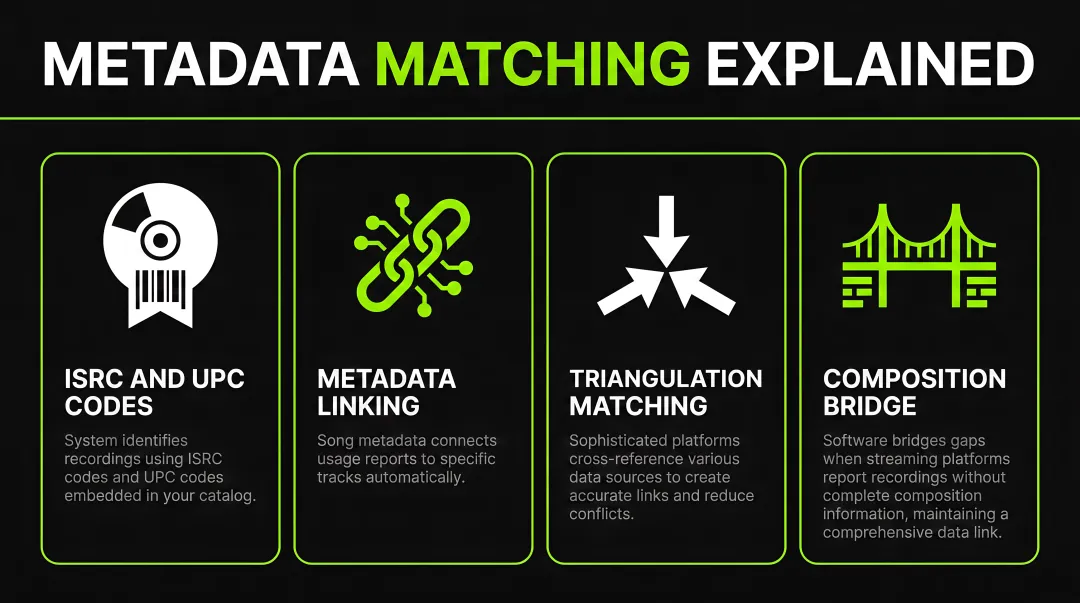
When data arrives, the system identifies and matches recordings in your catalog. The software uses ISRC codes, UPC codes, and song metadata to link usage reports to specific tracks.
Sophisticated platforms employ "triangulation and matching" across various data sources to create accurate links and reduce conflicts. This matching becomes critical when streaming platforms report recordings without complete composition information. The software bridges this gap by maintaining a comprehensive database of your catalog that links recordings to underlying compositions, properly attributing all usage.
Step 3: Intelligent Royalty Calculation
The system applies your specific split agreements, deductions, and fee structures to calculate what each stakeholder earns. For a track with a 60/20/20 split between writer, producer, and featured artist, the software automatically applies these percentages to every payment from every source.
Calculations account for territory-specific rates, currency conversions, and platform-specific payment structures. The software maintains these rules as templates that apply automatically to all future earnings, eliminating repetitive manual calculations.
Step 4: Automated Split Distribution
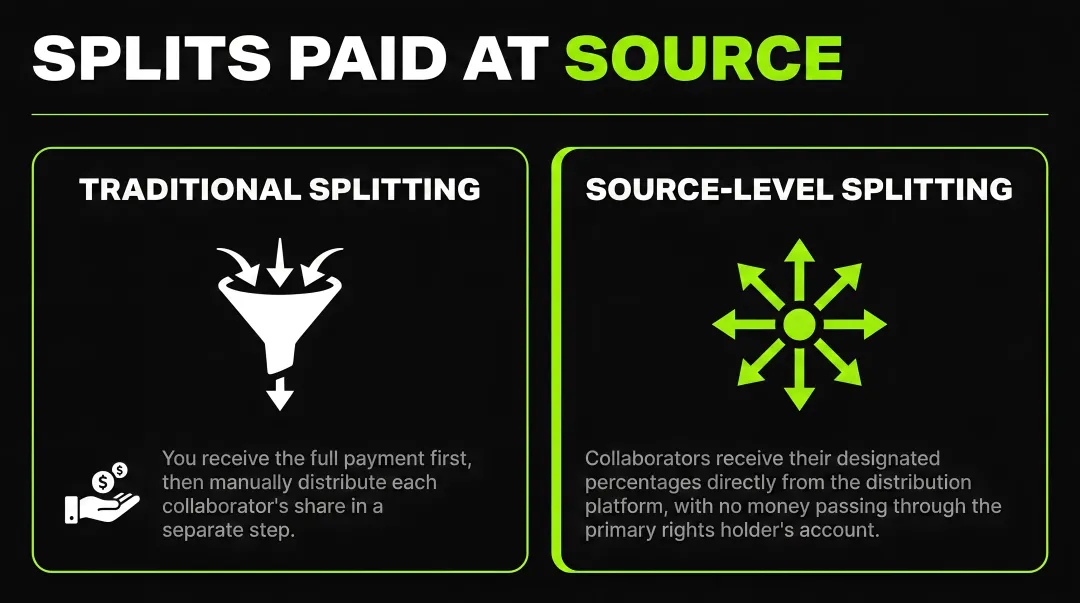
Two distribution models exist: traditional and source-level splitting.
Traditional systems calculate splits after the primary account receives payment, requiring an additional distribution step. You receive the full amount, then manually distribute shares to collaborators.
Source-level splitting—offered by platforms like Madverse—works differently. Collaborators receive their designated percentages directly from the distribution platform without money passing through the primary rights holder's account first. This increases transparency and eliminates the trust issue of waiting for someone else to receive payment before distributing shares. All parties see their earnings simultaneously.
Step 5: Transparent Reporting and Payment
The software generates detailed statements for all stakeholders showing exactly how their earnings were calculated. Reports break down revenue by:
- Platform (Spotify, Apple Music, YouTube)
- Territory (US, UK, India, global)
- Time period (daily, weekly, monthly)
- Song or album
- Royalty type (mechanical, performance, sync)
These transparent reports provide the audit trail needed to resolve disputes and build trust among collaborators.
Behind the Scenes: AI and Machine Learning
Modern systems now use artificial intelligence for pattern recognition and anomaly detection. Companies like BMAT deploy deep learning classifiers to improve matching accuracy, while machine learning algorithms flag unusually low payments that might indicate reporting errors or platform issues. Predictive analytics forecast revenue trends based on historical performance, helping artists make informed decisions about release timing and marketing investment.
Key Features and How to Choose the Right Software
Essential Features to Prioritize
Multi-Platform Integration Connects with major distributors, DSPs, and collection societies to centralize data from all revenue sources. Look for direct integrations rather than manual CSV uploads—automation is the entire point.
Automated Split Management Configures complex agreements with multiple collaborators and enforces them automatically across all future earnings. The system should handle percentage splits, fixed fees, and tiered arrangements.
Real-Time Reporting and Analytics Provides dashboards showing revenue by platform, song, territory, and time period. The best systems update daily rather than monthly, giving you current visibility into performance.
Audit Trail and Transparency Maintains detailed records of all calculations for accountability and dispute resolution. Every split calculation should be traceable back to the source data and agreement terms.
Collaboration Tools Allows team members—managers, accountants, collaborators—to access relevant data with permission controls. Different stakeholders need different views: collaborators see their earnings, managers see everything, accountants need export capabilities.
Decision Framework: Standalone vs. Integrated Platforms
Standalone royalty software works best when:
- You already have distribution deals in place
- You need advanced accounting features and custom reporting
- You manage a large catalog requiring sophisticated reconciliation
- You operate as a label with roster management needs
Integrated distribution + royalty platforms work best when:
- You're an independent artist needing both distribution and royalty management
- You want simplified workflows with fewer systems to learn
- Consolidated pricing appeals more than paying separately for distribution and royalty tools
- You value having everything in one dashboard
Platforms like Madverse exemplify this integrated approach, combining distribution to major streaming services with built-in royalty management, automated split distribution at source, and team collaboration features.
This unified model eliminates the need to export data from your distributor and import it into separate royalty software.
Cost Considerations and ROI
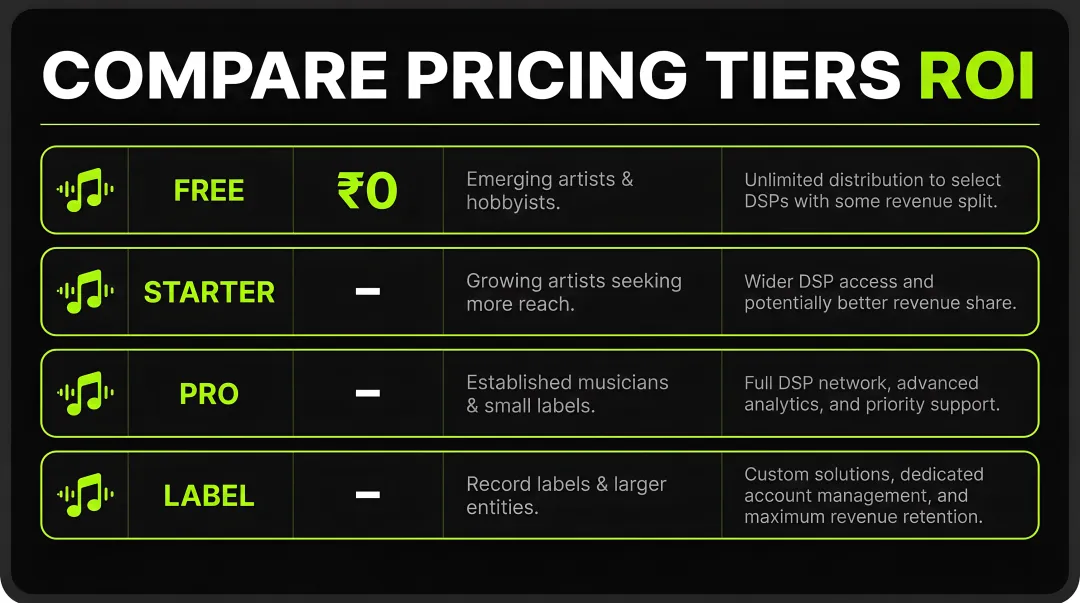
Pricing models vary across the market:
| Tier | Monthly Cost | Target User | Notes |
|---|---|---|---|
| Free | ₹0 | Artists earning <₹8,000/month | Limited features, good for testing |
| Starter | ₹1,500-₹3,000 | Small catalogs, emerging artists | Core features, reasonable limits |
| Growth | ₹4,000-₹8,000 | Growing indies, small labels | Advanced analytics, higher limits |
| Enterprise | ₹8,000-₹20,000+ | Established labels, high volume | Custom features, dedicated support |
| Commission | 15-20% of collections | Publishing administration | No upfront cost, percentage of recovered royalties |
Calculate ROI based on two factors: time savings and revenue recovery. If you currently spend 10 hours monthly on royalty tracking at a ₹4,000/hour opportunity cost, that's ₹40,000/month in lost productivity. A ₹4,000/month tool that eliminates this work pays for itself immediately.
Additionally, software that recovers even 5% of previously unmatched royalties can generate significant returns—on a ₹1,60,000/month income, that's ₹8,000 recovered monthly.
Integration and Scalability Requirements
Ensure compatibility with your existing ecosystem:
- Distribution platforms - Direct API connections to your current distributor
- Accounting software - Export capabilities for QuickBooks, Xero, or your tax preparation system
- Payment systems - Integration with PayPal, Stripe, or direct bank transfers for collaborator payments
- Collection societies - Connections to your PRO (ASCAP, BMI, PRS, APRA, etc.)
Choose software that scales from solo artist to label operations if you plan to expand. Starting with a system that only handles single-artist scenarios means migrating later when you sign your first artist or expand your roster.
This migration can be painful and requires careful planning to avoid payment disruptions.
Common Challenges and Solutions
Legacy Data Migration
Moving from spreadsheets to specialized software presents immediate challenges. Years of historical data exist in various formats—some in Excel, some in Google Sheets, some in email attachments from distributors.
Start with your current period rather than attempting to backfill everything immediately. Configure the system for today's active releases and revenue streams, then gradually add historical data as time permits.
Prioritize accuracy over speed—incorrect historical data creates more problems than missing historical data. Be prepared to revert to previous methods temporarily if the transition encounters issues.
Collaborator Resistance
Team members accustomed to receiving direct payments may resist adopting new systems. Common friction points include:
- Producers who've always invoiced directly
- Co-writers who trust handshake agreements
- Featured artists who prefer simple bank transfers
Demonstrate transparency benefits through concrete examples. Show collaborators how automated splits eliminate payment disputes and reduce delays from "I'll pay you when the money clears." The detailed statements also help them with their own accounting.
Offer a trial period where they can see their earnings calculated automatically while still receiving payments through the old method, proving the system's accuracy before full transition.
Learning Curve and Setup Time
Implementing royalty software isn't plug-and-play. Initial configuration requires inputting your catalog, defining split agreements, connecting integrations, and verifying calculations.
Allocate 2-4 weeks for initial setup and don't attempt to migrate everything simultaneously. Use a phased rollout:
- Week 1: Configure your top 5 revenue-generating releases
- Week 2: Add recent collaborations with active splits
- Week 3: Connect primary revenue streams (main distributor, PRO)
- Week 4: Verify calculations and expand to full catalog
Invest in training—whether through the platform's documentation, onboarding calls, or hiring a consultant for complex setups. The upfront time investment pays dividends through years of automated processing.
Frequently Asked Questions
Do I need royalty management software as an independent artist?
If you have multiple collaborators, earn from 3+ revenue streams, or spend over 5 hours monthly tracking royalties, the software pays for itself. Solo artists with simple catalogs may start with spreadsheets, but automation becomes essential as your career grows.
What's the difference between royalty management software and music distribution platforms?
Distribution platforms get your music onto streaming services, while royalty management software tracks and splits the earnings you receive. Integrated platforms like Madverse combine both functionalities in one system.
How much does royalty management software typically cost?
Pricing ranges from free basic tools for artists earning under ₹8,000 monthly to ₹1,500-₹4,000/month for mid-tier solutions and ₹8,000+/month for enterprise systems. Some administrators charge 15-20% commission instead. Most artists break even within the first month.
Can royalty management software track royalties from streaming platforms like Spotify?
Yes. The software integrates with your distributor, who collects payments from Spotify, Apple Music, and other platforms, then automatically imports and processes those royalty statements. You connect through your distributor, not directly to each streaming platform.
What happens to my royalty data if I switch software providers?
Most platforms allow data export in CSV and Excel formats. Before committing, verify export capabilities and maintain backup copies of original statements from distributors and PROs independently of the software.
How does royalty management software handle collaborations and splits?
You configure split percentages once, and the software automatically applies them to all future earnings. Platforms like Madverse enable splits at source, where collaborators receive their percentages directly from the distributor, increasing transparency and eliminating redistribution delays.