Introduction
Picture this: You're an independent artist who just released a collaborative single featuring two producers and a guest vocalist. Within weeks, streams are coming in from Spotify, Apple Music, YouTube, and a dozen other platforms across 50+ countries. Each platform reports data differently, payments arrive at different times, and you're manually calculating splits in a spreadsheet at 2 AM, hoping you haven't miscalculated anyone's share.
This isn't a hypothetical scenario—it's daily reality for thousands of independent music professionals. Manual royalty management becomes overwhelming fast.
The challenges pile up: tracking tiny payments across global platforms, applying complex split agreements, converting currencies, ensuring every collaborator gets paid accurately and on time. According to industry estimates, approximately 30% of global music royalties fail to reach their intended recipients due to data errors and administrative gaps.
This guide explains what royalty management software is, how it works, which features matter most, and how to choose the right solution for your music business—whether you're a solo artist with a few collaborators or a label managing dozens of releases.
TLDR:
- Royalty management software automates tracking, calculation, and distribution of music payments from multiple sources
- Modern platforms reduce processing time by over 90%, from months to just days
- Key features include automated splits, multi-source data integration, real-time reporting, and transparent statements
- Solutions range from standalone platforms to distributor-integrated tools based on catalog size
What is Royalty Management Software?
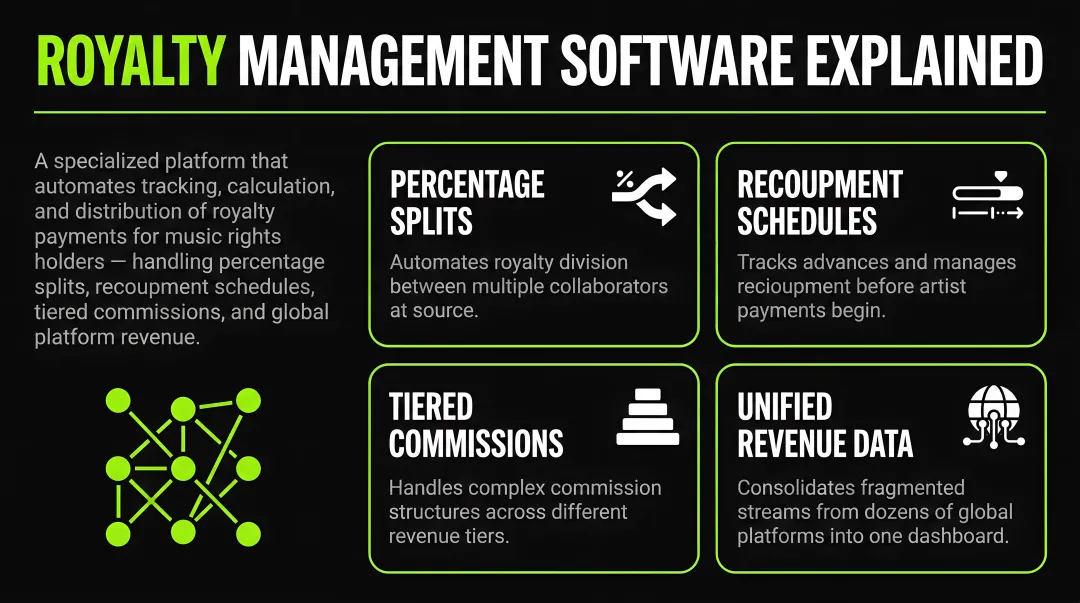
Royalty management software is a specialized platform designed to automate the tracking, calculation, and distribution of royalty payments for music rights holders.
Unlike generic accounting software, these systems handle the unique complexities of the music industry: percentage splits between multiple collaborators, recoupment schedules, tiered commission structures, and revenue flowing in from dozens of global platforms.
The core problem it solves: combining fragmented data. When you release music today, revenue comes from streaming platforms (Spotify, Apple Music, YouTube Music), sync licensing deals, performance royalties from PROs, international territories with different reporting standards, and potentially physical sales or Bandcamp.
Each source reports differently, at different times, in different formats. Manual consolidation is tedious and error-prone.
How it works:
- Data ingestion - The software automatically imports sales and streaming data from distributors, DSPs, and other sources (often using industry standards like DDEX)
- Automated calculation - It applies your contractual terms: split percentages, recoupment rules, territory-specific rates
- Statement generation - The system creates detailed, itemized royalty statements for all stakeholders
- Payment processing - The software divides and distributes payments to collaborators according to pre-configured agreements
Manual vs. Automated: The Time Difference
The efficiency gains are dramatic. In one documented case study, a distributor processing over 2,000 statements reduced their workload from months to just days per period—a time reduction of over 90%. This automation eliminates the "labor-intensive process" of spreadsheet updates and removes the risk of human error that's common in manual calculations.
Types of Royalty Management Solutions:
| Solution Type | Best For | Key Characteristics |
|---|---|---|
| Standalone Platforms | Indie labels, publishers needing detailed accounting | Dedicated software (Curve, Reprtoir, eddy.app) with deep features like cross-collateralization and complex contract modeling |
| Distributor-Integrated Tools | Independent artists, small collectives | Built-in "splits at source" features from distributors (DistroKid, Stem) that divide revenue automatically at payout |
| Enterprise Systems | Major labels, large publishers | High-volume platforms (VISTA, Rightsline) with custom configurations for massive catalogs |
The right choice depends on your catalog size, revenue complexity, and whether you need features beyond basic splits—like recoupment tracking across multiple releases or consolidation from sources outside your distributor.
Key Features of Royalty Management Software
Automated Royalty Calculations
Modern software eliminates manual math by automatically applying complex contractual terms. The system handles:
- Percentage splits between multiple rights holders (artist gets 50%, producer 25%, featured artist 15%, songwriter 10%)
- Recoupment schedules that track advances and expenses before paying out royalties
- Minimum guarantees and tiered commission structures that change based on revenue thresholds
- Nested splits where payments cascade through multiple layers (label takes their cut, then remaining amount splits between artist and collaborators)
This automation eliminates the "quiet inaccuracies that compound over time" inherent in manual calculations. These errors lead to payment disputes and damaged relationships between collaborators.
Real-Time Reporting and Dashboards
Modern platforms eliminate weeks-long reporting delays with:
- Live visibility into earnings as data flows in from streaming platforms
- Customizable dashboards showing breakdowns by track, album, platform, territory, and collaborator
- Performance comparisons (month-over-month growth, top-performing releases, geographic trends)
- Instant access for all stakeholders through dedicated portals
This transparency becomes essential as your business grows.
Once you're managing multiple releases and collaborators, "transparency, accuracy, and trust stop being nice to have and become essential" to maintaining healthy partnerships.
Multi-Source Data Integration
Effective royalty software connects with:
- Streaming platforms - Spotify, Apple Music, YouTube Music, Amazon Music, Tidal
- Digital distributors - Automated data feeds from your distribution service
- PROs and collection societies - Performance royalty data from ASCAP, BMI, SESAC, international CMOs
- Sync licensing platforms - Revenue from TV, film, advertising placements
- Accounting systems - Integration with QuickBooks, Xero, or other financial software
The software imports data in various formats—DDEX XML files for high-volume feeds and CSV files for smaller sources.
It then automatically reconciles everything against your catalog using unique identifiers like ISRCs.
Split Payment Automation
Once data flows in from these sources, automated split distribution becomes one of the most valuable features:
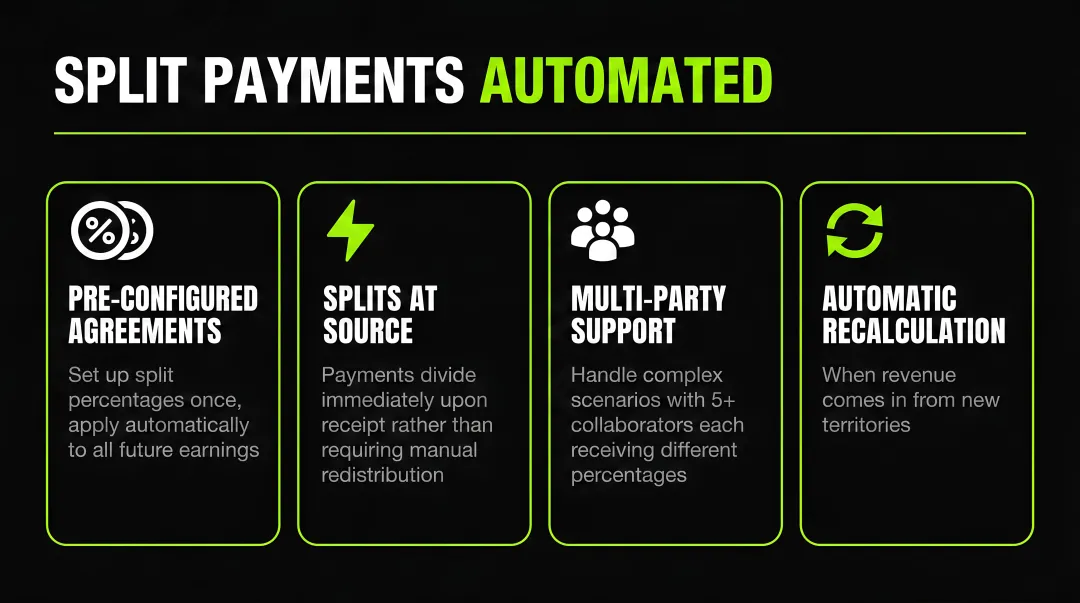
- Pre-configured agreements - Set up split percentages once, apply automatically to all future earnings
- Splits at source - Payments divide immediately upon receipt rather than requiring manual redistribution
- Multi-party support - Handle complex scenarios with 5+ collaborators each receiving different percentages
- Automatic recalculation - When revenue comes in from new territories or sources, splits apply instantly
Distribution platforms like Madverse offer splits at source functionality, allowing artists to keep 95% of their royalties while automatically distributing shares to collaborators directly from distribution earnings.
Transparent Statements and Audit Trails
Professional software generates:
- Detailed, itemized statements for every stakeholder showing exactly where money came from
- Complete transaction history with timestamps and source documentation
- Audit trails that track every calculation and payment for dispute resolution
- Exportable reports in standard formats for accountants and tax preparation
This documentation is crucial because most royalty problems "start earlier... when decisions are made quickly during production," and software helps enforce contract logic consistently.
Global Currency and Tax Compliance
For international earnings, quality platforms provide:
- Multi-currency support - Handle payments in INR, USD, EUR, GBP, and dozens of other currencies
- Automatic currency conversion using current exchange rates
- Tax withholding calculations for different territories based on international treaties
- Compliance reporting - Generate required tax forms and documentation automatically
Benefits for Music Professionals
Time Savings and Efficiency
Royalty management software immediately reclaims your time. Processing royalties manually can take weeks per period, while automation handles the same work in days or even hours. For a label processing 2,000 statements quarterly, this represents hundreds of hours saved annually.
This freed time allows you to focus on what matters: creating music, building artist relationships, developing marketing strategies, and growing your business rather than wrestling with spreadsheets.
Improved Accuracy and Reduced Errors
Automation eliminates the risk of human error inherent in manual calculations. Common mistakes that disappear include:
- Miscalculations of percentage splits
- Missed payments to collaborators
- Incorrect currency conversions
- Failed reconciliation between sources
- Duplicate or omitted transactions
Approximately 30% of global music royalties never reach their intended recipients due to data errors. Recovering even a fraction of these lost payments justifies the software investment.
Enhanced Transparency and Trust
Real-time access to earnings data and detailed statements builds trust among collaborators. When producers, featured artists, and songwriters can log into a portal and see exactly how much they've earned, from which platforms, and when they'll be paid, disputes decrease dramatically.
This transparency creates tangible benefits:
- Collaborators verify earnings instantly without back-and-forth emails
- Artists stay with labels that provide clear, timely reporting
- Disputes resolve faster with accessible documentation
- Trust strengthens professional relationships across your roster
Better Financial Planning
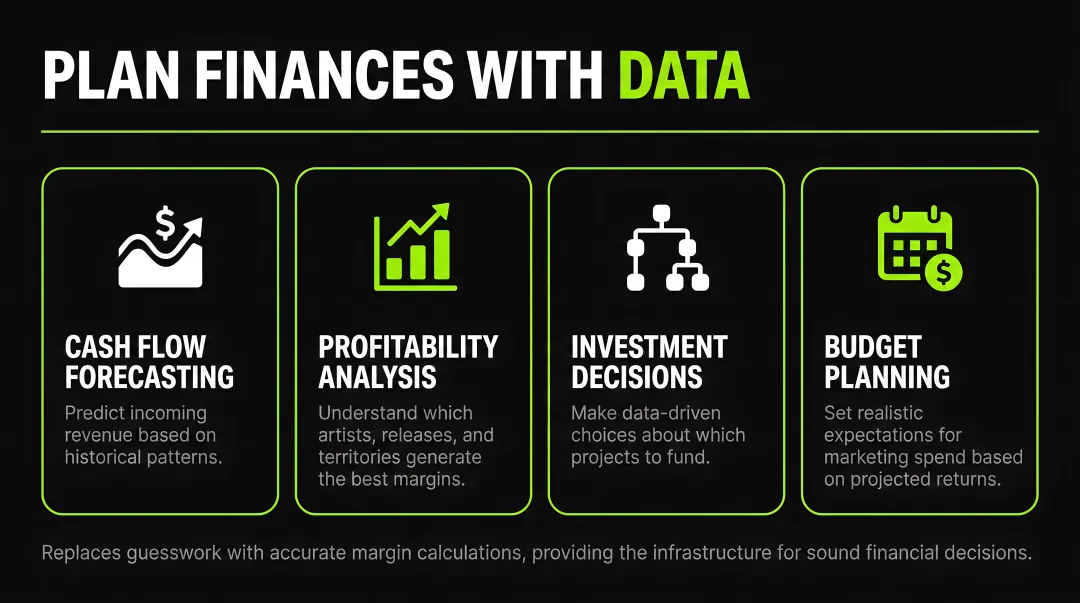
Moving beyond guesswork, accurate royalty data enables:
- Cash flow forecasting - Predict incoming revenue based on historical patterns
- Profitability analysis - Understand which artists, releases, and territories generate the best margins
- Investment decisions - Make data-driven choices about which projects to fund
- Budget planning - Set realistic expectations for marketing spend based on projected returns
This replaces "guesswork" with accurate margin calculations, providing the infrastructure needed to scale professionally.
Scalability for Growing Catalogs
Perhaps the most critical long-term benefit is scalability. Software handles growth easily—whether you have 50 tracks or 5,000, the administrative burden remains consistent.
The breaking point for manual methods varies, but typically occurs when "spreadsheets that once worked start to strain under the weight of more releases, more collaborators, and more revenue flowing in from more places." Once you hit this wall, software becomes essential rather than optional.
Who Needs Royalty Management Software?
Independent Artists with Multiple Collaborators
Solo artists typically need software when they:
- Work regularly with producers, co-writers, or featured artists requiring split payments
- Generate significant income from 3+ revenue sources (streaming, sync, performance royalties)
- Release music frequently enough that manual tracking becomes time-consuming
- Want to maintain professional relationships through transparent, timely payments
Small to Mid-Size Labels
The tipping point for labels usually arrives when:
- Managing 3+ active artists with regular releases
- Processing dozens of individual payments quarterly
- Facing artist inquiries about payment status or statement details
- Spending more time on royalty admin than on A&R, marketing, or business development
At this stage, revenue "begins to show up in your dashboard, and what once felt hypothetical now feels very real," making accurate tracking essential.
Artist Managers and Music Collectives
For managers juggling multiple artists, royalty software provides:
- Centralized tracking across all clients in one system
- Consolidated reporting for business overview and tax preparation
- Ability to provide clients with professional, detailed statements
- Reduced administrative overhead that scales with roster size
The independent artist market is projected to reach USD $170.91 billion in 2026. As this segment grows, more professional independent artists need sophisticated royalty tracking tools.
How to Choose the Right Royalty Management Software
Assess Your Specific Needs
Before evaluating solutions, determine:
- How many tracks do you currently manage, and how fast is your catalog growing?
- How many parties typically split revenue on your releases?
- Are you tracking just streaming, or also sync, physical, and performance royalties?
- Do you need recoupment tracking, cross-collateralization, or tiered commission structures?
Evaluate Integration Capabilities
Check compatibility with your existing tools:
- Does it connect with your music distributor for automatic data ingestion?
- Can it import data from your PRO or collection society?
- Does it integrate with your accounting software (QuickBooks, Xero)?
- Does it support DDEX standards for industry-standard data exchange?
Seamless integration eliminates manual data transfers and reduces reconciliation errors.
Once you've mapped out your technical requirements, evaluate how pricing models align with your business stage and growth projections.
Consider Scalability and Pricing Models
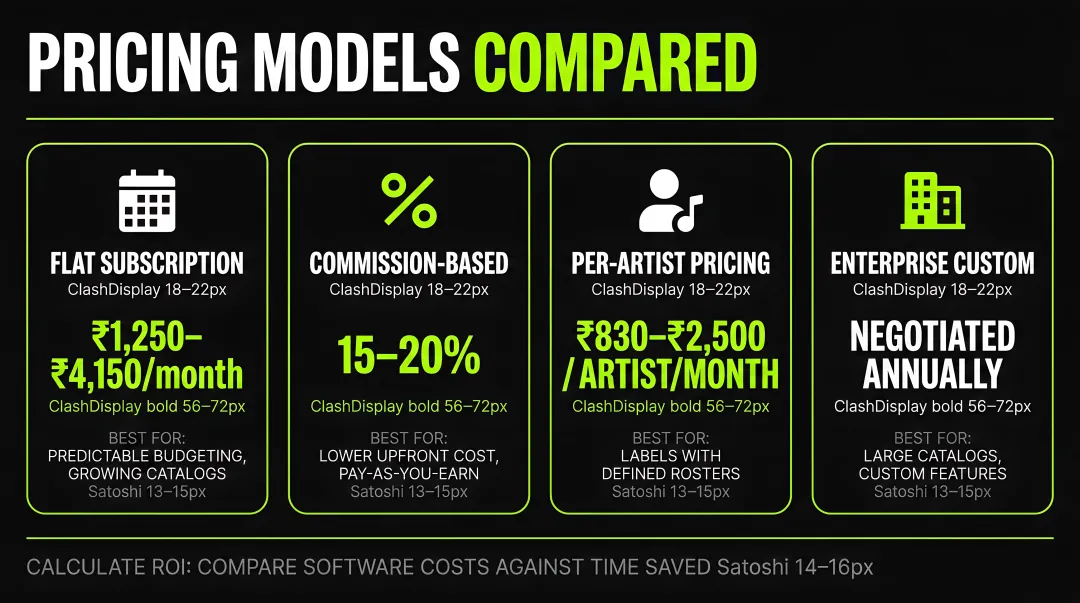
Common pricing structures include:
| Pricing Model | Typical Cost | Best For |
|---|---|---|
| Flat subscription | ₹1,250-₹4,150/month | Predictable budgeting, growing catalogs |
| Commission-based | 15-20% of royalties | Lower upfront cost, pay-as-you-earn |
| Per-artist pricing | ₹830-₹2,500 per artist/month | Labels with defined rosters |
| Enterprise custom | Negotiated annually | Large catalogs requiring custom features |
Calculate ROI by comparing software costs against time saved (valued at your hourly rate) plus revenue recovered from improved accuracy.
Check for Music Industry-Specific Features
Essential features for music professionals include:
- Split sheet management with nested calculations
- Recoupment tracking for advances and expenses
- Multi-territory and multi-currency support
- Integration with streaming analytics platforms
- Artist portals for transparent self-service access
- Audit trails for dispute resolution
Generic royalty software designed for book publishing or franchising won't handle music industry complexities effectively.
Integration with Music Distribution Platforms
An emerging trend is the integration of royalty management directly into distribution platforms, creating "splits at source" functionality where revenue divides automatically at the point of payout. This approach eliminates the gap between distribution and payment processing.
Advantages of Integrated Solutions:
- Seamless data flow - No manual import/export between distribution and royalty systems
- Automatic reconciliation - Distribution data flows directly into royalty calculations
- Simplified administration - One platform handles both distribution and payment splits
- Lower cost - Often included in distribution fees rather than requiring separate subscription
For example, Madverse enables automatic split payments directly from distribution earnings, allowing artists to keep 95% of royalties while handling multi-party splits without additional software. This integrated approach works well for straightforward scenarios.
When Standalone Software Is Necessary
You may need standalone software when:
- Combining revenue from multiple distributors
- Tracking income from sources beyond streaming (sync deals, physical sales, direct licensing)
- Managing complex recoupment across multiple releases
- Requiring cross-collateralization between different artists or projects
- Needing advanced features like royalty forecasting or detailed financial modeling
For artists primarily earning from streaming through a single distributor with relatively simple collaborator splits, integrated tools often provide sufficient functionality without additional cost or complexity.
Frequently Asked Questions
What is royalty management software?
Royalty management software automates the tracking, calculation, and distribution of music royalty payments from streaming platforms, sync deals, and performance royalties. It consolidates fragmented data and applies contractual terms to ensure accurate payments to all rights holders.
What is the royalty software for publishers?
Music publishers use specialized software to manage mechanical, performance, and sync royalties for songwriters and composers. Publisher platforms support more complex rights tracking than artist-focused tools, including CWR standards and worldwide collection society integration.
How does royalty management software work for independent artists?
Artists connect their distribution accounts, set collaborator split percentages, and the system automatically calculates and distributes payments as revenue arrives. Real-time dashboards show earnings by track, platform, and territory with transparent statements for all collaborators.
What's the difference between royalty software and music distribution platforms?
Distribution platforms deliver music to streaming services, while royalty software tracks earnings and splits payments among collaborators. Many modern distributors now combine both functions in one platform.
How much does royalty management software cost?
Pricing varies widely based on features and catalog size. Entry-level services may charge ₹8,300 one-time plus 15-20% commission. Mid-market SaaS platforms typically cost ₹1,250-₹4,150 monthly. Enterprise solutions for large catalogs involve custom annual licensing. Calculate ROI by comparing costs against time saved and revenue recovered from improved accuracy.
Do I need royalty management software if I use a distributor?
Solo artists with simple releases may find their distributor's built-in tools sufficient. However, if you collaborate with multiple parties, manage complex splits, consolidate revenue from multiple sources, or run a label, dedicated royalty software becomes essential.