
Introduction: Why Music Distribution is Your Gateway to Success
By the end of 2025, streaming platforms hosted 253 million tracks, with 106,000 new songs uploaded daily. Independent and DIY artists now account for 96.2% of these daily uploads.
Yet 88% of all tracks received fewer than 1,000 annual streams in 2025.
For independent artists, distribution is no longer just about uploading music. Success requires:
- Strategic positioning within platform algorithms
- Metadata optimization that drives discoverability
- Maximizing every available revenue stream
- Timing releases for maximum impact
The difference between obscurity and breakthrough comes down to these platform-specific strategies that most artists overlook.
This guide reveals the streaming platform secrets that separate successful independent artists from the 88% struggling for visibility.
TLDR: Key Takeaways
- Distributors give independent artists access to Spotify, Apple Music, and 150+ platforms that labels reach directly
- Pick distributors based on pricing models, royalty retention (85-100%), and features like payment splitting
- Metadata consistency, strategic release timing, and playlist pitching boost algorithmic visibility
- Retain 85-100% royalties depending on fee structure; source-level splits eliminate payment disputes
- Avoid inconsistent metadata, poor timing, incorrect distributor switches, and ignoring YouTube Content ID
What is Music Distribution and Why Does it Matter?
Digital music distribution is the technical pipeline that delivers your music from the studio to listeners' devices worldwide.
Distributors act as bridges between independent artists and Digital Service Providers (DSPs) like Spotify, Apple Music, Amazon Music, TikTok, and 150+ other platforms.
Here's why that matters: without a distributor, independent artists cannot access major streaming platforms. While major labels maintain direct deals with DSPs, DIY artists must use distribution services to handle technical delivery, metadata management, and royalty collection.
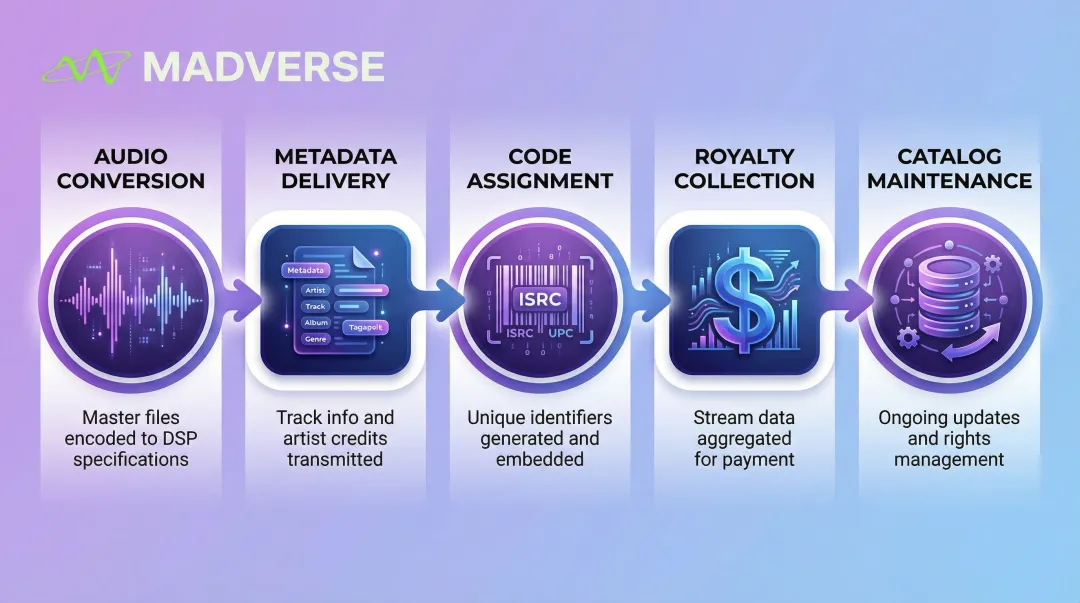
The distribution process involves:
- Converting audio files to platform-specific formats
- Delivering metadata (artist name, song title, genre tags, credits) using DDEX industry standards
- Assigning unique identifiers (ISRC codes for recordings, UPC codes for releases)
- Managing royalty collection and payment distribution
- Maintaining catalog presence across all platforms
The right distributor does more than make your music available. It positions your catalog for algorithmic discovery, playlist placement, and revenue optimization across multiple income streams including streaming, sync licensing, and user-generated content monetization.
How to Choose the Right Music Distributor for Your Career
Selecting a distributor is a business decision that impacts your revenue model, global reach, and career trajectory.
Identify Your Priorities
Before comparing distributors, determine what matters most:
- Maximum royalty retention: Keep 100% of earnings with subscription models
- Lower upfront costs: Commission-based distributors charge no annual fees
- Advanced features: YouTube Content ID, VEVO distribution, Dolby Atmos
- Collaborative tools: Payment splitting at source for producers and co-writers
- Marketing support: Editorial playlist pitching and promotional services
Compare Pricing Models
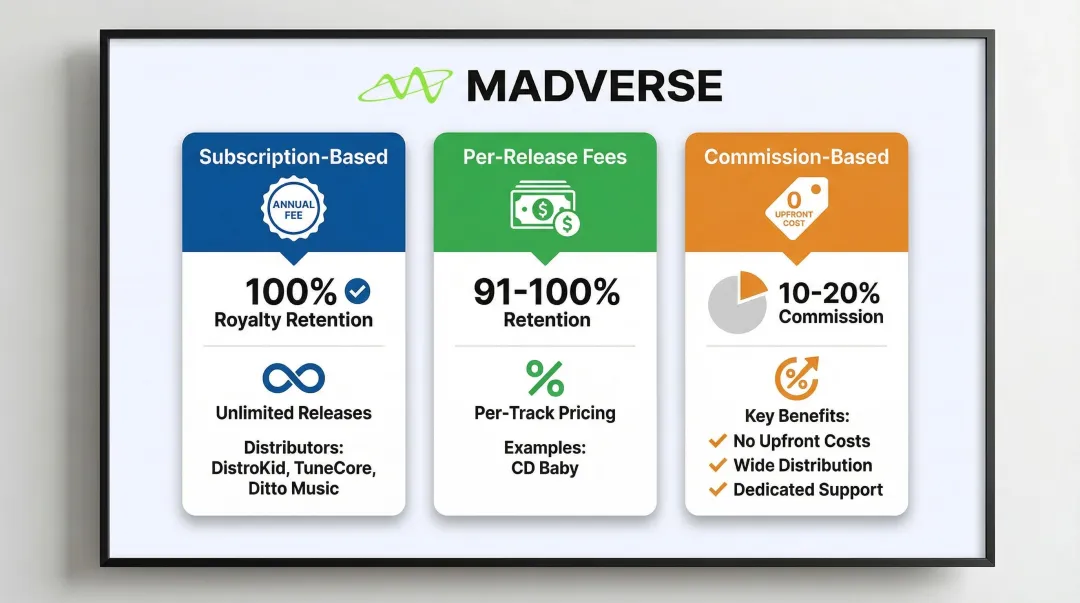
Distributors operate on three primary pricing structures:
Subscription-Based Models:
- Annual fee for unlimited releases
- Keep 100% of streaming royalties
- Examples: DistroKid (₹1,900/year), TuneCore (₹2,100/year), Ditto Music (₹1,600/year)
- Best for: Artists releasing multiple tracks annually
Per-Release Fees:
- One-time payment per single or album
- Keep 91-100% of royalties
- Example: CD Baby (₹830/single, takes 9% commission)
- Best for: Artists releasing infrequently
Commission-Based Models:
- No upfront fees
- Distributor takes 10-20% of all earnings
- Examples: RouteNote Free (15% commission), AWAL (15%, invite-only)
- Best for: Artists testing distribution without financial commitment
Payment Splitting at Source
Artists who collaborate frequently benefit from automatic royalty splitting, which eliminates accounting headaches:
- DistroKid: Requires collaborators to have paid subscriptions or pay ₹830/year
- TuneCore: Free splits on unlimited plans; collaborators pay ₹660/year for restricted accounts
- RouteNote: Free revenue sharing for all users
- Madverse: Royalty splits at source starting at ₹1,240/year (Rise plan)
Payment splitting at source means the distributor divides revenue before it reaches your account. This ensures collaborators get paid directly without manual transfers or disputes.
Platform Reach: Emerging Markets
Global distribution extends beyond Spotify and Apple Music. Access to emerging markets significantly expands your audience:
China:
- Platforms: Tencent (QQ Music, KuGou, Kuwo), NetEase Cloud Music
- Distributors: TuneCore, DistroKid, Madverse
India:
- Platforms: JioSaavn, Gaana
- Distributors: DistroKid, TuneCore, Madverse
- Market size: 1.4 billion potential listeners
Africa:
- Platform: Boomplay (leading African streaming service)
- Distributors: DistroKid, TuneCore, Madverse
Essential Features Checklist
Before committing to a distributor, verify they offer:
- ✅ Lyrics distribution: Increases engagement and algorithmic visibility
- ✅ Full credits: For instrumentalists, producers, engineers (critical for metadata accuracy)
- ✅ YouTube Content ID: Monetizes your music in user-generated videos
- ✅ VEVO distribution: Professional music video hosting
- ✅ Social platform delivery: TikTok, Instagram, Facebook monetization
- ✅ Spatial audio formats: Dolby Atmos for premium streaming tiers
Streaming Platform Secrets: Optimization Tactics Most Artists Miss
Success on streaming platforms requires understanding their specific editorial and algorithmic mechanisms.
Metadata Optimization
Metadata directly impacts algorithmic recommendations and playlist placement. Poor metadata fragments your audience and costs you streams.
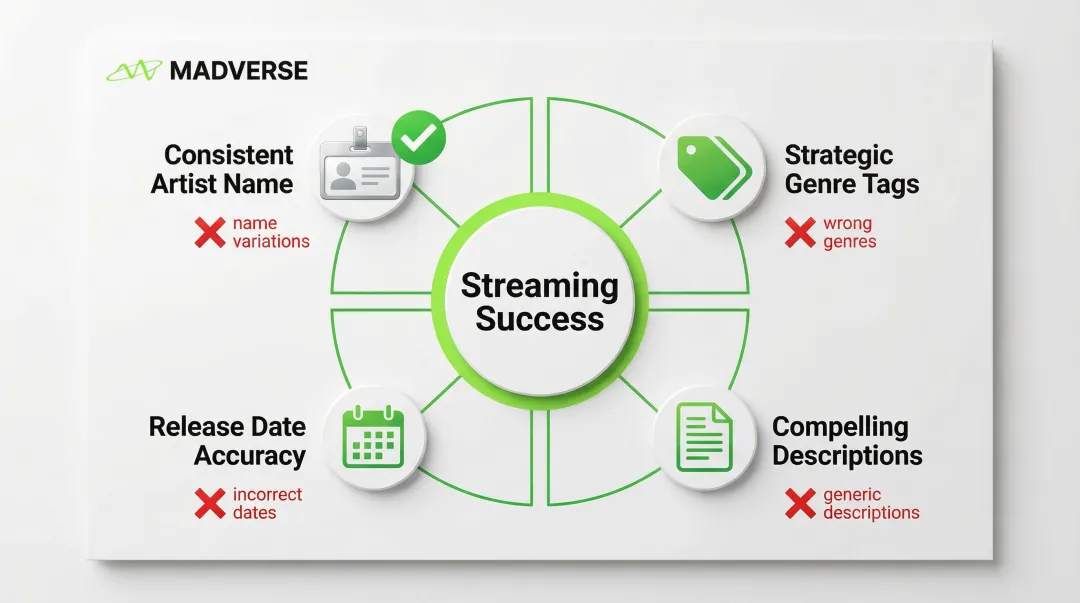
Critical metadata elements:
- Consistent artist name: Use identical spelling across all releases (avoid "John Smith," "J. Smith," "John Smith Music" variations)
- Strategic genre tags: Choose primary and secondary genres that match your sound and target playlists
- Release date accuracy: Incorrect dates disqualify you from editorial consideration
- Compelling descriptions: Write clear, keyword-rich song descriptions for playlist curators
Common metadata mistakes include misspelled artist names that create separate profiles, incorrect ISRCs preventing royalty tracking, and missing credits that exclude you from collaborative discovery features. Generic genre tags reduce algorithmic matching accuracy and limit playlist placement opportunities.
Release Timing Strategies
When you release matters as much as what you release. The industry standard is Friday releases for editorial playlist consideration, with 2-4 weeks lead time for distributor submission.
Algorithms favor active artists releasing regularly—every 4-6 weeks is ideal. Avoid releasing multiple singles on the same day; instead, space them for sustained momentum.
Research shows that consistent release schedules train the algorithm to prioritize your catalog, increasing algorithmic playlist placements like Discover Weekly and Release Radar.
This consistent release strategy sets the foundation for algorithmic success—but understanding platform-specific signals takes your optimization further.
Spotify Algorithm Hacks
Spotify employs an "algo-torial" feedback loop where editorial decisions train algorithmic recommendations.
Key algorithmic signals:
- Save rate: Aim for 10-20%+ (saves signal quality more than passive streams)
- Completion rate: High completion rates indicate listener satisfaction
- Skip rate: Skips in the first 30 seconds are "algorithm killers"
- Playlist adds: User-generated playlist additions boost discovery
Tactics to implement:
- Pre-save campaigns: High pre-save numbers signal intent, boosting day-one performance
- Target playlist curators: Submit to independent playlists before release to build momentum
- Encourage saves: Ask fans to save tracks, not just stream them
- Optimize first 30 seconds: Hook listeners immediately to reduce skip rates
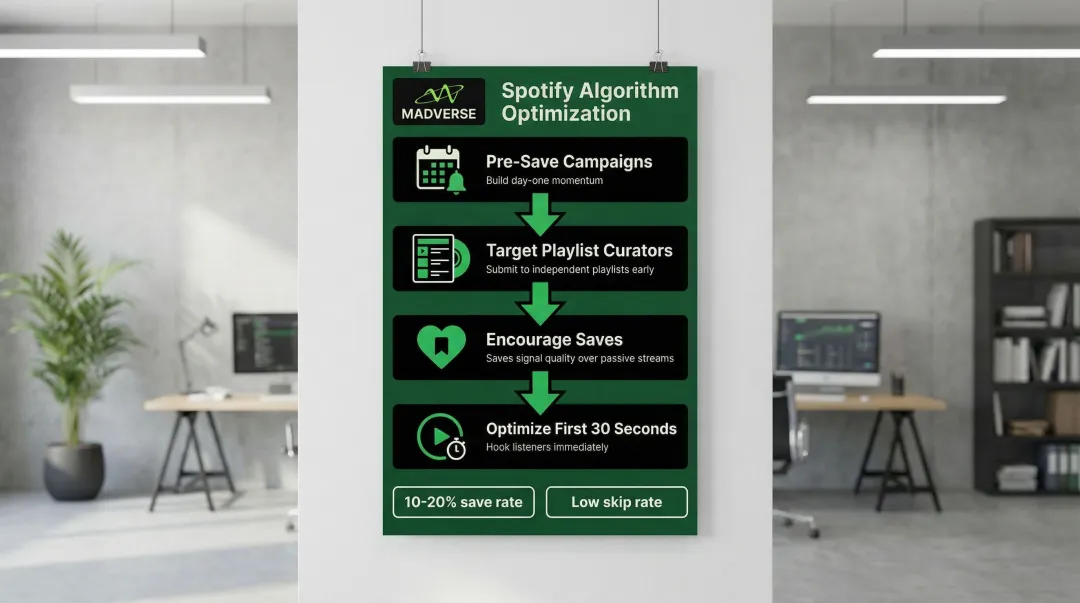
Editorial pitching timeline: Submit via Spotify for Artists at least 7 days before release (2-4 weeks recommended) to qualify for Release Radar and editorial consideration.
While Spotify leans heavily on algorithmic curation, Apple Music takes a different approach worth understanding.
Apple Music Editorial Pitching
Apple Music relies heavily on human curation, offering a different opportunity than Spotify's algorithm-driven approach.
Submission requirements:
- Deadline: 10 days minimum before release for full consideration
- Pitch quality: Craft compelling narratives explaining your music's story, influences, and ideal audience
- Press materials: Include high-quality artist photos, press quotes, and streaming history
Apple curators prioritize:
- Pre-add momentum (similar to Spotify's pre-saves)
- Shazam data showing early discovery trends
- Radio spins and media coverage
- Strong completion rates and listener retention
Apple's human curation means personalized, story-driven pitches perform better than generic submissions.
TikTok Virality Tactics
84% of Billboard Global 200 entries in 2024 went viral on TikTok first, making the platform essential for music discovery.
TikTok optimization strategies:
- Preview clip selection: Choose the most engaging 30-60 seconds (typically the hook or chorus)
- Storytelling hooks: Focus on emotional connection rather than just catchy sounds
- Create your own content: Don't wait for others to use your music—demonstrate how it works in videos
- Engage with creators: Comment on videos using your sound to build community
- Trending sound strategy: Participate in trends while maintaining authenticity
Artists who leverage TikTok trends see 11% week-over-week streaming growth compared to 3% for non-correlated artists, demonstrating the platform's direct impact on streaming performance.
Playlist Pitching Best Practices
Beyond distributor pitching tools, strategic playlist outreach multiplies your visibility.
Independent playlist strategy:
- Research curators: Identify playlists with 1,000-50,000 followers in your genre
- Personalize outreach: Reference specific tracks on their playlist and explain why your music fits
- Build relationships: Engage with curators on social media before pitching
- Submit early: Reach out 2-3 weeks before release to give curators time to review
- Create momentum: Secure independent playlist placements first to demonstrate traction for editorial pitches
What playlist curators want:
- Professional-quality production
- Clear genre fit with their playlist's aesthetic
- Evidence of existing audience engagement
- Respectful, non-spammy communication
Royalty Splits and Payment Structures: Keeping More of What You Earn
Understanding royalty structures ensures you maximize earnings while maintaining fair collaborations.
Commission vs. Subscription Models
Subscription-Based Distributors:
- Pay annual fee (₹1,200-3,000 typical range)
- Keep all streaming revenue
- Best for: Artists earning ₹10,000+ annually from streaming
Commission-Based Distributors:
- No upfront costs
- Distributor takes 9-15% of all earnings forever
- Best for: New artists testing distribution without financial risk
Break-even analysis: If you earn ₹20,000 annually from streaming, a commission-based distributor taking 15% costs you ₹3,000—more than most subscription services.
Payment Splitting Mechanics
Once you understand pricing models, the next consideration is how to split revenue with collaborators. Payment splitting at source uses DDEX industry standards to allocate revenue before it reaches the primary artist's account, automating what used to require manual transfers.
How it works:
- Artist sets split percentages during release setup (e.g., 60% artist, 30% producer, 10% co-writer)
- Distributor receives royalties from streaming platforms
- System automatically calculates and distributes payments to each collaborator
- All parties receive direct deposits without manual transfers
Madverse's royalty split at source removes common collaboration issues:
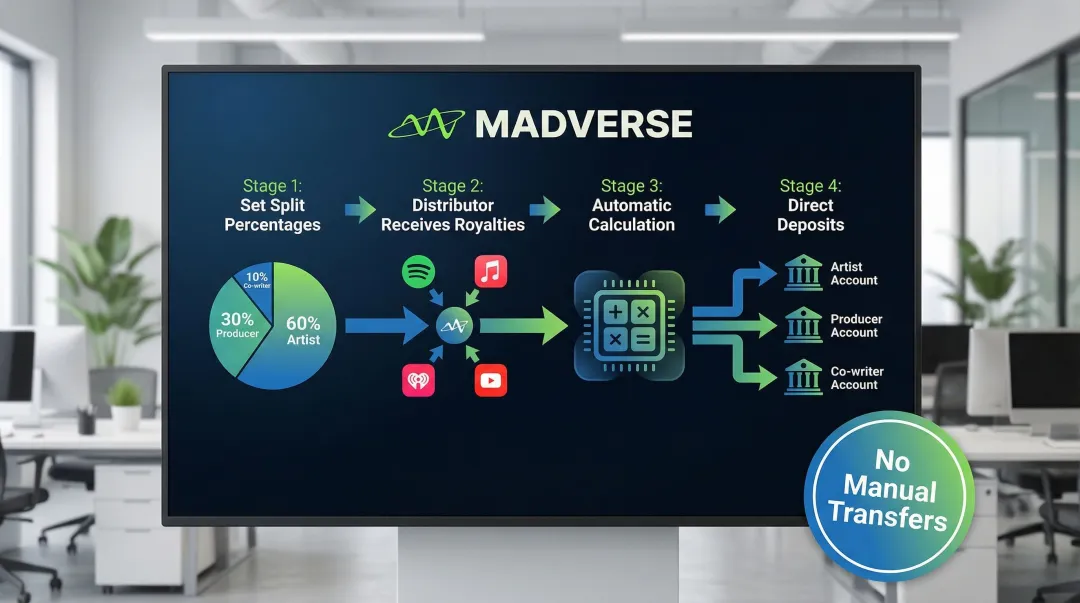
- No manual accounting or spreadsheet tracking
- No payment delays waiting for primary artist to distribute funds
- Transparent reporting for all collaborators
- Automatic tax compliance (W-9/W-8BEN forms required)
Recoupment Features
Advanced distributors allow you to recoup recording or marketing costs before collaborators receive their split percentage. This feature is particularly valuable for artists who fund production costs upfront.
Example scenario:
- Recording costs: ₹50,000
- Producer receives 20% split after recoupment
- First ₹50,000 in royalties goes entirely to artist
- After recoupment, producer begins receiving 20% of ongoing earnings
Payment Timelines and Thresholds
Payment schedules vary significantly across distributors:
| Distributor | Payment Schedule | Minimum Threshold | Processing Time |
|---|---|---|---|
| DistroKid | On-demand | ₹0 | 1-2 days |
| TuneCore | Quarterly | ₹0 | 45-60 days |
| CD Baby | Monthly | ₹830 | 30-45 days |
| RouteNote | Monthly | ₹4,150 | 45 days after month-end |
| Ditto Music | Weekly | ₹2,075 | 7-14 days |
| Madverse | Monthly (on-demand) | Contact for details | Monthly crediting |
On-demand payouts with low thresholds provide better cash flow for independent artists relying on streaming income.
Advanced Distribution Features That Separate Good from Great
Three advanced features can multiply your music income beyond standard streaming: YouTube Content ID, VEVO distribution, and spatial audio formats. Each monetizes your catalog in different ways.
YouTube Content ID
Content ID monetizes your music across YouTube's entire ecosystem, not just your official uploads. YouTube's system scans all uploaded videos, detects your music, and lets you earn ad revenue from those videos—including millions of user-generated content pieces using your tracks.
Revenue potential: YouTube pays rights holders for ads served on videos containing their music. For viral tracks used in thousands of videos, Content ID can generate significant income beyond traditional streaming.
Understanding commission structures helps you keep more revenue:
| Distributor | Commission | Additional Fees |
|---|---|---|
| DistroKid | 20% | ₹410/year per single |
| TuneCore | 20% | — |
| CD Baby | 30% | — |
| Madverse | 0% | Included in Rise plan (₹1,240/year) |
VEVO Distribution
Beyond Content ID, VEVO distribution elevates your video presence with professional branding and separate revenue streams.
Benefits:
- Professional channel branding
- Higher perceived credibility
- Extra revenue from video streams
- Integration with major DSPs' video features
Pricing comparison:
| Distributor | Cost | Notes |
|---|---|---|
| DistroKid | ₹685/month | Via DistroVid add-on |
| Symphonic | ₹7,900+ | One-time setup fee |
| RouteNote | Included | — |
| Madverse | Included | Rise plan and higher (VEVO, Apple Music, Tidal) |
Dolby Atmos and Spatial Audio
The third monetization lever is spatial audio. Major platforms now prioritize immersive formats, giving these tracks better placement and potential rate premiums.
Platform support:
- Apple Music: Heavily promotes Dolby Atmos tracks
- Amazon Music: Spatial audio tier
- Tidal: Immersive audio formats
Revenue impact: Some platforms pay higher per-stream rates for spatial audio formats, though platforms don't publicly disclose exact rates.
Distribution costs:
| Distributor | Dolby Atmos Fee | Royalty Share |
|---|---|---|
| Symphonic | ₹2,490 | Varies by plan |
| Madverse | Included | 95% retention (Star plan, ₹2,900/year) |
For independent artists serious about maximizing revenue, combining all three features—Content ID, VEVO, and spatial audio—creates multiple income streams from the same catalog. Madverse bundles these in its Rise and Star plans, letting you access professional distribution tools without per-feature upcharges.
Common Music Distribution Mistakes That Cost You Streams and Revenue
Independent artists lose thousands in streaming revenue through preventable mistakes. Understanding these errors helps you protect both your momentum and earnings.
Inconsistent Metadata Across Releases
Metadata errors cause billions of dollars in royalty leakage annually. Different spellings, inconsistent credits, or reused codes fragment your catalog and confuse streaming algorithms.
Common inconsistencies that damage your reach:
- Different artist name spellings ("Sarah Johnson" vs. "Sarah Johnson Music" vs. "S. Johnson")
- Varying genre tags that confuse algorithmic recommendations
- Inconsistent songwriter credits that fragment publishing royalties
- Reused ISRCs for different recordings (remixes and remasters require new ISRCs)
Create a metadata style guide and follow it consistently. Use identical artist names, consistent spelling, and accurate credits across all platforms.
Switching Distributors Incorrectly
Changing distributors without proper planning resets stream counts and breaks playlist placements. The process requires careful coordination to preserve your streaming history.
Critical requirements for safe switching:
- Use identical ISRC codes for each recording
- Use identical UPC codes for each release
- Upload with new distributor before issuing takedown with old distributor
- Keep releases live on both services for 48-72 hours to allow DSPs to link track data
Failing to preserve ISRCs and UPCs triggers immediate consequences. Stream counts reset to zero, playlist placements break, and algorithmic momentum disappears. Listeners see "unavailable" in their libraries until they manually re-save your tracks.
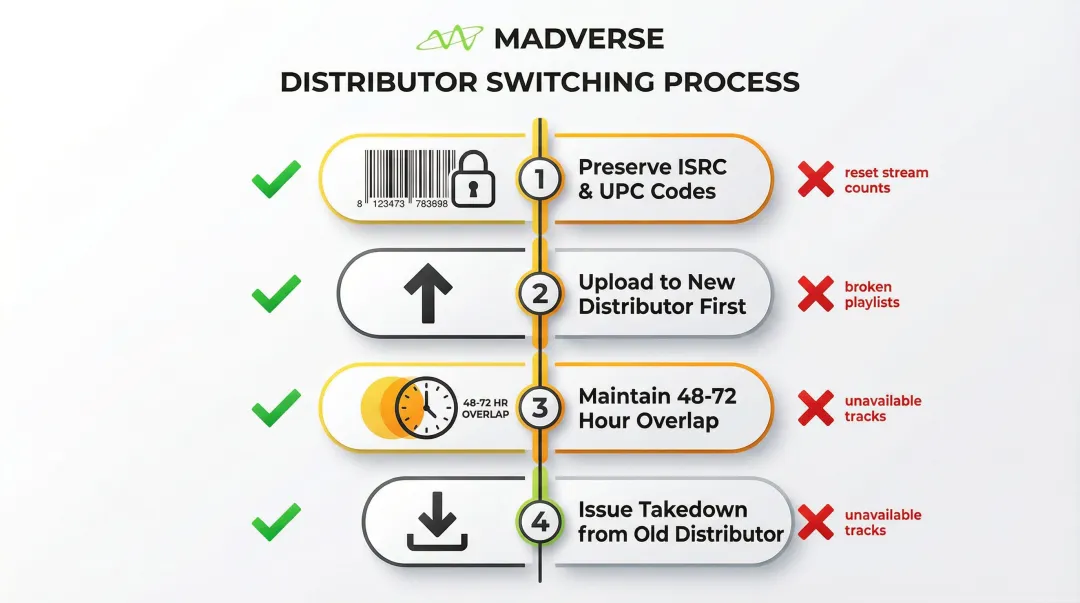
Proper distributor switching preserves your streaming history and maintains all playlist placements, but requires careful coordination with both services.
Neglecting Pre-Release Promotion
Submitting to editorial playlists without building momentum significantly reduces placement chances. Curators and algorithms both favor releases with strong day-one performance.
Pre-release essentials:
- Launch pre-save campaigns to build day-one momentum that signals quality to algorithms
- Create promotional content (behind-the-scenes, lyrics videos, teasers) before release
- Contact independent curators 2-3 weeks before release
- Secure blog features, interviews, or reviews timed to release day
- Tease the release across social platforms to prime your audience
Start promotional activities at least three weeks before release. The momentum you build beforehand determines how streaming platforms prioritize your music in the critical first 24-48 hours.
Frequently Asked Questions
How do I get my music on Spotify and Apple Music?
You need a music distributor to deliver your music to these platforms. Upload at least 2-4 weeks before your release date to qualify for editorial playlists, though most distributors can get tracks live within 1-7 business days.
What's the difference between distribution and a record label?
Distributors handle delivery and royalty collection while you retain 100% of your master rights. Record labels take ownership of your masters in exchange for funding, marketing, and industry connections.
Do I keep 100% of my royalties with all distributors?
No. Subscription-based distributors (DistroKid, TuneCore, Ditto) typically let you keep 100% while charging annual fees. Commission-based distributors (RouteNote Free, AWAL, CD Baby) take 9-20% of your earnings but charge no upfront fees. Some distributors also charge additional fees for premium features like YouTube Content ID or payment splitting.
Can I switch distributors without losing my streams and playlist placements?
Yes, but use the exact same ISRC and UPC codes. Upload with your new distributor before taking down the old release, maintaining a 48-72 hour overlap to preserve your stream counts and playlist placements.
What is payment splitting and why does it matter?
Payment splitting is automatic royalty distribution to collaborators (producers, co-writers, musicians) at the source, before revenue reaches the primary artist's account. This eliminates accounting headaches, prevents payment disputes, and ensures everyone gets paid fairly and transparently. It's particularly valuable for artists who collaborate frequently and want to maintain professional relationships.
How long does it take to get my music on streaming platforms?
Delivery typically takes 1-7 business days, varying by distributor (DistroKid: 1-2 days, TuneCore: 2-3 days, CD Baby: 1-3 weeks). Upload 2-4 weeks early for editorial playlist consideration.