
Introduction
Apple Music pays approximately ₹0.83 per stream to rights holders—roughly 2-3 times higher than Spotify's average rate—making it one of the most lucrative streaming platforms for independent musicians.
Despite this premium payout structure, most independent artists still struggle to convert these higher rates into sustainable income.
The real challenge? Understanding how Apple's payment model works, what factors influence your actual earnings, and how to position your music to maximize every stream. This guide walks you through Apple Music's royalty structure, the hidden factors impacting your payouts, and proven strategies to boost your streaming revenue in 2025.
TLDR: Key Takeaways for Independent Musicians
- Apple Music pays USD 0.008-0.01 per stream vs. Spotify's USD 0.003-0.004
- US and UK streams pay more than emerging markets based on geography and subscription type
- Only streams exceeding 30 seconds generate royalties—optimize your intros accordingly
- Keep 90-95% of royalties with standard independent distribution deals
- Optimize profiles and metadata tags to boost algorithmic playlist placement
Understanding Apple Music's Royalty Structure
Apple Music operates on a pro-rata payment model where the platform pools 52% of its subscription revenue and distributes it to rights holders based on their share of total streams.
Unlike Spotify's freemium model that dilutes payouts with ad-supported listening, Apple Music's subscription-only ecosystem generates consistently higher per-stream values.
What You Actually Earn Per Stream
The widely cited $0.01 per stream figure applies specifically to individual paid subscriptions. In practice, your effective rate varies:
- Individual paid plans: $0.008-$0.01 per stream
- Family and student plans: $0.006-$0.009 per stream
- Geographic variations: Streams from high-subscription-cost countries yield more than emerging markets
The 30-Second Minimum Threshold
Apple only counts streams that exceed 30 seconds toward royalty calculations. This threshold means:
- Songs under 30 seconds generate zero royalties
- Listeners who skip within the first 30 seconds don't count
- Front-loading engaging content in your first 30 seconds is critical
Apple has doubled penalties for streaming fraud as of 2026. The platform actively removes manipulated streams and fines distributors who enable fake plays.
Payment Timeline Reality
Understanding when you actually get paid helps manage cash flow expectations:
- Month 1: Streams occur on Apple Music
- Month 2: Apple calculates royalties and reports to distributors
- Month 3-4: Distributors process payments (timing varies by platform)
- Minimum thresholds: Most distributors require you to reach a minimum balance (typically ₹500-₹2,000) before issuing payment
Realistic Earnings Scenarios
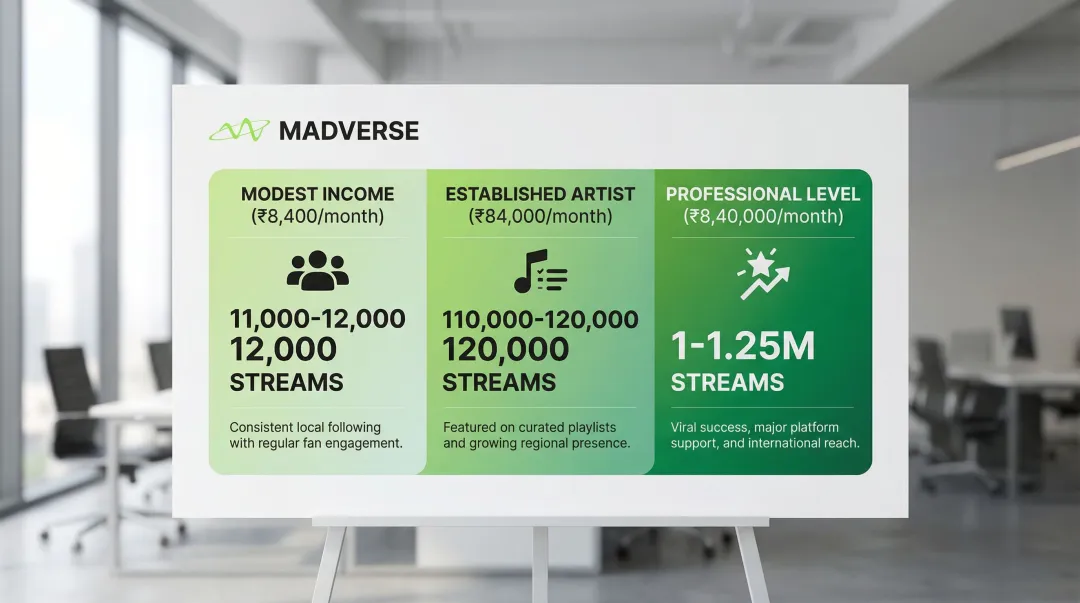
Here's what different streaming volumes translate to in actual earnings, assuming an average rate of $0.009 (approximately ₹0.75) per stream and a distributor keeping 5-10%:
| Target Earnings | Streams Needed | What This Requires |
|---|---|---|
| ₹8,400 (~$100) | 11,000-12,000 | Modest local following with consistent releases |
| ₹84,000 (~$1,000) | 110,000-120,000 | Established audience, playlist placements, or viral moment |
| ₹8,40,000 (~$10,000) | 1-1.25 million | Significant promotional investment or major playlist support |
Factors That Impact Your Apple Music Earnings
Not all streams generate equal royalties. Several variables determine your actual payout per play.
Geographic Location of Your Listeners
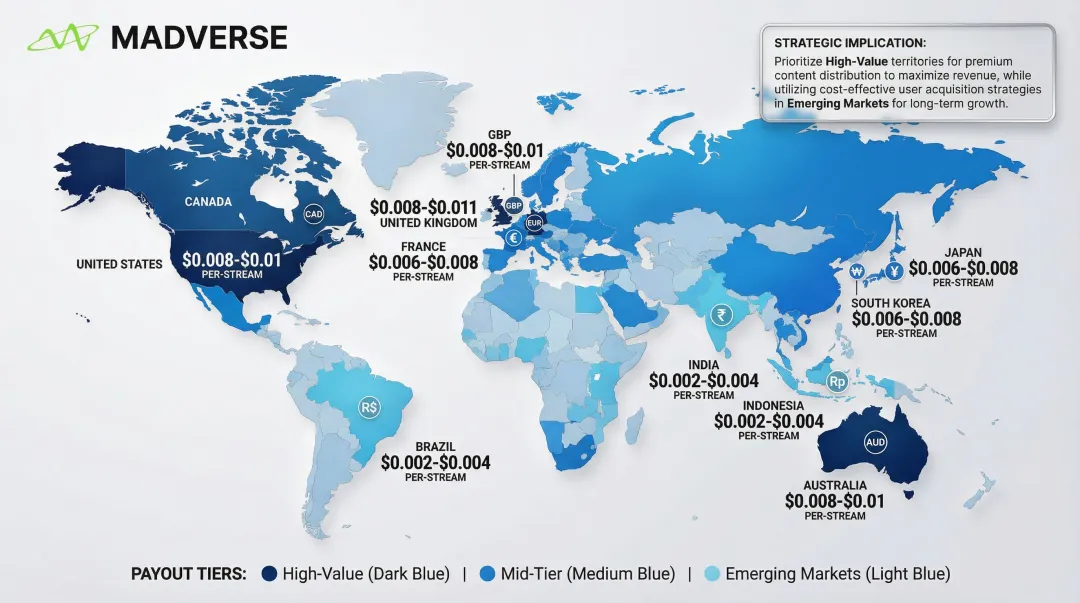
Subscription prices vary dramatically by country, directly affecting your per-stream rate:
- High-value territories: US, UK, Germany, Australia, Canada generate $0.008-$0.01 per stream
- Mid-tier markets: Japan, France, South Korea pay $0.006-$0.008
- Emerging markets: India, Brazil, Indonesia yield $0.002-$0.004 per stream
Strategic implication: Marketing spend focused on high-ARPU (Average Revenue Per User) territories delivers better ROI than broad global campaigns.
Subscription Type Matters
Apple Music offers various subscription tiers at different price points:
- Individual plans: Generate the highest per-stream rates
- Family plans: Divided among multiple users, reducing effective payout
- Student plans: Discounted pricing results in lower per-stream values
- Bundled plans: Apple One subscriptions may yield slightly different rates
Your Distribution Deal Structure
While Apple Music pays your distributor based on these subscription factors, the percentage you keep depends entirely on your distributor's fee model:
Percentage-based distributors:
- Take 10-30% of your royalties
- No upfront costs
- Better for new artists with uncertain volume
Flat-fee distributors:
- Charge annual fees ($15-$35 annually)
- You keep 90-100% of royalties
- More economical once you exceed 50,000 annual streams
Some distributors like Madverse Music offer tiered plans where artists retain 90-95% of royalties while gaining access to consolidated analytics, playlist pitching, and sync licensing opportunities—making the higher retention rate worthwhile for artists focused on long-term earnings growth.
Master Recording Ownership
Your ownership structure fundamentally affects what you receive:
- Own your masters: Receive 100% of the artist/label share (minus distributor fees)
- Licensed recordings: Receive only the agreed percentage per your contract
- Label deals: Typically receive 15-25% after repayment of advances
Getting Your Music on Apple Music: Distribution Strategies
Choosing the right distribution strategy directly impacts your royalty earnings. Apple Music doesn't accept direct uploads from individual artists—you must use a digital distributor or aggregator service.
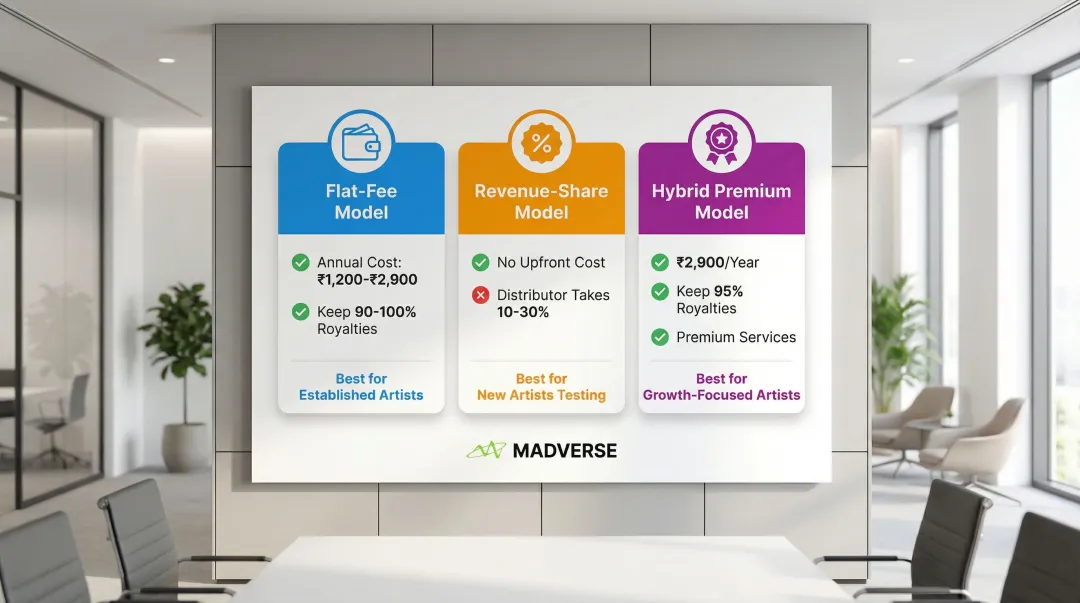
Distribution Model Comparison
| Distribution Model | Upfront Cost | Royalty Split | Best For | Examples |
|---|---|---|---|---|
| Flat-Fee | ₹1,200-₹2,900/year | Keep 90-100% | Artists with established streaming volume | DistroKid, CD Baby (annual) |
| Revenue-Share | None | Distributor takes 10-30% | New artists testing the waters (becomes expensive as streams grow) | TuneCore (commission plan) |
| Hybrid Premium | ₹2,900/year | Keep 95% | Artists wanting value-added services with high retention | Madverse Music Star plan (includes editorial pitching, sync licensing, YouTube Content ID, 150+ platforms) |
Technical Requirements for Apple Music
Once you've selected a distributor, prepare your music to meet Apple's technical standards. Before submitting, ensure you meet these specifications:
Audio quality standards:
- 16-bit or 24-bit resolution
- Sample rates: 44.1, 48, 88.2, 96, 176.4, or 192 kHz
- For "Apple Digital Masters" badge: 24-bit masters with specific encoding guidelines
Artwork requirements:
- Minimum 3000 x 3000 pixels (4000 x 4000 recommended)
- JPEG or PNG format in RGB color space
- No URLs, pricing, or advertising text
Approval timeline:
- Minimum 3-4 weeks lead time recommended
- Allows for worldwide availability and proper indexing
- Apple Music will reject submissions with metadata errors or quality issues, causing delays
Optimizing Your Apple Music Presence for Maximum Earnings
Optimizing your Apple Music profile improves discoverability and drives significantly higher stream counts than passive distribution alone.
Claim Your Apple Music for Artists Profile
Verification unlocks critical promotional tools:
- Access detailed analytics (streams, listeners, geographic data, playlist adds)
- Upload custom artist images and bio
- Share "Milestones" on social media when you hit streaming benchmarks
- Submit music for editorial playlist consideration
Metadata Optimization Strategy
Your metadata choices directly affect where Apple Music's algorithm places your tracks in recommendations and playlists.
Genre selection:
- Choose the most specific applicable genre
- Avoid generic categories that increase competition
- Apple's algorithm uses genre for playlist and radio recommendations
Mood and descriptive tags:
- Select tags that accurately reflect your track's energy and emotion
- These feed into Apple Music's mood-based playlists and radio stations
Contributor credits:
- Tag all songwriters, producers, and featured artists
- Proper crediting creates cross-linking opportunities and improved discovery
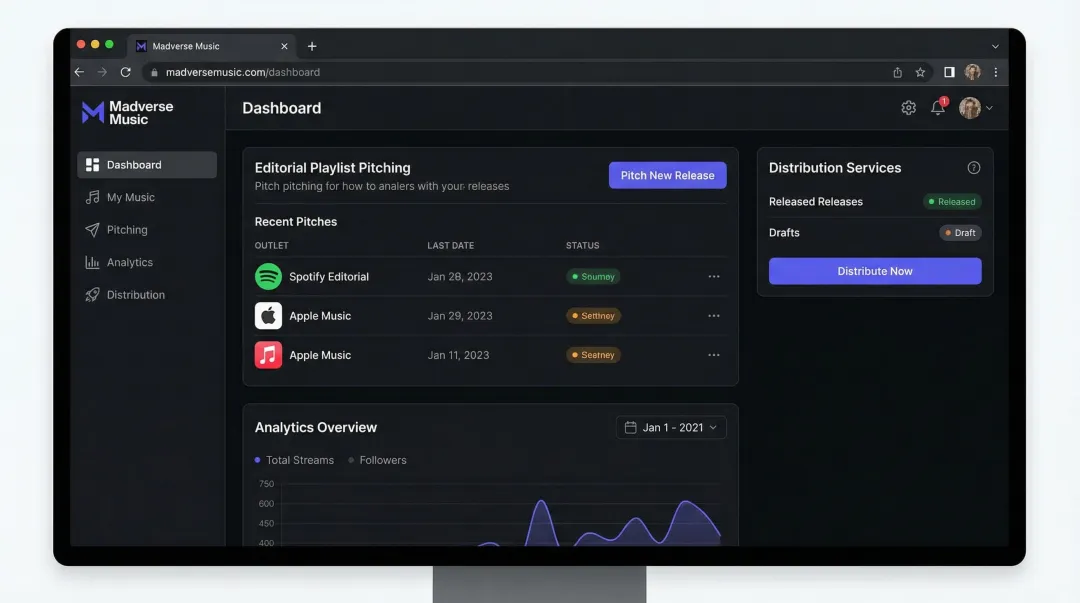
Editorial Playlist Pitching Process
Editorial playlists drive the highest-quality streams and long-term listener growth. Understanding the submission process increases your acceptance chances.
Submission timeline:
- Submit pitches at least 10 days before release (4-6 weeks ideal)
- Earlier submissions receive fuller editorial consideration
What increases your chances:
- Professional, concise pitch highlighting what makes the track unique
- Accurate genre and mood metadata
- Previous streaming momentum or press coverage
- Strategic release timing (avoid major release weeks)
Most independent artists pitch through their distributor.
- Platforms like Madverse Music include editorial playlist pitching for Apple Music in their Star and Label plans
- Provide context: tour dates, press coverage, social media growth
Leverage Visual Elements
Beyond playlist placement, visual optimization keeps listeners engaged once they discover your music.
Apple Music's visual features increase engagement and completion rates.
Motion album art:
- Animated album art creates more engaging visual experience
- Deliver as 1:1 aspect ratio video files
- Submitted through your distributor, not directly
Artist images:
- High-quality, professional photos improve profile credibility
- Update seasonally to maintain fresh presence
Release Strategy Optimization
Single vs. album approach:
- Singles allow more frequent editorial consideration opportunities
- Albums demonstrate artistic depth and encourage longer listening sessions
- Strategic pre-release singles build momentum for full album
Release frequency:
- Consistent monthly or bi-monthly releases maintain Apple Music's favor
- Never sacrifice production quality for release speed
Pre-add campaigns:
- Enable pre-adds at least one week before release
- Fans who pre-add receive automatic notifications on release day
- This significantly boosts Day 1 stream counts, improving algorithmic promotion
Drive External Traffic to Your Profile
Apple Music's algorithm rewards external engagement signals, so directing your existing audience matters.
Social media strategies:
- Share direct Apple Music links (not generic landing pages)
- Use platform-specific calls-to-action: "Listen on Apple Music"
- Create shareable content featuring Apple Music player embeds
Email marketing:
- Include Apple Music links prominently in release announcements
- Segment your list by known Apple Music users for targeted campaigns
Cross-platform promotion:
- Link to Apple Music from Spotify, YouTube, and other platforms
- Use smart link services that detect user preference and route accordingly
Tracking and Analyzing Your Apple Music Performance
Understanding your Apple Music analytics is the difference between guessing and growing. Data-driven decisions separate artists who build sustainable careers from those who rely on luck.
Key Metrics to Monitor
Apple Music for Artists provides:
- Stream counts: Total plays and daily trends
- Listener counts: Unique users who played your music
- Playlist adds: How many users saved tracks to personal playlists
- Shazam data: Discovery through Shazam integration
- Geographic breakdown: Where your listeners are located
- Source data: Which playlists, albums, or search drove streams
Using Analytics to Inform Strategy
Identify your strongest songs by analyzing completion rates and replay frequency:
- Focus promotional efforts on tracks listeners finish
- Create similar-sounding follow-up releases
- Pitch your best-performing tracks for playlist consideration
Target your top geographic markets instead of spreading efforts thin:
- Concentrate marketing spend where listener concentration is highest
- Time releases for peak hours in your strongest territories
- Understand cultural preferences in your top markets
Optimize timing based on when your audience is active:
- Schedule social posts when engagement peaks
- Launch releases for maximum Day 1 visibility
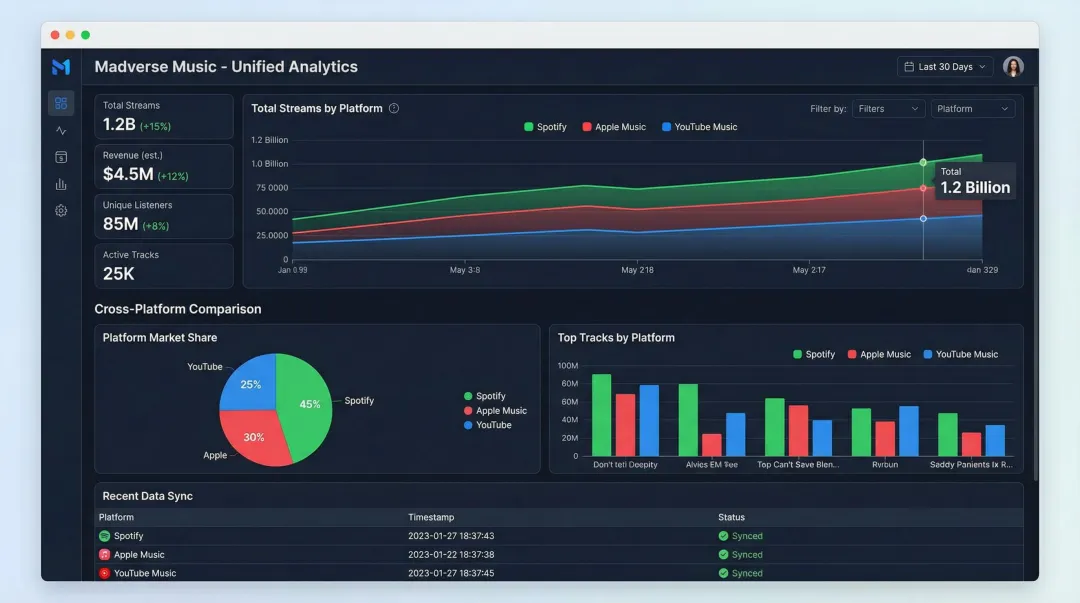
Consolidated Analytics Platforms
Tracking performance across Apple Music, Spotify, YouTube Music, and other platforms individually wastes hours each week.
Distribution services like Madverse Music solve this with unified dashboards that combine all your streaming data in one place, allowing you to:
- Compare performance across DSPs from a single interface
- Identify which platforms drive the most revenue
- Understand cross-platform listener behavior
- Make informed decisions about where to focus promotional resources
Diversifying Revenue Beyond Apple Music Royalties
Even with Apple Music's premium payout rates, streaming royalties alone rarely provide sustainable income for independent artists.
Why Streaming Isn't Enough
To earn ₹1,00,000 monthly (around $1,200) from Apple Music alone requires roughly 1.3-1.5 million streams per month. For context, this places you in the top 1-2% of independent artists globally.
Complementary Revenue Streams
The key to sustainable music income lies in building multiple revenue channels that work together. Here are the most lucrative options for independent artists:
Sync Licensing Opportunities
TV shows, films, commercials, and video games typically pay ₹42,000-₹8,40,000+ per placement. One sync placement can exceed an entire year's streaming revenue.
Distribution platforms like Madverse Music offer sync licensing services that connect your catalog with music supervisors actively seeking tracks. This passive income stream requires no additional marketing effort once your music is submitted.
Direct Fan Support
Patreon, Bandcamp, and similar platforms offer higher margins than streaming. Fans pay directly for exclusive content, early access, or community membership.
Artists with 50-500 paying supporters earn ₹4,200-₹42,000 monthly from these channels alone.
Merchandise & Physical Products
Physical merchandise offers 50-70% profit margins, while digital products like sample packs and production tutorials scale infinitely. Merchandise transforms streaming listeners into paying customers while strengthening fan connection.
Live Performances
Streaming serves as discovery; live shows generate substantial income. Use Apple Music analytics to identify cities with your highest listener concentration for strategic tour planning.
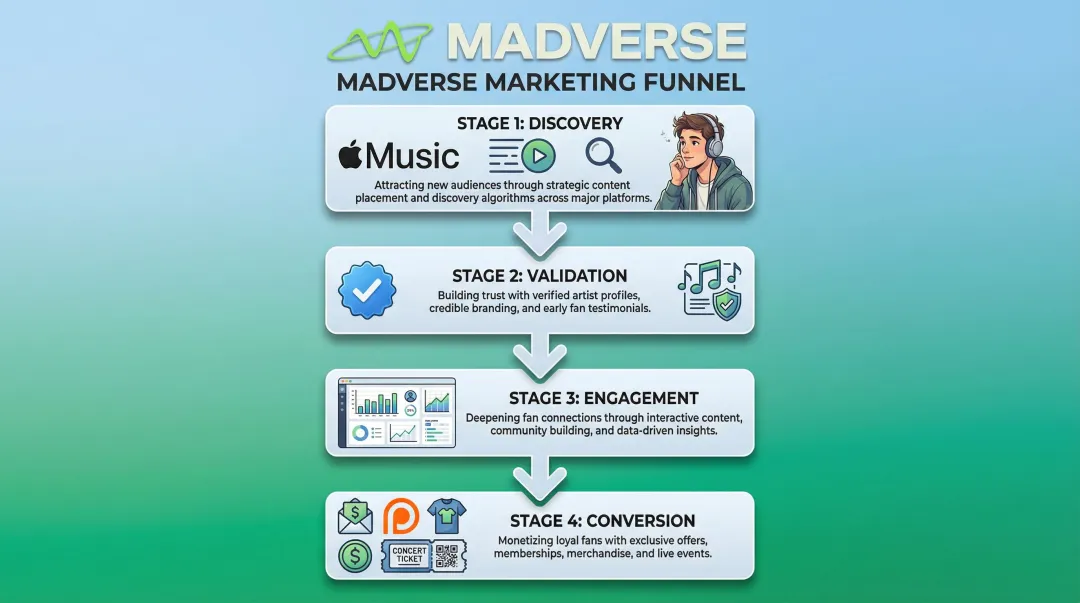
Apple Music's Role in Your Marketing Funnel
Think of Apple Music as a discovery and credibility tool that leads to higher-margin opportunities:
- Discovery — Listeners find you through playlists or search
- Validation — Streaming presence establishes professional credibility
- Engagement — Analytics reveal your most dedicated fans
- Conversion — Direct these fans to higher-value opportunities like your mailing list, Patreon, merchandise store, or live shows
Frequently Asked Questions
How much per 1,000 streams on Apple Music?
Independent artists typically earn ₹670-₹840 per 1,000 streams, though rates vary by listener location and subscription type. US and UK streams generate higher payouts than emerging markets.
How many streams on Apple Music to make ₹8,40,000?
You need approximately 1-1.25 million streams to earn ₹8,40,000 after accounting for distribution fees, assuming you retain 90-95% of royalties.
Does Apple Music pay more than Spotify?
Yes, Apple Music's per-stream rate (₹0.67-₹0.84) is roughly 2-3 times higher than Spotify's average rate, making it significantly more lucrative for independent artists.
How long does it take to receive Apple Music royalties?
Royalties are calculated monthly, reported to distributors 1-2 months later, and then paid to artists based on their distributor's payment schedule—often quarterly. Total timeline from stream to payment typically ranges 2-4 months.
Do I need a distributor to get my music on Apple Music?
Yes, Apple Music doesn't accept direct uploads, so you must use a digital distributor. Choose one that offers royalty retention (90-95%), detailed analytics, and additional services like playlist pitching.
Can I see who's listening to my music on Apple Music?
Apple Music for Artists provides demographic and geographic data about your listeners, including age ranges, gender distribution, and location breakdowns. However, individual listener information isn't available due to privacy protections.