
Introduction
Picture this: You check your Spotify for Artists dashboard and discover your latest single hit 100,000 streams. Excitement builds as you calculate potential earnings—only to find ₹26,000 in your account. Where did the rest go?
This confusion isn't unique. Streaming royalties are now the primary income source for digital-era musicians, accounting for 84% of US recorded music revenue.
The payment structure remains complex and fragmented, with multiple intermediaries between streams and your bank account. Independent artists without distribution expertise often struggle to understand where their money goes.
This article decodes the streaming royalty system so you can:
- Understand how royalties flow from platforms to your account
- Compare payout rates across major streaming services
- Identify factors that affect your earnings per stream
- Build sustainable income strategies based on real data
TLDR
- Streaming platforms pay ₹0.08 to ₹1.08 per stream ($0.001-$0.013 USD), with Tidal paying highest and Pandora lowest
- Earnings vary by listener location, subscription tier (premium pays 5-7x more), and your distribution deal
- Payment flows Platform → Distributor → Rights Holders → PROs → Artist, with cuts ranging 10-20% per party
- Most platforms use pro-rata pooling (total revenue divided by total streams), which favors high-volume artists
- Earning ₹83 lakhs ($100,000) annually requires approximately 31.4 million Spotify streams or 7.8 million Tidal streams
What Is Music Streaming Royalty?
A streaming royalty is compensation paid to rights holders when a song is played on digital platforms like Spotify, Apple Music, or YouTube Music. Each stream generates revenue that gets distributed among songwriters, performers, producers, and publishers who own rights to the recording or composition.
Streaming royalties differ from traditional revenue models in important ways:
Two royalty types per stream:
- Mechanical royalties – paid to songwriters and publishers for the composition
- Performance royalties – paid for the public performance of the recording
Unlike physical album sales (one-time payment) or radio play (performance royalty only), each stream triggers both royalty types simultaneously.
The challenge: Payments are fractional—typically ₹0.01-0.10 per stream depending on platform and region—making volume essential for meaningful income. An artist needs thousands of streams monthly to generate substantial revenue.
Platform rates vary significantly. Spotify pays approximately ₹0.25-0.40 per stream in India, while Apple Music often pays slightly higher. YouTube Music rates tend to fall on the lower end of this spectrum.
Why Understanding Streaming Royalties Matters for Musicians
Streaming now dominates the music economy. In 2024, streaming generated $14.9 billion in the US, representing 84% of total recorded music revenue. For independent artists globally, streaming has become the primary income channel.
The financial reality is harsh. Independent artists need 3.77 million to 5 million streams annually just to reach US federal minimum wage.
For Indian artists, this translates to roughly 250,000-500,000 monthly streams across platforms to earn a sustainable income.
Without understanding royalties, artists make costly mistakes:
- Signing unfavorable distribution deals that take 15-30% of earnings unnecessarily
- Failing to collect all royalty types (mechanical, performance, master)
- Facing payout confusion when stream counts don't match expected earnings
- Missing the ability to forecast income or make strategic career decisions
This confusion isn't accidental. The music industry deliberately keeps royalty structures complex, with major labels and platforms benefiting from opacity while independent artists lose money to hidden fees and unclaimed royalties.
Decoding how royalties work puts you back in control—enabling smarter platform selection, better distribution deals, and realistic income planning that turns streams into sustainable revenue.
How the Streaming Royalty Payment Process Works
When a listener streams your song, the platform collects subscription fees (averaging ₹830/month) or advertising revenue for free-tier users.
These funds enter a monthly revenue pool. Platforms then divide this pool among all rights holders based on their share of total platform streams.
Here's what happens to your money:
Premium subscriber streams generate 5-7x more revenue than ad-supported streams. On Spotify, premium users (42% of the base) generate 90% of total revenue, creating a massive value gap between listener types.
The payment breakdown:
- Platforms convert individual streams into revenue pools
- Algorithms calculate each rights holder's percentage share
- Payments arrive 60-90 days later
- Deductions: distributors (10-30%), labels (50-85% if signed), and PROs
Traditional distributors often trap earnings below minimum payout thresholds (₹830-4,150), effectively confiscating small payments. Madverse addresses this by letting artists keep **95% of royalties** and offering royalty splits at source.
This means more money reaches creators directly with less complexity.
Step 1: Revenue Collection
Streaming platforms collect revenue from two sources with dramatically different values:
Premium subscriptions (majority of revenue):
- Individual plans: ₹830-1,080/month (Spotify, Apple Music, Amazon)
- Generate higher per-stream payouts
- Create stable, predictable revenue pools
Advertising (free-tier users):
- Lower per-stream payouts (15-20% of premium rates)
- Fluctuates based on ad market conditions
- Creates unpredictable artist earnings
Step 2: Pro-Rata Calculation
Most platforms use the pro-rata model: pool all monthly revenue, then calculate each song's share by dividing its streams by total platform streams.
Example calculation:
- Platform collects ₹830 crores (₹8.3 billion) in monthly revenue
- Total platform streams: 10 billion
- Your song: 1 million streams
- Your share: (1,000,000 ÷ 10,000,000,000) × ₹8,300,000,000 = ₹8,300
Why this matters: This model favors high-volume artists. Your 1 million streams compete against Drake's 500 million streams in the same pool, diluting your percentage share regardless of whether listeners specifically chose your music.
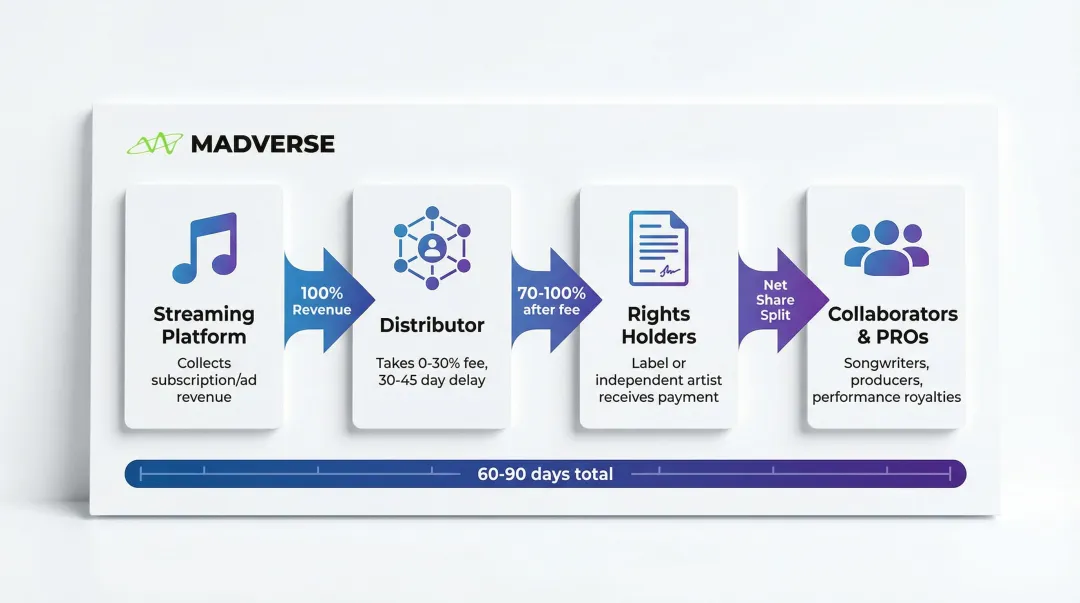
Step 3: Multi-Party Distribution
Payment flows through a complex chain:
- Platform pays distributor (Madverse, DistroKid, CD Baby) - Takes 0-30% depending on deal
- Distributor pays rights holders (record label or independent artist) - Retains agreed percentage
- Rights holders pay collaborators (songwriters, producers, featured artists) - Based on split agreements
- PROs collect and distribute performance royalties separately - ASCAP, BMI, SESAC handle this stream
Each step adds 30-45 days of delay. This is why you receive earnings 60-90 days after streams occur—the money exists, but it's moving through the chain.
Platform-by-Platform Payout Comparison
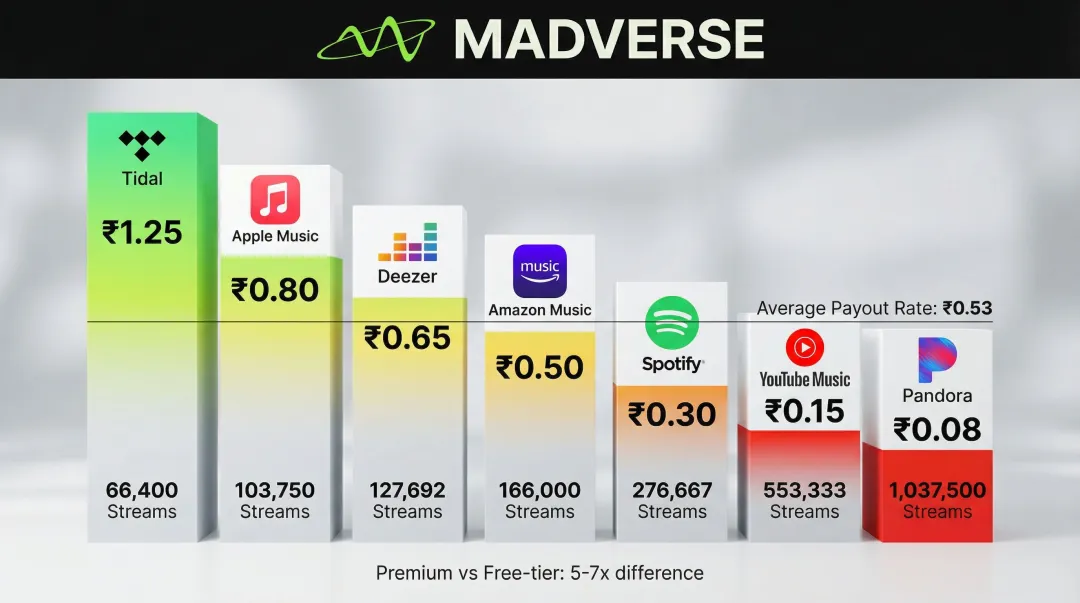
Per-stream rates vary dramatically based on platform business model, subscriber base size, and geographic distribution. Here's what each major platform pays:
| Platform | Payout Per Stream (INR) | Payout Per Stream (USD) | Streams for ₹83,000 ($1,000) |
|---|---|---|---|
| Tidal | ₹1.06-1.25 | $0.0128-$0.015 | ~77,000 |
| Apple Music | ₹0.58-0.83 | $0.007-$0.01 | ~125,000 |
| Amazon Music | ₹0.33-0.66 | $0.004-$0.008 | ~250,000 |
| Spotify | ₹0.25-0.41 | $0.003-$0.005 | ~314,000 |
| YouTube Music | ₹0.16-0.66 | $0.002-$0.008 | ~500,000 |
| Deezer | ₹0.09-0.23 | $0.0011-$0.0028 | ~909,000 |
| Pandora | ₹0.11 | $0.0013 | ~769,000 |
Note: INR conversions based on ₹83 = $1 USD exchange rate
Spotify's 1,000 Stream Threshold
In April 2024, Spotify implemented a minimum threshold: tracks must reach 1,000 streams in the previous 12 months to generate recorded royalties. This policy reallocates around ₹330 crores ($40 million) annually from micro-payments to active artists.
Impact:
- 99.5% of all streams come from tracks meeting this threshold
- Tracks below 1,000 streams earn nothing
- Helps prevent distributor fees from consuming tiny payments
User Base Context
Platform size directly impacts your potential reach and earnings. Here's where the listeners are:
- Spotify: 675 million users, 263 million premium subscribers
- Apple Music: 95 million premium-only subscribers
- Amazon Music: 75 million users via Prime integration
- YouTube Music: Massive reach, lower per-stream rates
These numbers matter, but subscriber type affects your earnings even more.
Premium vs Free-Tier Reality
Premium subscribers generate 90% of Spotify's revenue despite representing only 42% of users.
This creates a massive payment differential:
- Premium stream: ₹0.33-0.41 ($0.004-$0.005)
- Free-tier stream: ₹0.05-0.08 ($0.0006-$0.001)
- Multiplier: 5-7x higher for premium
Your earnings depend heavily on your audience's subscription habits, not just stream counts.
Key Factors That Affect Your Streaming Royalty Payouts
Listener Geography
Subscription prices vary globally to match purchasing power, directly impacting per-stream rates. Where your listeners are located matters as much as how many streams you generate.
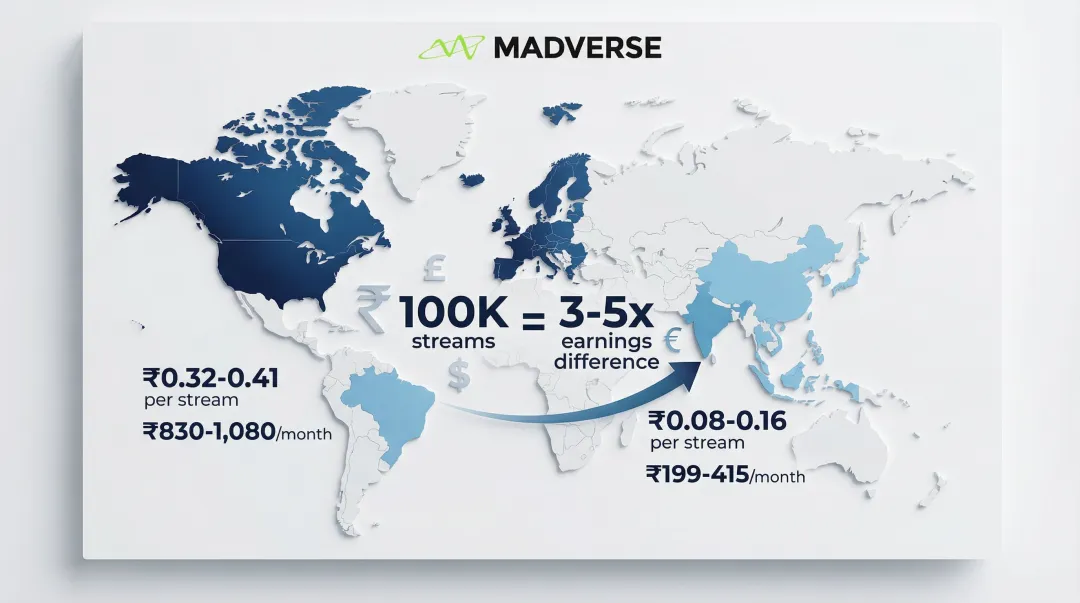
Market tier comparison on Spotify:
- US, UK, Western Europe: ₹0.32-0.41 per stream | ₹830-1,080/month subscriptions
- India, Brazil, Southeast Asia: ₹0.08-0.16 per stream | ₹199-415/month subscriptions
100,000 streams from US listeners earns 3-5x more than the same number from Indian listeners, even though both count equally in your total stream count.
Premium vs Free-Tier Streams
Not all streams pay equally. Premium subscriber streams generate 5-7x more revenue than ad-supported free streams.
Your audience's subscription habits directly impact earnings. To optimise for premium listeners:
- Target playlists with higher premium subscriber ratios
- Build engaged fanbases more likely to pay for subscriptions
- Track premium vs free-tier ratios in platform analytics
Your Distribution Deal
Your distributor's fee structure determines how much of each stream payment you actually keep.
Annual subscription models (you keep 100% of streaming royalties):
- DistroKid: ₹1,915/year | Unlimited uploads
- TuneCore: ₹1,245-4,150/year | Tiered features
- Best for: Artists releasing multiple tracks annually
Commission-based models (no upfront cost, ongoing percentage):
- CD Baby: ₹830/single upfront + 9% of all royalties
- ONErpm: 15% of all royalties
- Best for: Artists releasing 1-2 tracks per year
Madverse takes a 5% commission while providing full distribution services, allowing artists to retain 95% of royalties without annual subscription fees or per-release charges.
Rights Ownership Structure
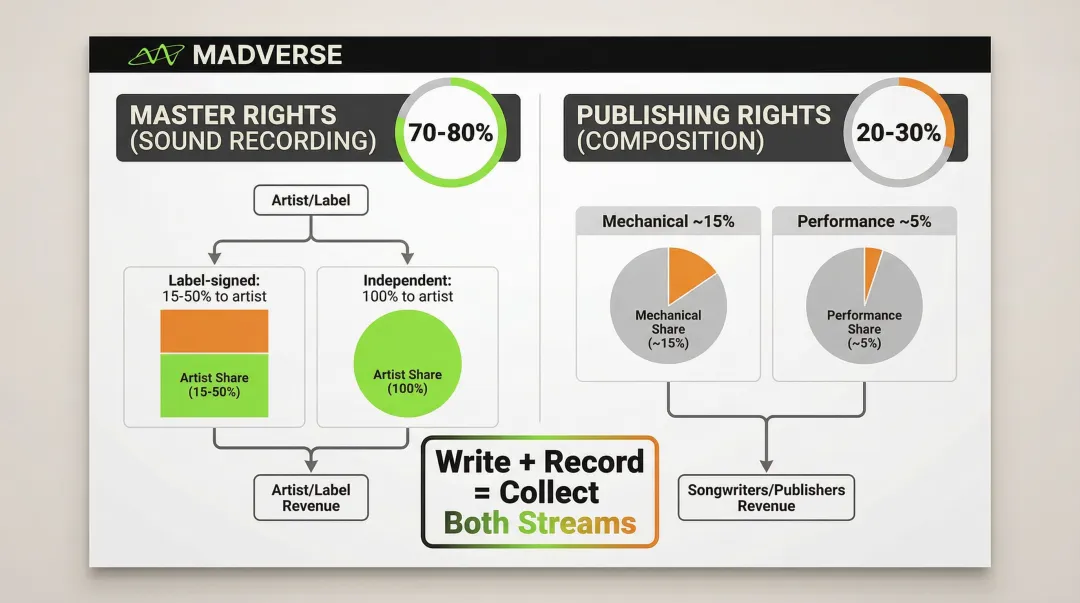
Streaming payouts split between two rights categories, each going to different parties:
Master rights (sound recording owner):
- 70-80% of total platform payout
- Goes to artist if independent, or label if signed
- Label-signed artists typically receive 15-50% after the label's cut
Publishing rights (composition owner):
- 20-30% of total platform payout
- Splits into mechanical (~15%) and performance (~5%) royalties
- Goes to songwriters and their publishers
If you write and record your own music, you collect both streams—maximising your per-stream earnings.
Common Misconceptions About Streaming Royalties
"Streams = Direct Payment"
Reality: You don't get paid per stream in isolation. Your payment depends on your percentage of the platform's total monthly streams and revenue pool.
If total platform streams increase faster than your streams, your earnings can actually decrease even with more plays. The pro-rata model means you're competing against every other artist for a share of the fixed monthly pool.
"High Stream Counts Guarantee Good Income"
Here's the math most artists get wrong: 1 million streams earns ₹2.5-6.6 lakhs ($3,000-$8,000) before splits, not the ₹41+ lakhs ($50,000+) that many expect.
After distributor fees, label cuts (if signed), producer splits, and featured artist payments, your actual take-home may be 20-50% of gross earnings.
Plus, most artists need 3.77-5 million streams annually just to reach minimum wage.
"Streaming Royalties = Total Royalties"
Understanding income expectations leads to another critical misconception: the belief that streaming payments represent your complete royalty picture. Streaming actually generates both mechanical royalties (for composition) and master recording royalties (for sound recording), each coming from different sources.
You must register with:
- PRO (ASCAP, BMI, SESAC) for performance royalties
- MLC (Mechanical Licensing Collective) for mechanical royalties
- Distributor for master recording royalties
Missing any registration means leaving money unclaimed.
The MLC holds ₹3,300 crores ($397 million) in historical unmatched royalties waiting to be claimed by registered songwriters.
Building Your Financial Roadmap as a Musician
Diversify Income Streams
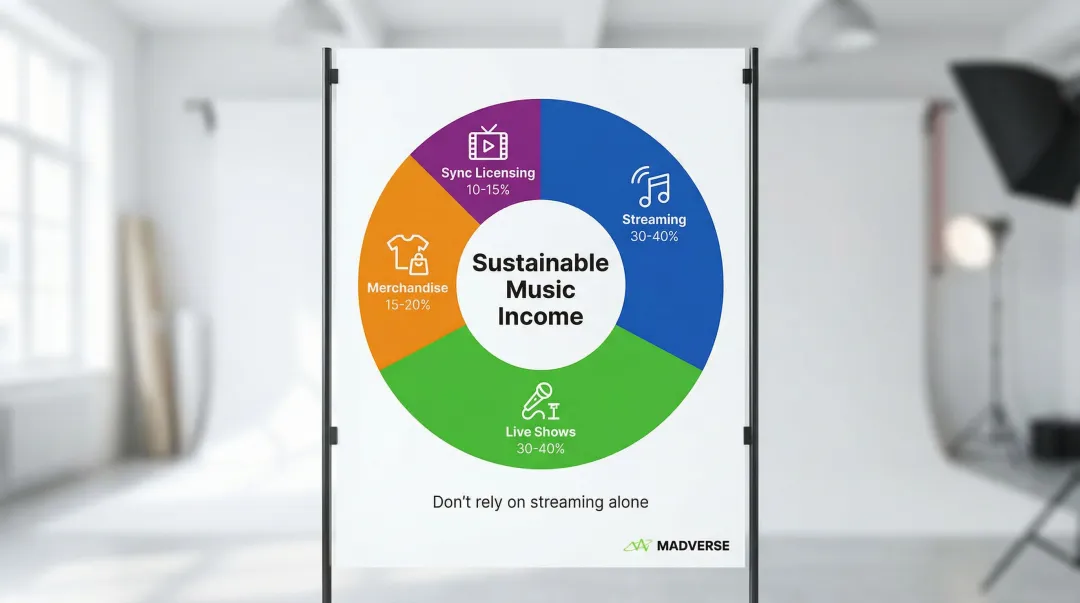
Streaming alone won't sustain most artists. Successful independent musicians typically earn:
- Streaming: 30-40% of total income
- Live shows: 30-40% of total income
- Merchandise: 15-20% of total income
- Sync licensing: 10-15% of total income
Platforms like Madverse offer sync licensing opportunities for TV, movies, and commercials, helping artists build multiple revenue streams beyond streaming alone.
Track Performance Strategically
Use platform analytics:
- Spotify for Artists (audience demographics, playlist placements)
- Apple Music for Artists (listener locations, song performance)
- Distributor dashboards (cross-platform combined data)
Monitor which factors drive revenue:
- Platforms generating the most earnings per stream
- Geographic regions paying highest rates
- Songs attracting premium vs free-tier listeners
- Playlists delivering engaged, high-value audiences
Understanding these metrics helps you identify where to focus promotional efforts. Once you know what's working, ensure you're capturing every royalty stream available.
Register for All Royalty Types
Critical registrations:
- PRO registration (ASCAP, BMI, SESAC) - Collects performance royalties from streaming and radio
- MLC registration - Collects mechanical royalties from US streams (free membership)
- Sound Exchange registration - Collects royalties from non-interactive streams (Pandora, SiriusXM)
- Distributor registration - Collects master recording royalties from interactive streams
Each registration captures a different royalty type. Missing even one means leaving 20-30% of your streaming income unclaimed—money that's rightfully yours but goes uncollected.
Set Realistic Income Goals
To earn ₹41 lakhs ($50,000) annually from streaming:
- Spotify: 15-20 million streams needed
- Apple Music: 6.25 million streams needed
- Tidal: 3.9 million streams needed
To earn ₹83 lakhs ($100,000) annually from streaming:
- Spotify: 31.4 million streams needed
- Apple Music: 12.5 million streams needed
- Tidal: 7.8 million streams needed
These calculations assume you retain 100% of royalties. Most artists don't after distributor fees, label cuts, and collaborator splits.
That's why building multiple income streams from day one matters more than chasing streaming numbers alone.
Frequently Asked Questions
How many streams do I need to make ₹83 lakhs ($100,000)?
Approximately 31.4 million Spotify streams, 12.5 million Apple Music streams, or 7.8 million Tidal streams at 100% royalty retention. After distributor fees, label cuts, and collaborator splits, expect to need 50-100% more streams.
How much do streaming services pay for royalties?
Rates range from ₹0.08 ($0.001) per stream on Pandora to ₹1.08 ($0.013) on Tidal. Major platforms pay ₹0.25-0.66 ($0.003-$0.008) per stream, with exact rates depending on listener location, subscription tier, and your distribution deal.
Why don't my stream counts match my payouts?
Payouts lag 60-90 days, bot streams and plays under 30 seconds are filtered out, and distributors/labels take their cut first. Spotify's 1,000-stream threshold also means tracks below this earn nothing.
What's the difference between master and publishing royalties?
Master royalties go to whoever owns the recording (usually artist or label, 70-80% of payout). Publishing royalties go to songwriters and publishers (20-30% of payout). If you write and record your own music, you collect both, maximising earnings per stream.
Can I collect royalties from old streams?
Unclaimed royalties have a 3-5 year statute of limitations. Register with PROs and the MLC now to claim future royalties for catalogue tracks—the MLC holds ₹3,300 crores in historical unmatched royalties for registered members.
Do I need a distributor or can I upload directly to Spotify?
Major platforms don't accept direct uploads from individual artists (except SoundCloud and Bandcamp). You must use a distributor like Madverse, DistroKid, or CD Baby to access Spotify, Apple Music, and other major streaming platforms. Choose based on your release frequency and whether you prefer upfront fees or commission models.